

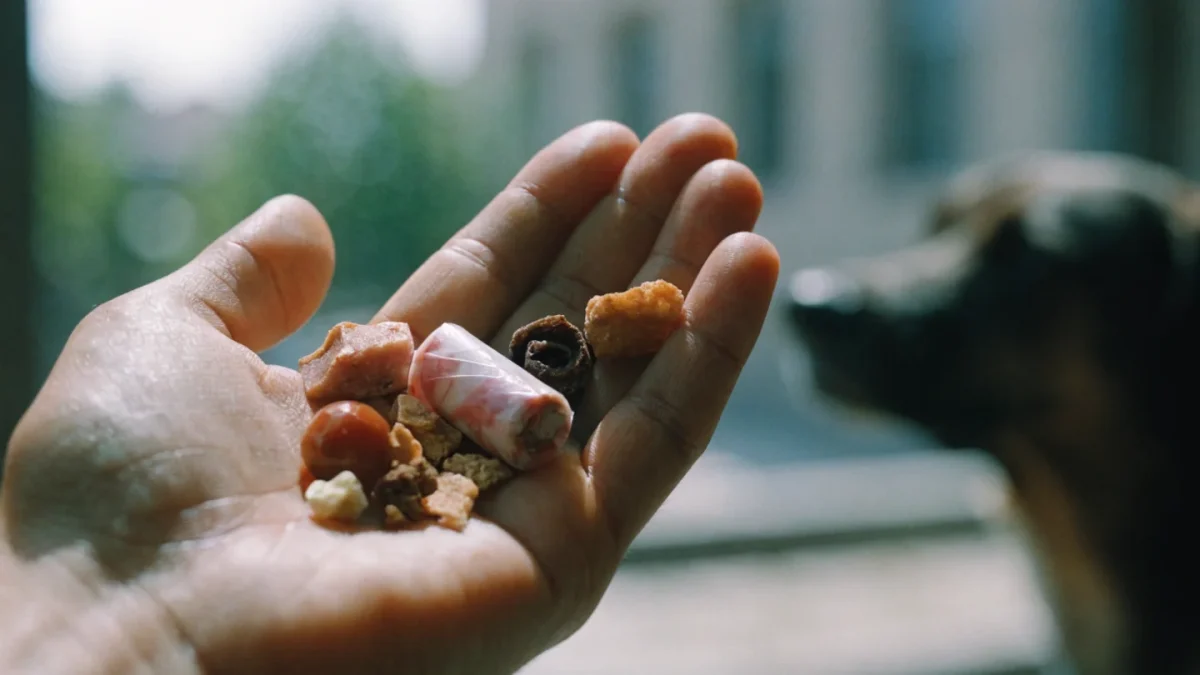
I once watched a guy at a group class spend fifteen minutes trying to get his Labrador to hold a down-stay. The dog kept breaking. The trainer kept asking him what he was using for treats. "His regular kibble," the guy said. Meanwhile, there were three other dogs twenty feet away. I told him to switch to something smellier and softer. Same dog, same handler, solid five-second down-stay on the next rep.
Treats aren't just fuel. They're information about how much the behavior is worth.
Size Matters More Than You Think
The most common mistake is using treats that are too big. If each reward is the size of a grape, your dog spends ten seconds chewing it, loses focus, and the training rhythm falls apart. By the time they're ready for the next rep, they've forgotten what they just got clicked for.
Training treats should be roughly pea-sized — small enough to swallow in one gulp. In a five-minute session, you might go through thirty reps. That adds up to a meaningful calorie load if you're using large pieces.
Adjust your dog's meals on heavy training days. You're not just rewarding behavior — you're part of their daily food intake.
The Value Hierarchy: Not All Treats Are Equal
Dogs have opinions about food. Most dogs have a mental hierarchy of what they'll work for, and that hierarchy matters in different contexts.
Think of it in three tiers:
Low value — kibble, standard biscuits, plain rice cakes. Good for easy tasks in low-distraction environments like your living room. Fine for maintenance when behavior is already solid.
Medium value — soft commercial training treats, pieces of plain cooked chicken, carrot, freeze-dried treats. Works for moderate-difficulty behaviors in familiar environments.
High value — real meat (cooked beef, turkey, salmon), cheese, hot dogs, liver treats. Reserve for new behaviors, high-distraction situations, or anything you need your dog to care deeply about.
Here's the practical rule: match treat value to difficulty. Teaching a sit in your kitchen? Low value is fine. Practicing recall at the dog park with squirrels nearby? Break out the good stuff.
Understanding positive reinforcement fundamentals helps here — the reward must be rewarding. If the treat doesn't compete with the distraction, you're not actually reinforcing the behavior, you're just throwing food.
Texture: Soft vs. Crunchy
Soft treats work better for most training scenarios because:
- They're faster to eat (maintains session pace)
- They're usually smellier (more motivating)
- They're easier to break into smaller pieces
Crunchy biscuits have their place for duration work — giving a dog something to crunch on during a long wait can keep them engaged. But for rapid-fire repetition work, soft wins.
One thing to watch: some soft treats are incredibly sticky. If your dog is trying to unstick treat from their molars instead of paying attention, that's a texture problem.
Matching Treats to Your Dog's Preferences
You can have an opinion about what treats to use. Your dog's opinion is the only one that matters in training.
Some dogs go crazy for freeze-dried liver and ignore chicken. Some will drop everything for a piece of carrot and couldn't care less about meat. You have to find what your specific dog finds valuable — not what worked for your last dog or what a forum said was the best option.
Test it: sit in a neutral space, hold out two different treats, one in each hand. Note which one your dog gravitates toward, noses harder for, or jumps at faster. That's your high-value option.
Also consider training tools beyond treats for certain dogs — some are more motivated by toys or play than food. An exploration of rewards beyond food is worth it if your dog is indifferent to treats or has dietary restrictions.
Dietary Considerations
If your dog has allergies, food sensitivities, or is on a prescription diet, check ingredients carefully. Treats for training don't need to be exotic — plain cooked lean protein (chicken, turkey, white fish) works well and is usually safe across dietary restrictions.
Avoid treats with xylitol, onion, or garlic, which are toxic to dogs at certain doses.
If you're training a dog on a weight management plan, freeze-dried options are often more nutritious per calorie than many commercial treats. A tiny piece goes a long way in flavor impact.
Building a Training Treat Kit
For most training, carry three levels in your pouch:
- Something low-value you can toss as a reset or a "free" reward for calm behavior
- Something mid-value for known behaviors under moderate distraction
- Something high-value for anything challenging or new
Switch levels during sessions based on how hard your dog is working. The right treat at the right moment turns good sessions into great ones.
FAQ
Can I use my dog's regular kibble as training treats?
Yes, for easy behaviors in low-distraction environments. Kibble is fine for maintaining already-learned behaviors at home. For new skills or any situation with distractions, upgrade to something more motivating.
How many treats should I use in a training session?
For a five-minute session with 30-40 reps, you might use 30-40 pea-sized treats. That's roughly equivalent to a small meal, so adjust feeding accordingly. More isn't always better — focus on timing and value rather than quantity.
My dog isn't food motivated. What do I do?
First, check whether you're using genuinely high-value options — most dogs that seem "not food motivated" are just being offered food they don't find valuable enough. Try real meat, cheese, or something they don't normally get. If they truly aren't interested, consider working before meals when hunger adds value, or exploring play-based rewards instead.