
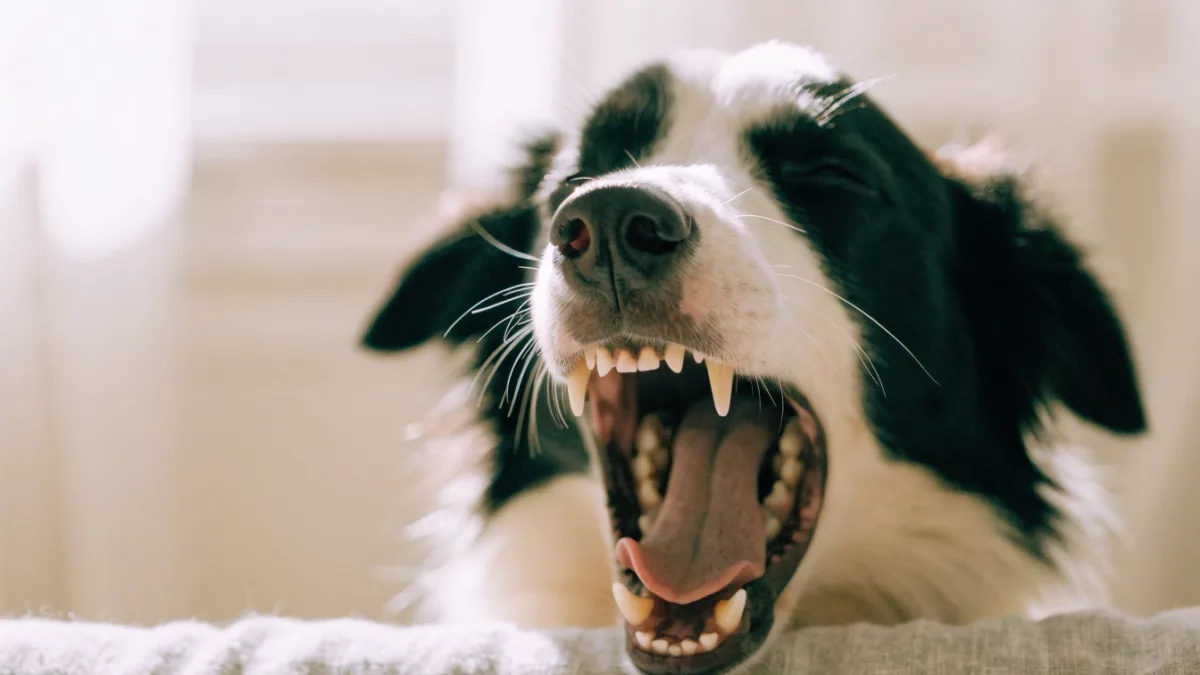
You’re sitting on the couch, tired after a long day. You stretch your arms back and let out a massive, jaw-cracking yawn. A second later, you look down at your dog snoozing next to you. They look up, smack their lips, and let out a long, drawn-out yawn of their own.
It’s a scenario anyone with a dog has probably witnessed a hundred times. But have you ever stopped to wonder why it happens? Or better yet, have you ever noticed that when you yawn in front of your cat, they usually just stare at you with a mix of pity and mild annoyance?
It turns out, there is a massive amount of evolutionary biology hiding behind that simple open-mouthed gulp of air. When your dog catches your yawn, it isn’t just a quirky coincidence. It’s a window into how their brains are wired to connect with you.
The Science of the Shared Yawn
For a long time, people thought contagious yawning was purely a human thing. You see your coworker yawn at the water cooler, and suddenly your jaw is unhinging, too. But back in 2008, a landmark study led by researcher Dr. Ramiro Joly-Mascheroni and published through the National Institutes of Health completely shifted the conversation.
The study confirmed what many of us secretly suspected: dogs catch our yawns. In fact, you’ll sometimes see the stat floating around online that dogs are one of “only three animals” known to experience contagious yawning. While the science has expanded a bit since that original claim—we now know that humans, chimpanzees, bonobos, baboons, wolves, elephants, and even parakeets (budgerigars) do it too—that doesn’t make your dog’s behavior any less special. Dogs remain part of a very small, exclusive club in the animal kingdom.
What makes dogs truly remarkable isn’t just that they yawn when they see another dog do it. The real magic is cross-species contagion. Your dog is catching a yawn from an entirely different species. They aren’t just reacting to a physical trigger; they are actively reading your body language and responding to your internal state.
Are They Feeling What We’re Feeling?
So, why do they do it? The leading theory among animal behaviorists comes down to one word: empathy.
When your dog catches your yawn, they are essentially mirroring your emotional and physical state. Dogs have evolved right alongside us for thousands of years. Along the way, their brains developed a highly tuned mechanism for reading human faces, body language, and even our eye movements. When you yawn, your dog’s brain registers that shift in your energy and effectively says, “Hey, our human is winding down, I should sync up with them.”
I used to think contagious yawning in dogs was just a sign of a sleepy, lazy afternoon. But my perspective completely changed a few years back when I was working with an incredibly high-drive German Shepherd named Kaiser. Kaiser was a working-line dog who rarely sat still. His owner, Mark, was dealing with a lot of job-related stress at the time. Whenever Mark would sit at the kitchen table, rub his face, and let out a massive stress-relief yawn, Kaiser would immediately walk over, lean against Mark’s leg, and let out a soft, quiet yawn.
Kaiser wasn’t tired. He was reading Mark’s anxiety and exhaustion, and he was using that physical mirroring to connect with him. It was a physical display of emotional attachment. Modern veterinary resources and animal behaviorists continually point to this kind of behavioral mirroring as proof that mutual behaviors deepen the human-animal bond and build better, more responsive training outcomes.
The Stress Yawn Trap
Before you assume every yawn is a sign of deep emotional bonding, we need to talk about stress. Dogs use yawning for more than just empathy. They use it as a pressure valve.
I see this all the time in vet’s office waiting rooms. A nervous dog sitting on the floor will start yawning repeatedly, often accompanied by a lip lick or looking away. This isn’t them catching a yawn from the poodle sitting across the room. This is a displacement behavior. The dog is overwhelmed, and yawning is a physiological way for them to self-soothe and calm themselves down.
If you’re trying to bond with your dog and you fake a yawn to see if they will copy you, pay attention to the rest of their body. Are their ears relaxed? Is their posture loose? Then you’re probably sharing a moment of empathetic connection. Are their ears pinned back? Are they panting or looking around frantically? Your yawn might have just added to their confusion. Always read the whole dog, not just their mouth.
Empathy or Group Alertness?
While the empathy theory gets all the headlines, not every scientist agrees that warm, fuzzy feelings are the only reason dogs catch our yawns. There is a healthy debate happening in the animal behavior world regarding empathy versus arousal.
The other major theory argues that contagious yawning isn’t about emotion at all. Instead, it’s a biological mechanism used to control levels of arousal and coordinate group alertness. Think about it from an evolutionary standpoint. If you are a wild canine out hunting, and one member of the pack starts yawning to wake up their brain, it might be beneficial for the rest of the pack to do the same. It syncs everyone up. It keeps the group from falling asleep when they need to be vigilant.
That 2008 NIH study touched on this, noting that yawning helps modulate arousal levels to facilitate interaction and communication. So, when your dog catches your yawn on the couch, one camp of researchers says, “They love you and feel your tiredness.” The other camp says, “They are biologically syncing their alertness levels with the pack leader so nobody gets left behind if a squirrel attacks.” Honestly, it’s probably a mix of both.
Why Your Cat Just Looks Annoyed
Let’s get back to the cat. If you yawn in front of your dog and get a yawn back, why does doing the exact same thing in front of your cat just earn you a slow blink and a look of sheer disappointment?
It comes down to how cats and dogs were domesticated and what they were domesticated to do. Dogs evolved to work with us. They were bred to read us, coordinate with us, and operate as an extension of their human handlers. Contagious yawning relies heavily on this pack coordination.
Cats, on the other hand, do not rely on pack coordination in the same way. They are highly social creatures, and they absolutely form deep bonds with their owners, but their social structures don’t require the same level of behavioral synchronicity as a pack of hunting dogs. Cats process social cues differently. They communicate through scent, slow blinks, and proximity, rather than mirroring our physical states.
Don’t get me wrong—cats are incredibly intelligent. They just haven’t been biologically wired to need to sync their arousal levels with a human. So, when you yawn, your cat doesn’t feel the evolutionary pull to match you. They might appreciate that you’re settling down for a nap (which means a warm lap for them), but they aren’t going to mirror your yawn just to show you they care. They’ll show you they care by head-butting your shin or taking up exactly half of your keyboard.
The Big Takeaway for You and Your Dog
Whether your dog is yawawning because they are deeply empathetic to your soul, or because their brain is telling them to sync their alertness levels with yours, the end result is the same. You and your dog are connected.
Understanding that your dog is constantly monitoring your physical and emotional state should change how you interact with them. If your dog is feeding off your stress, it’s a reminder that taking a breath and regulating your own emotions can directly help regulate your dog’s behavior. Our pets aren’t just living in our houses; they are actively trying to communicate with us on a biological level.
While there is no conservation status to worry about with domestic dogs and cats, there is a vital lesson here about respecting the wild instincts that still live inside our living rooms. By understanding the evolutionary reasons behind their behavior, we can give them the grace, patience, and empathy they constantly offer us.
So, the next time you let out a massive yawn and your dog follows suit, take a second to appreciate it. They aren’t just copying you. They are telling you, in the most primal way possible, that they are paying attention. Now, if only we could figure out how to get the cat to care.