

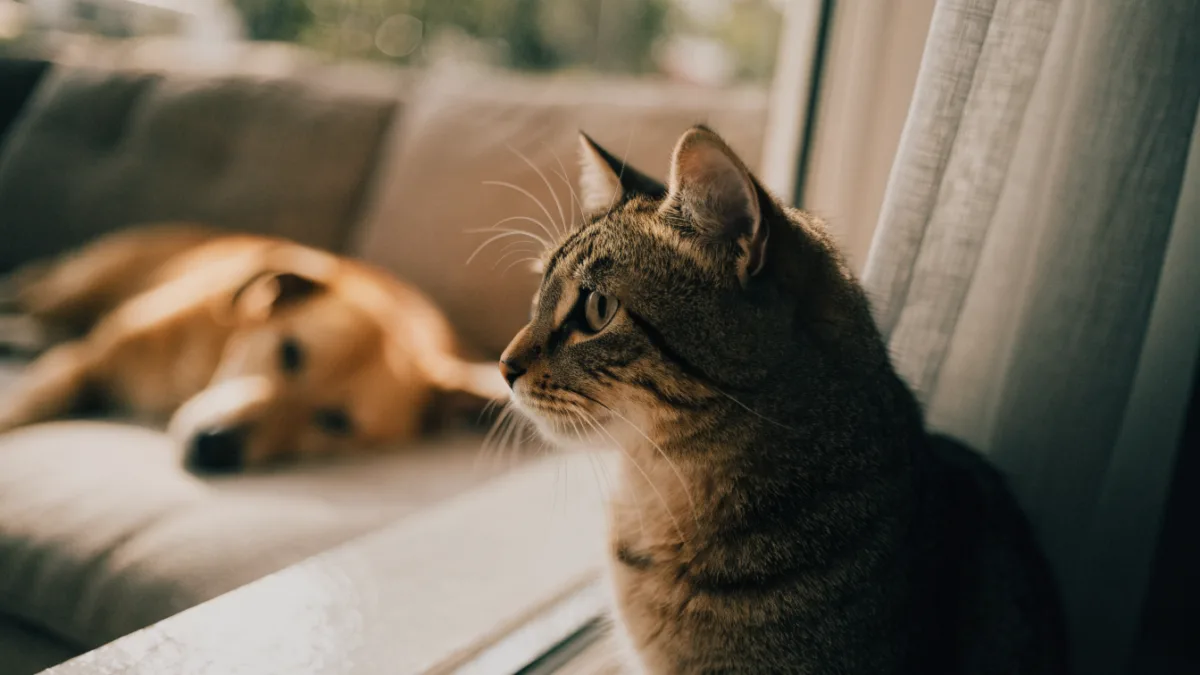
The first time I set up a pet camera, I was convinced I’d catch my cat Mochi living a secret double life — throwing wild parties, hosting underground poker games, maybe revealing she could speak fluent French. What I actually found was her sitting on the kitchen counter, staring at a wall, for forty-five minutes straight. Then she moved to a different wall and stared at that one. Riveting stuff.
It turns out the real secret lives of pets are simultaneously more mundane and more fascinating than anything Hollywood could dream up. That blockbuster movie got one thing right: we’re all a little obsessed with what happens after we turn the key in the lock. But the truth about what dogs and cats do when we leave is less about chaotic adventure montages and more about understanding two completely different operating systems.
Dogs: The Sentinels Who Wait
My neighbor’s golden retriever, Biscuit, has a routine that breaks my heart a little every time I think about it. When his family leaves for work, he walks to the front window, puts his chin on the sill, and watches the street. He’s not looking for squirrels to chase or mail carriers to bark at — he’s watching for his people to come back. Sometimes for hours.
Dogs are social creatures wired for pack cohesion, and when the pack leaves, their job becomes sentinel duty. That window-watching behavior isn’t boredom — it’s a dedicated monitoring system. Your dog is scanning for threats and waiting for the return of their most important resource: you.
A landmark investigation featured in the BBC documentary series exploring pets’ hidden lives found that 85% of dogs showed signs of not coping well when left alone. That’s a staggering number. Most owners have absolutely no idea their dogs are struggling because the destruction and vocalization happen when nobody’s home to witness it.
Post-pandemic life has only intensified this. Pets who spent two years with their humans working from home suddenly got hit with eight-hour absences, and behaviorists have seen a massive spike in separation anxiety cases as a result. The dogs weren’t broken — they’d just never learned that leaving doesn’t mean abandoning.
Cats: The Solo Patrol Squad
Cats operate on entirely different software. While your dog is emotionally stationed at the window, your cat is running a security sweep of the premises.
Mochi’s “alone time” routine, which I’ve now spent far too many hours observing, looks like this: sleep for three hours on the back of the couch, wake up, patrol the perimeter of every room, investigate anything that has moved even one millimeter since her last check, attempt to murder a dust particle in the sunbeam, eat a small amount of food, and return to a different sleeping location. If she’s feeling particularly energetic, she’ll relocate to the top of the bookshelf and judge the living room from above.
Cats sleep 12 to 16 hours a day, but their awake time alone is purposeful. They’re territorial creatures who patrol their space methodically, and their vertical exploration isn’t random acrobatics — it’s environmental control. A cat on top of the refrigerator isn’t just being weird; she’s surveying her kingdom from a strategic vantage point.
The famous 3 AM zoomies? Also normal. Cats are crepuscular, meaning they’re most active at dawn and dusk. That frantic sprint down the hallway at odd hours is hunting behavior looking for an outlet, not evidence that your cat has lost her mind.
Reading the Footage: What the Camera Actually Tells You
Pet cameras have become a booming industry, and modern devices do everything from flinging treats to letting you reassure your pet through a speaker. But before you start interacting through the camera, you need to learn how to read what you’re seeing.
Decoding Dog Behavior on Camera
For dogs, the signs of genuine distress are pretty recognizable once you know what to look for:
- Panting when it’s not warm — this is a stress response, not temperature regulation
- Pacing or inability to settle — a relaxed dog finds a spot and lies down
- Excessive licking or self-chewing — displacement behavior that signals anxiety
- High-pitched, persistent barking or whining — not the same as alert barking at a noise
- Drooling, dilated pupils, or a tense, hunched posture
A relaxed dog, by contrast, might sigh dramatically, circle a few times, and sprawl out for a nap. That’s what you want to see. If your dog is spending the entire eight hours in a state of agitation, that’s not a discipline problem — that’s an emotional issue that deserves attention and probably a conversation with your vet.
Understanding Cat Behavior on Camera
Cats are harder to read because their “weird” behaviors are often completely normal. Wall-staring? Probably tracking a tiny bug or shadow you can’t see. Random sprinting? Patrolling and hunting instincts in action. Sitting in a cardboard box for two hours? Peak cat contentment.
The red flags for cats look different:
- Hiding in one spot for the entire day — cats who feel confident in their space should be visible and moving around periodically
- Excessive grooming that creates bald patches — stress manifests differently in cats than dogs
- Refusal to eat or use the litter box during alone hours when they normally would
- Vocalizing persistently — some cats meow for attention, but continuous crying is worth noting
The Two-Way Audio Trap
Here’s where I have a strong opinion: that microphone button on your pet camera? Use it with caution.
Animal behaviorists increasingly warn that talking to your pet through a camera can actually cause more distress, not less. Think about it from your dog’s perspective: he hears your voice coming from a small plastic box on the shelf. He can’t find you. He can’t get to you. The voice he loves most in the world is now a disembodied sound with no body attached, and that’s confusing at best, panic-inducing at worst.
I learned this the hard way. I tried cooing at Mochi through the camera once when she seemed lonely. She froze, stared directly into the lens with an expression of pure betrayal, and then knocked the camera off the shelf. Message received.
If your pet is distressed, your voice through a speaker doesn’t fix the underlying problem — it just reminds them you exist somewhere they can’t reach. The solution isn’t better technology. It’s better preparation.
Enrichment: Keeping Them Sane While You’re Away
For Dogs
Dogs need occupation. A bored dog with unspent energy is the one who redesigns your couch cushions. The goal is mental and physical engagement that outlasts your departure:
- Frozen puzzle toys filled with wet food or plain yogurt — these take twenty to thirty minutes to work through and create a positive association with your leaving
- Snuffle mats hidden with dry kibble — nosework is genuinely tiring for dogs
- Long-lasting, safe chew options — choose appropriate sizes and materials for your dog’s jaw strength, and always check with your vet about what’s safe for unsupervised chewing
- Background noise — talk radio or classical music can simulate household activity and dampen triggering outside sounds
I’ll defer to actual dog trainers on the specifics here — my colleague Jake knows more about canine enrichment than I ever will — but the principle is simple: a dog with a job is a dog without time for anxiety.
For Cats
Cats need environmental complexity. A flat, static environment is a boring environment, and bored cats find their own entertainment.
- Vertical spaces — cat trees, wall shelves, cleared bookshelf perches. Cats think in three dimensions, and floor-level living is psychologically limiting for them
- Window access — a cat perch with a view of a bird feeder is basically feline Netflix. “Cat TV” is real and it works
- Rotating toys — don’t leave everything out all the time. Novelty matters. Put some toys away and swap them weekly
- Puzzle feeders — food-dispensing toys that require batting, rolling, or problem-solving tap into that hunting instinct
- Safe outdoor access — catios (enclosed patios) or leash training give cats enrichment without the ecological damage of free-roaming
The Anthropomorphism Problem
We’ve all come home to a crime scene and thought, “She did this on purpose to punish me for leaving.” I once returned to find Mochi had systematically pushed every item off my desk, one by one, while maintaining eye contact with the camera. It felt personal.
It wasn’t.
Behaviorists consistently emphasize that destructive behavior in pets isn’t revenge or spite — it’s unmanaged anxiety, understimulation, or in cats’ cases, natural behaviors being expressed in environments that don’t accommodate them. Cats knock things off surfaces because they’re investigating objects with their paws. Dogs chew furniture because chewing is soothing when they’re stressed. Neither species has the cognitive framework for “I will make my human regret this.”
Understanding this changes how you respond. Instead of punishment (which increases anxiety and makes everything worse), you start asking better questions: What need isn’t being met? What can I change about the environment?
The biggest takeaway from all those hours of pet camera footage is this: our animals aren’t waiting to misbehave. They’re just trying to meet their own needs in a world we’ve built for human convenience. Dogs are waiting for us because they love us. Cats are patrolling because they’re cats. Both are doing their best with the instincts they have.
And while we’re thinking about natural instincts and their consequences — if you have an outdoor cat, consider this: that same hunting drive that sends your indoor cat chasing laser pointers is responsible for billions of wild bird and small mammal deaths annually when cats roam free. Keeping cats indoors with enriched environments, or providing safe outdoor access like catios, isn’t just better for wildlife conservation — it’s genuinely better for cats, who face fewer injuries, diseases, and shorter lifespans outdoors. Protecting local ecosystems and giving your cat a long, healthy life turn out to be the same goal.