
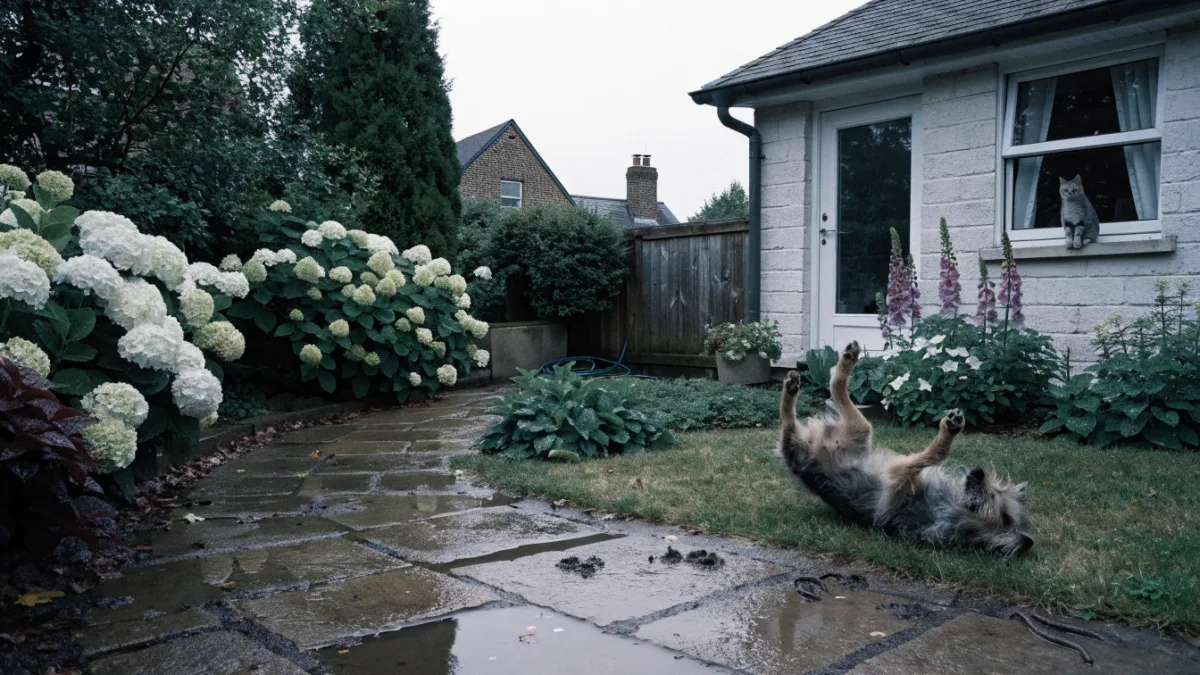
There’s a particular noise dogs make when they’ve found something truly revolting. It’s a low, focused grunt — almost like they’re savoring a fine wine. I call it the “Eau de Dead Worm” symphony. Your dog drops their shoulder, presses their cheek into the grass, and proceeds to writhe with the enthusiasm of a kid making snow angels. Whatever deceased creature, rotting plant matter, or mystery pile they’ve discovered is now being ground into their fur with deep, undeniable satisfaction.
If you’ve ever stood there holding a leash wondering why on earth your beloved companion would do this, you’re not alone. It’s one of the most common questions I get from frustrated dog owners who are tired of emergency baths. And the answer is actually pretty fascinating — it stretches back thousands of years to your dog’s wild ancestors and touches on some of the most sophisticated sensory equipment on the planet.
First, Understand How Your Dog Experiences Smell
Before we get into the why, you need to understand the what. Your dog’s nose is somewhere between 10,000 and 100,000 times more sensitive than yours, depending on the breed and what you’re measuring. When you smell a dead worm on the sidewalk, your brain says “gross, walk away.” When your dog smells that same worm, they’re experiencing a layered, complex symphony of information.
Dogs don’t process foul odors the way we do. Where we register disgust, they register interest. That rotting worm isn’t a health hazard to your dog’s brain — it’s a newsletter. It contains information about what died, when it died, what might have killed it, and what else has been in the area. Rolling in it is their way of filing that newsletter for later.
I used to think dogs were just being jerks when they did this. I’d watch a client’s Golden Retriever throw himself into a patch of something unidentifiable and assume he was being deliberately difficult. I was wrong. This isn’t misbehavior. It’s an instinct so deeply wired that punishing it would be like punishing a person for blinking.
Three Theories Why Dogs Do This
Here’s where it gets interesting. Animal behaviorists don’t have a single, neat answer for why dogs roll in foul-smelling things. There’s no scientific consensus, and honestly, the debate itself is part of what makes this topic so compelling. Let me walk you through the three main theories.
The Camouflage Theory: Hiding From Prey
This is the oldest and most widely cited explanation. Wolves and wild canids are.[1] — they chase down their food over long distances. Prey animals like deer, rabbits, and elk have a powerful sense of smell and will bolt at the first whiff of a predator.
The theory goes that wild canids learned to mask their own scent by rolling in strong-smelling substances found in their environment. A wolf that smells like a rotting carcass doesn’t smell like a wolf anymore. They become olfactory invisible, allowing them to close the distance before their prey even knows they’re there.
It’s a compelling theory, and it makes logical sense. Your dog isn’t trying to sneak up on a squirrel in your backyard — but the instinct to “become” the smell of their environment is still very much alive in their DNA.
The Scent Communication Theory: Sharing Intel
Some [2] argue it’s not about hiding at all. It’s about sharing information.
Wolves are social animals. They hunt cooperatively, raise young cooperatively, and survive as a group. When a wolf finds something interesting — a dead elk, a pile of Bison dung, a patch of particularly pungent decay — rolling in it might be a way of “wearing” that information back to the pack.
Think of it like a postcard. The wolf can’t describe what they found, but they can bring the smell home. The rest of the pack can then investigate the scent and potentially track back to the source. For a hunting pack, knowing where a large carcass is located could mean the difference between eating and going hungry.
When your dog rolls in a dead worm and then trots back to you gleefully, they might literally be trying to show you what they found. They’re sharing intel with their pack — and you, whether you like it or not, are the pack.
The Scent Marking Theory: Claiming the Prize
There’s a third theory that gets less attention but makes a lot of sense when you think about it. Instead of the dead thing covering up the dog’s scent, the [3]
Dogs are territorial. They urinate on fire hydrants, they scratch the ground after defecating, and they rub their cheeks on furniture. All of these behaviors deposit scent and claim ownership. Rolling in something smelly could be another form of the same impulse. Your dog is saying “this dead worm is mine, and I want everyone who comes by to know it.”
I lean toward believing all three theories have some truth to them. Dogs are complex animals with overlapping motivations. It’s possible that rolling in a dead worm serves multiple purposes at once, and different dogs might be doing it for different reasons.
Why Cats Watch From the Sidewalk With Disgust
The brief asks why cats don’t do this, and it’s a great question. If rolling in foul odors is such a useful survival behavior for wild canids, why didn’t cats develop the same instinct?
The answer comes down to hunting strategy. Cats are ambush predators. They stalk, they freeze, they pounce. Their entire survival strategy depends on being undetectable until the last possible second. A cat covered in the smell of rotting meat would be advertising their presence to every mouse and bird within fifty yards.
Cats also need to avoid attracting larger predators. In the wild, smelling like a dead thing could attract scavengers and competitors who might view the cat itself as a meal. Staying clean, staying neutral, staying invisible — that’s the feline playbook.
This is also why cats groom themselves so obsessively. That fastidious licking isn’t vanity. It’s survival engineering. A clean cat is a cat that catches dinner and doesn’t become dinner.
Dogs took a completely different evolutionary path. Pack hunters don’t need to be invisible the same way ambush hunters do. They rely on endurance, coordination, and numbers. A little extra stink isn’t going to ruin a cooperative hunt the way it would ruin a solo stalk.
What You’re Actually Supposed to Do About It
So your dog is hardwired to roll in gross stuff. Great. What now?
The first thing is to let go of the idea that your dog is misbehaving. They’re not. This is a natural, harmless instinct that millions of years of evolution baked into their brain. Getting angry about it is like getting angry at a retriever for picking things up in their mouth.
What you can do is manage the situation. Teach a solid “leave it” cue — one of the most valuable commands any dog can learn. When you spot your dog locking onto something with that telltale intense focus, redirect before the shoulder drops. You’ll get good at spotting the warning signs.
Keep your dog on a long line in areas where you know there are temptations, like trails with lots of wildlife or beaches with washed-up marine life. And carry pet-safe wipes for quick cleanups when prevention fails. Because it will fail sometimes. That’s just the deal you make when you bring a predator into your family.
And please — skip the punishment. Rubbing your dog’s nose in the mess or scolding them after the fact doesn’t teach them anything except that you’re unpredictable. They won’t connect the punishment to the rolling. They’ll just learn to be afraid of you, which damages your relationship without solving the problem.
The Bigger Picture
When you really think about it, there’s something beautiful about this behavior. Your pampered Labradoodle, curled up on an orthopedic bed and eating grain-free kibble, still carries the instincts of a wild hunter. That dead worm on the sidewalk connects them to ancestors who ran down elk across frozen tundra. The instinct didn’t disappear just because we invented dog parks and CBD treats.
Dogs aren’t broken wolves. They’re not failed humans. They’re something wonderfully specific — a species that evolved alongside us, carrying ancient instincts into a modern world that doesn’t always make sense to them. Rolling in a dead worm is your dog being authentically, unapologetically canine.
So the next time you’re giving an emergency bath and muttering under your breath, try to remember that. Your dog isn’t trying to ruin your day. They’re just answering a call that’s older than civilization itself. Stock up on dog shampoo, invest in a good “leave it” cue, and appreciate the wildness that still lives in your living room.
Sources
- pursuit predators — akc.org
- modern behaviorists — earthbath.com
- dog is covering the dead thing with their scent — quora.com