

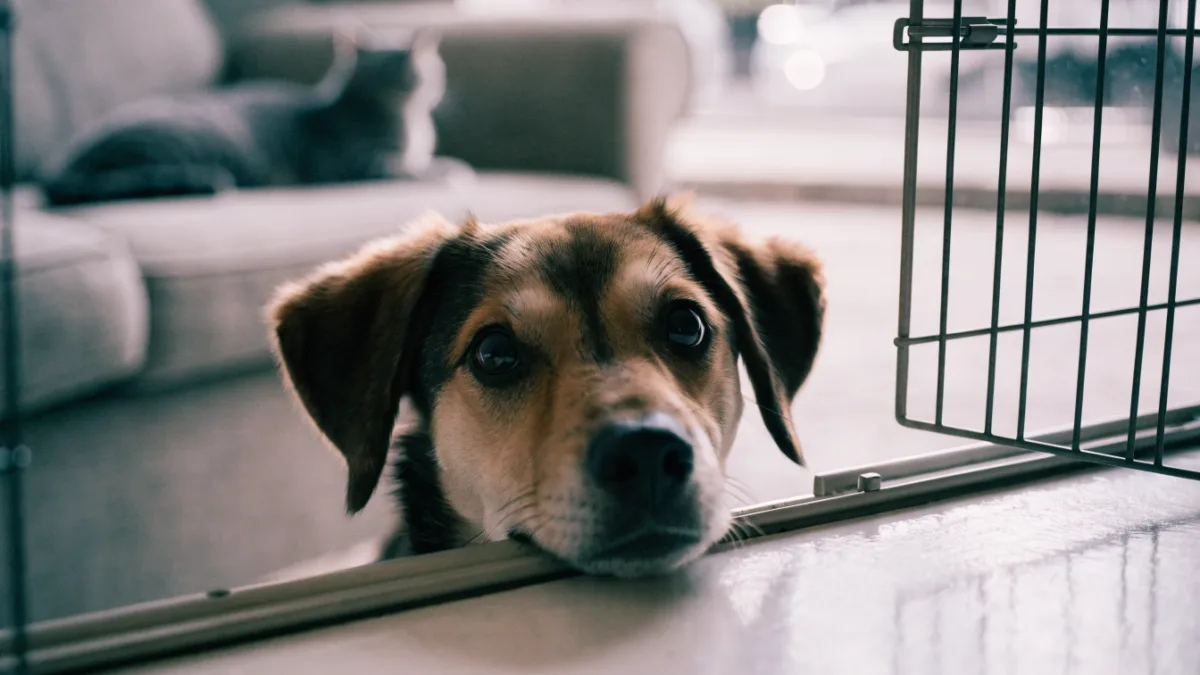
Walk into any typical multi-pet household, and you’ll notice a pretty glaring double standard. Somewhere in the living room, there’s a feline perched on a cat tree, lounging on the back of the sofa, or patrolling the kitchen counters. They have the run of the house. Meanwhile, the family dog is behind a closed door in a wire or plastic crate.
We almost universally accept that indoor cats need to free-roam. We know they have an innate drive to patrol territory, climb vertically, and use their litter box whenever nature calls. But when it comes to our dogs, we often default to locking them in a box for hours at a time. Why do we restrict canine movement while giving felines a free pass? And more importantly, is our reliance on dog crates actually helping or hurting?
The Cat in the Room: Why Felines Get a Free Pass
Let’s look at why we don’t even blink an eye when a cat roams the house freely. Cats are apex predators and solitary survivors by nature. Their entire psychological framework is built around controlling their environment. If a cat feels threatened or stressed, their first instinct is to climb up high or hide. If they need to eliminate, they seek out a quiet, safe spot.
Because we humans generally don’t want our furniture shredded or our neighbors complaining about howling, we naturally accommodate these feline needs. We give them vertical space and open litter boxes. We let them move.
But here’s the thing: dogs also have natural behaviors they need to express. When we bring a dog into our homes, we often immediately restrict their movement under the guise of “training” or safety. We justify it by saying dogs are den animals.
The “Denning” Myth vs. Natural Canine Behaviors
You’ve probably heard the argument a hundred times. “Dogs are den animals, so a crate makes them feel safe, like a cozy cave.”
I used to buy into this completely. I’d tell every client to stuff their puppy in a crate and cover it with a blanket. But if we look at the actual biology and behavior of wild canines, the denning argument falls apart pretty quickly. Adult wolves and wild dogs use dens for exactly one thing: raising helpless pups. Once those pups are old enough to walk, they leave the den and don’t look back. Adult canids don’t seek out tiny, enclosed boxes to sleep in. They roam miles every single day.
Confining a dog in a crate inherently deprives the animal of expressing normal, natural behavior patterns. When a dog is locked up, they cannot move freely, they cannot interact with their environment, and crucially, they cannot eliminate when they need to. Asking a dog to “hold it” for eight or nine hours goes against their basic biology.
That doesn’t mean crate training is universally evil or inherently animal cruelty. But it does mean we need to stop pretending dogs love being trapped in a closet-sized box. Crates are a human management tool. If you are going to use one, there are strict prerequisites to keep it humane. Before a dog goes into a crate, they must receive sufficient physical exercise, and they absolutely must have an opportunity to go to the bathroom. A tired dog might rest in a crate, but a dog with pent-up energy sitting in their own waste is experiencing pure psychological distress.
Real Dogs, Real Scenarios
Every dog is different, and the crate vs. free-roaming debate isn’t black and white. You have to look at the individual dog in front of you.
I worked with a family last year who had a one-year-old English Cocker Spaniel. Like a lot of adolescent dogs, he was a whirlwind of energy and lacked impulse control. For this specific dog, a crate was a lifesaver. It gave him a forced break when he got overtired, and it kept him from swallowing socks when his owners were at work. Because they met his needs with intense exercise before crating him, he actually would go into the crate willingly to sleep.
But compare that to another household I visited recently. They were trying to manage a four-year-old German Shepherd mix and a three-year-old French Bulldog. The owners were crating both dogs for ten hours a day while they commuted and worked. The Shepherd was losing her mind. She was chewing her paws raw, and the moment she was let out of the crate, she was bouncing off the walls.
In that scenario, the crate wasn’t providing safety; it was causing intense psychological stress. For those dogs, free-roaming in a dog-proofed room actually would have been the much better choice.
The Surprising Speed of Behavioral Progress
Here is what often surprises owners who decide to ditch the crate: dogs allowed to free-roam in a home or have access to larger spaces often exhibit relaxation much more quickly.
When you remove the frustration of confinement, you often remove the pent-up anxiety that causes bad behavior in the first place. I’ve seen it happen time and time again. You give a dog a whole room, a comfortable bed, and a window to look out of, and suddenly they just… sleep. They learn to self-soothe. They aren’t panicking about being trapped, so they aren’t exploding with frantic energy the second the door opens.
The Stress Factor: Confinement Anxiety vs. Environmental Hazards
The core of the great indoor boundary debate comes down to risk assessment. Are you protecting your dog’s physical safety at the expense of their mental well-being? Or are you risking their physical safety to give them freedom?
On one hand, free-roaming exposes a dog to environmental hazards. An unsupervised dog can chew through electrical wires, get into toxic foods like grapes or xylitol gum, or rip up a stuffed animal and get a bowel obstruction. These are life-threatening emergencies. This is exactly why crates became so popular in the first place—it keeps the dog alive when you can’t watch them.
On the other hand, confinement can cause severe stress. A dog that is stressed will develop behavioral issues. They might become reactive, depressed, or aggressive.
The good news is that you don’t have to choose between a tiny crate and giving your dog the keys to the entire house. There is a massive middle ground.
Finding the Least Restrictive Environment
Modern animal welfare philosophies emphasize providing the “least restrictive humane environment.” We are seeing a huge cultural shift away from prolonged crate training toward smarter management setups.
If your dog isn’t ready for total free-roaming, use a dog playpen. Baby gates are your best friend. Block off a dog-proofed kitchen or living room. Put away the trash cans, secure the wires, and close the doors to bedrooms where they might find something dangerous.
If you’re worried about what they’re doing when you aren’t looking, invest in a cheap camera monitoring system. You can pull up an app on your phone and check on them. Nine times out of ten, you’ll find your free-roaming dog is just asleep on the rug.
Redefining How We Live With Pets
We have to stop looking at dogs like they are wild animals that need to be caged for our convenience. If we accept that indoor cats need to patrol territory and move freely to be psychologically sound, we have to start extending that same logic to our dogs.
Take a look at your own setup. If your dog spends half their life in a box, ask yourself why. Are you using a crate because it genuinely benefits your specific dog’s training and safety, or are you using it because it’s easier for you?
Every animal in our home deserves the right to express natural behaviors, whether that means a cat climbing a scratching post or a dog stretching out on the living room floor. Challenge your assumptions, dog-proof your space, and give your dog the freedom they deserve.