

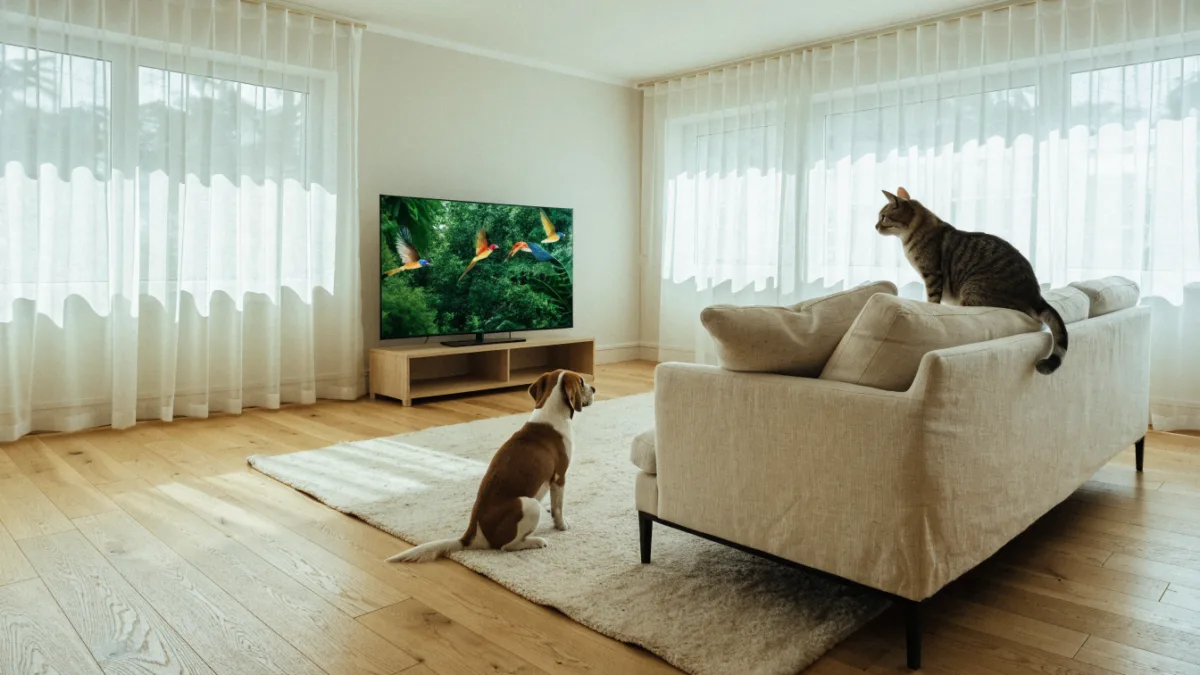
My cat Mochi once spent forty-five minutes locked in on a hummingbird documentary. Ears forward, pupils blown wide, tail lashing like a metronome counting down to something violent. She launched herself at the screen three times. The fourth time, she knocked over my coffee, and that was the end of nature night in our apartment. But it got me thinking — what was she actually seeing in there? Was she enjoying the show, or was I essentially torturing my cat with a high-definition bird feeder she could never access?
The Strobe Light Problem: Why Old TVs Were Useless to Pets
Here’s something that sounds like a design flaw but is actually just biology: for decades, your dog and cat couldn’t really watch television. Not because they weren’t interested, but because the technology literally couldn’t fool their eyes.
It comes down to something called flicker fusion threshold — the speed at which a flashing image merges into what appears to be continuous motion. Humans process visual information at around 60 frames per second (60 Hz). Standard-definition and older HDTVs refreshed at roughly that rate, which looked great to us. But dogs and cats process visual information at 70 to 80 Hz. That means when they looked at your old television, they weren’t seeing smooth video — they were seeing a rapidly flickering strobe light.
Imagine trying to enjoy a movie when every frame looks like a busted fluorescent bulb in a hospital basement. No wonder most pets ignored it.
Modern 4K televisions with 120 Hz refresh rates changed everything. Finally, the screen updates fast enough that [1] rather than a disco migraine. This is why you might have noticed your pet suddenly caring about the television in the last several years — the hardware caught up to their sensory processing. Pet sensory perception finally met its match in consumer electronics.
What Your Pet Actually Sees on That Screen
A Softer, Slower, Bluer World
Even with a fancy television, your pet isn’t seeing what you’re seeing. Dogs typically have around 20/75 vision, meaning a dog needs to be 20 feet from an object to see it as clearly as a human standing 75 feet away. Translation: when your dog plops down right in front of the TV, blocking everyone’s view, he’s not being a jerk. He genuinely needs to be closer to make out what’s happening.
Color is different too. Both dogs and cats are dichromatic, essentially red-green colorblind. They see the world primarily in blues, yellows, and grays. That lush green jungle on Animal Planet? To your pet, it reads as a wash of muted yellow-gray. The vibrant red cardinal on the nature documentary? Probably just another dark shape against a pale background.
But the Sound — That’s the Real Hook
This is where it gets interesting. While humans max out around 20,000 Hz, dogs can hear up to 45,000 Hz and cats up to an astonishing 64,000 Hz. Your television’s audio is compressed and filtered for human ears, but high-frequency sounds — the squeak of a rodent, the whine of a puppy, the rustle of small creatures in underbrush — still bleed through. And to your pet, those sounds are basically a dinner bell.
I’ve watched Mochi sleep through explosions, car chases, and orchestral soundtracks on screen. But the second a documentary featured high-pitched chittering bats, she was upright and staring at the speaker like it owed her money.
Do Dogs Watch TV? Yes, But They’re Particular About Content
So do dogs watch tv in a way that resembles human viewing? Sort of. Research suggests dogs can recognize biological motion — they understand when they’re watching a moving animal versus random visual noise. And they have preferences.
As veterinary scientist Dr. Freya Mowat puts it: “Dogs like to watch dogs, just like humans like to watch humans.”
If you’ve ever had your dog rush the television because another dog appeared on screen, you’ve seen this firsthand. They’re not confused. They recognize the shape, the gait, the sound. They know that’s a dog. Whether they understand it’s a recording is a different question entirely.
Breed Matters More Than You’d Think
Here’s a detail that surprised me: your dog’s head shape affects how they watch television. Brachycephalic breeds — Pugs, French Bulldogs, Boston Terriers — have eyes set closer together, giving them more binocular overlap. That means better depth perception and a visual field more similar to humans. They’re naturally positioned to get more out of a screen.
Long-snouted breeds like Greyhounds and Borzois have wider visual fields adapted for detecting motion across distances. Their visual streak is built for scanning horizons, which is incredible for spotting a rabbit three fields away but less useful for focusing on a 65-inch television eight feet from the couch.
Cat Vision on TV: Built for the Hunt, Fooled by the Flat
Cats are a completely different story. As movement-driven ambush predators, cat vision on tv is tuned to detect rapid, erratic motion — exactly the kind of thing that triggers their predatory sequence. A bird fluttering across a nature documentary will absolutely grab their attention.
But here’s the catch: cats rely heavily on depth perception and something called motion parallax (shifting their head side to side to gauge distance). A two-dimensional screen fundamentally lacks the spatial data cats need to make sense of what they’re seeing. Mochi can see the bird. She can hear the bird. She cannot tell how far away the bird is. So she tries to get behind the television to find it, fails, and then sits in front of the screen making that terrifying chittering sound cats make when they’ve spotted prey they absolutely cannot reach.
This is why cats often lose interest in television faster than dogs. The initial stimulus is strong, but the lack of 3D information eventually makes the whole experience feel broken to them.
Enjoyment or Frustration? The Uncomfortable Question
This is where I have to be honest about something pet owners don’t always want to hear. When Mochi throws herself at the television or sits there vibrating with frustration, she’s not having a good time. She’s experiencing an unfulfillable predatory drive. The bird sounds real, looks real enough, but she can never catch it. That’s not entertainment — it’s a tease.
The same goes for dogs. A dog barking at a dog on television might look like playful excitement, but it could easily be barrier frustration. They can see and hear a conspecific — a fellow dog — but they can’t smell it, can’t approach it, can’t complete the social interaction their brain is telling them to initiate. For some dogs, particularly territorial breeds, this can genuinely stress them out.
Animal behaviorists debate this constantly. Some argue that as long as your pet isn’t showing signs of distress — excessive vocalization, panting, pacing, destructive behavior — a little television stimulation is harmless. Others point out that we’re quick to label anything our pets do as “enjoyment” when we really have no idea what they’re experiencing. We project our own love of binge-watching onto creatures who experience media in a fundamentally different way.
The Rise of Pet-Specific Programming
Of course, capitalism noticed. Services like DOGTV emerged with programming scientifically designed for pet sensory perception — specific yellow and blue color palettes, adjusted frame rates, audio frequencies meant to either soothe or stimulate. Major streaming platforms and YouTube now offer “pet playlists” with hours of squirrels, birds, and other animals optimized for 4K screens.
Some of this is genuinely thoughtful. Using calming sounds and appropriate visual stimuli as background enrichment when you leave the house isn’t a terrible idea, especially for dogs with mild separation anxiety. The problem is when we start treating screen time as a substitute for actual enrichment.
Your cat doesn’t need a YouTube playlist. Your cat needs you to wave a feather wand around for fifteen minutes. Your dog doesn’t need a squirrel compilation. Your dog needs a walk and a training session and something to sniff. Television can supplement a pet’s environment, but it shouldn’t replace physical play, problem-solving, or one-on-one interaction.
I still put nature documentaries on sometimes. Mochi still loses her mind over them. But I’ve started viewing it less as entertainment and more as the feline equivalent of watching someone eat a sandwich when you’re starving — technically engaging, probably not great for your mental health, and best enjoyed in moderation.
The real takeaway isn’t that pets can’t enjoy television. Some clearly do, and modern screens have made that possible in a way that genuinely didn’t exist a decade ago. But understanding what they’re actually perceiving — the limited colors, the flattened depth, the unfulfillable instincts — makes me a better guardian of what they actually need. And what they need is rarely on a screen.
Sources
- dogs and cats perceive continuous motion — theguardian.com