

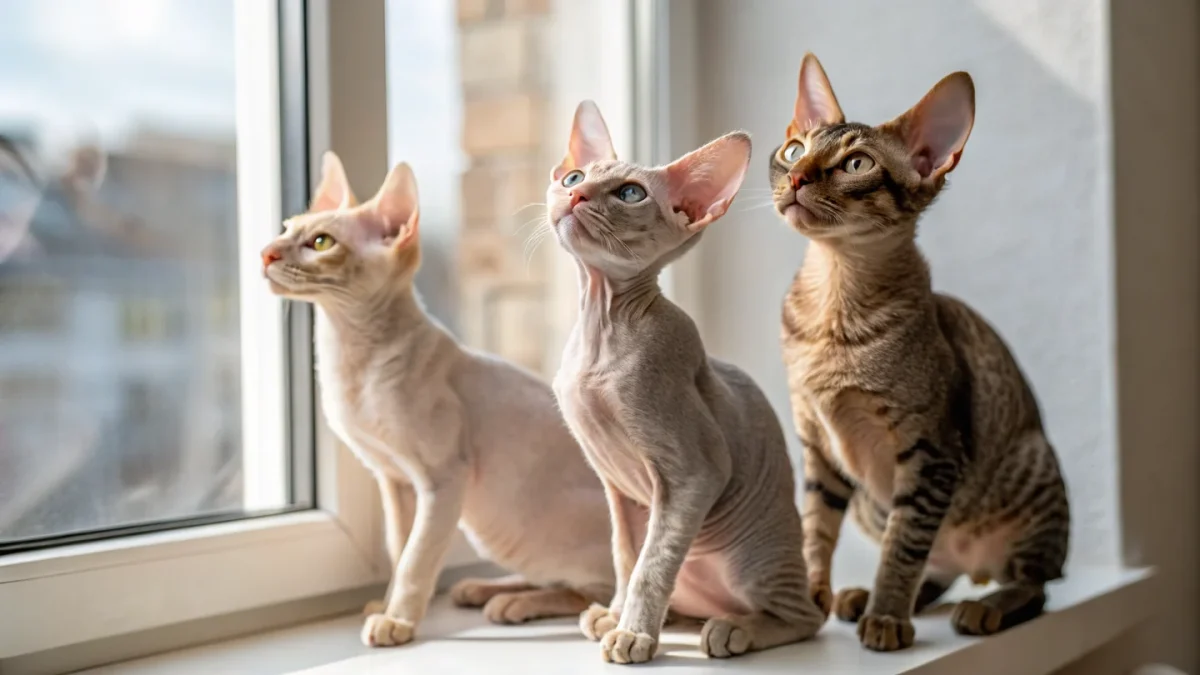
Three cats, all unusual-looking, all frequently confused with each other. The Cornish Rex, Devon Rex, and Sphynx get lumped together in the "weird cat" category and that's where the similarity ends. Each carries a completely separate genetic mutation. Each has a distinct physical type. Each has a personality you'd never mistake for either of the others once you've spent time with all three.
For anyone considering one of these breeds, understanding the differences isn't just an academic exercise — it's the difference between choosing the right match and ending up with a decade-long mismatch.
Quick Comparison
| Trait | Cornish Rex | Devon Rex | Sphynx |
|---|---|---|---|
| Coat | Short, tight waves; reduced guard hairs | Soft, loose curls; very short | Hairless or near-hairless; fine peach fuzz |
| Build | Slender, whippet-like, arched back | Small, pixie-faced, large ears | Medium, muscular, barrel-chested |
| Energy | Very high | Very high | High |
| Vocalization | Moderate | Moderate to high | High |
| Grooming need | Periodic baths for oily coat | Minimal (similar oil management) | Weekly baths essential |
| Good with other pets | Generally yes | Generally yes | Yes, strongly preferred |
| Independence | Low | Very low | Very low |
| Best for | Active home-present owner | Interactive families, playful homes | Devoted owners who love physical closeness |
The Genetics: Three Separate Mutations
This is the part people often get wrong: the Cornish Rex, Devon Rex, and Sphynx do not share the same mutation. The Cornish Rex mutation (gene symbol re) and the Devon Rex mutation (gene symbol re^d) are on different loci entirely — a Cornish Rex and Devon Rex crossed together produce normal-coated kittens. The Sphynx hairlessness comes from yet another distinct recessive gene (hr). These are three independent accidents of feline genetics, all discovered within a few decades of each other, all producing dramatically unusual coats through completely different mechanisms.
The Cornish Rex
The Cornish Rex is athletic in a way that reads as purposeful. They're built like a racing animal, and they move like one — quick, fluid, with a characteristic arched-back gallop. Their personality is engaging and persistent: they attach strongly to people, involve themselves in everything happening in the home, and maintain a kitten-level play drive well into adulthood.
Among the three breeds, the Cornish Rex is probably the most manageable in terms of daily care: their occasional baths are less labor-intensive than the Sphynx's weekly routine, and they have fewer of the Devon Rex's specific mischief tendencies.
For the full picture, see the full Cornish Rex breed profile.
The Devon Rex
The Devon Rex — for the full picture, see the full Devon Rex breed profile — shares the Cornish Rex's active personality but packages it differently. The face is distinctive — large, widely spaced eyes, enormous satellite-dish ears, a short muzzle that gives the whole expression a slightly mischievous or alien quality. The coat is softer and shorter than the Cornish Rex's, with looser curls.
Personality-wise, the Devon Rex is often described as "dog-like" — and they earn it. They follow you everywhere, want to perch on your shoulder, and approach strangers without hesitation. They're arguably even more socially demanding than the Cornish Rex, though individual variation runs wide.
The Devon Rex is also a notable food thief. Their appetite is considerable relative to their size, and they are creative about accessing anything edible left unattended. New owners are consistently surprised by how much dedication these small cats bring to this pursuit.
The Sphynx
The Sphynx is a fundamentally different animal from either Rex. Hairless or near-hairless (most have a fine peach-fuzz covering), they feel warm to the touch — like a heated suede object. The warmth isn't a trick; without insulating fur, body heat radiates directly. They feel more like a warm living creature than most cats do, which is either wonderful or unsettling depending on your threshold.
The personality is lavishly affectionate. Sphynx cats are devoted in a way that can seem almost need-based: they want to be pressed against you, under the covers, draped across your neck. They are vocal, social, and demanding. They also cannot be left in cold environments — without a coat, temperature regulation is genuinely challenging, and a cold Sphynx is an unwell cat.
The weekly bath is non-negotiable with Sphynx. Without fur to distribute skin oils, oils accumulate rapidly on the skin surface and in folds. Skipping baths leads to skin problems, a greasy-feeling cat, and odor. The grooming commitment is real.
The Verdict: Which Breed For Which Owner?
Choose the Cornish Rex if you want a highly active, social cat with manageable grooming, strong but not overwhelming attachment, and athletic grace that never gets old to watch. Good for: active households, work-from-home owners, people with one other sociable cat already.
Choose the Devon Rex if you want maximum dog-like attachment in a small package, don't mind a dedicated food thief, and love the pixie-alien aesthetic. Good for: interactive families, households with children who handle animals respectfully, people who genuinely want a cat on their shoulder.
Choose the Sphynx if you want the deepest physical closeness possible with a cat — warm, hairless, pressed against you — and are ready to commit to weekly baths, keeping the house warm, and an animal whose emotional need for contact is genuinely high. Good for: devoted single-pet owners, people who love high-contact companionship, warm climates or well-heated homes.
None of these is a background presence. All three are breeds you live with, not alongside. The difference is degree and style of engagement.