

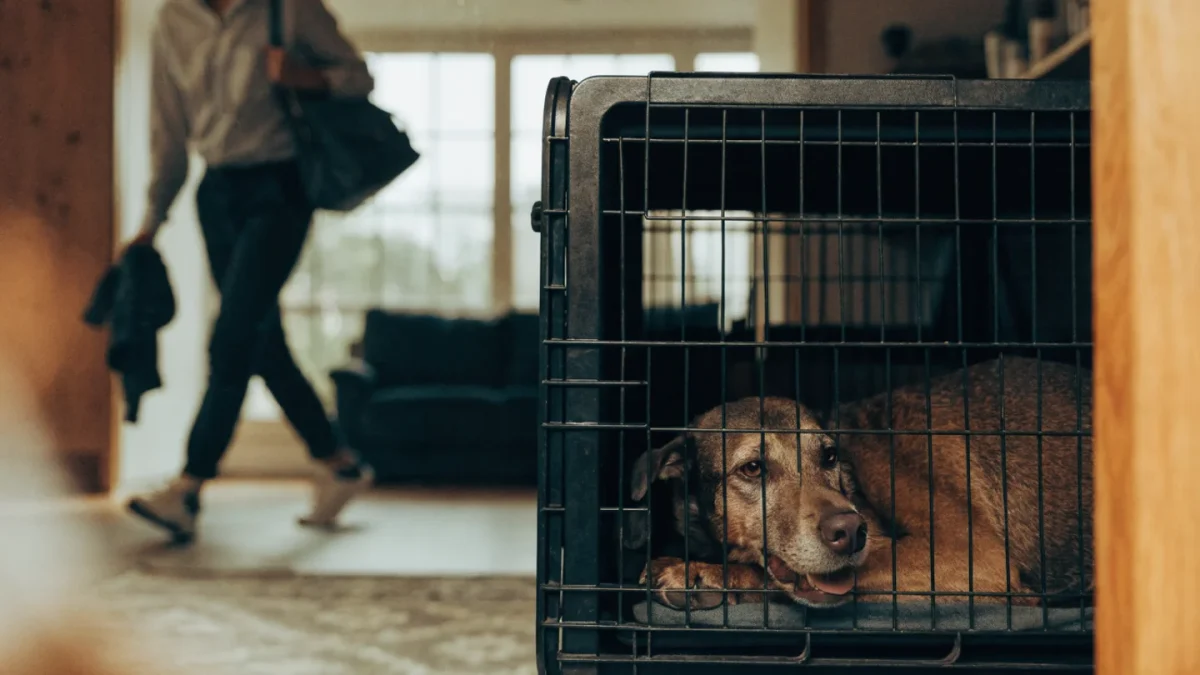
This is probably the most common misunderstanding I encounter: someone tells me their dog has separation anxiety and they're trying to fix it by crate training. I have to gently explain why that usually backfires.
The Difference Between Crate Resistance and Separation Anxiety
These look similar from the outside — dog distressed when owner leaves — but they're different problems.
Crate resistance: The dog objects to the crate specifically. They may be fine in a room alone, fine with a dog door, fine when left in a yard. The distress is about the crate, not about being alone.
Separation anxiety: The dog objects to the owner leaving, regardless of environment. The dog in a large room, in a yard, or in a crate all shows the same distress once the owner is gone. The trigger is departure, not confinement.
Signs of separation anxiety (as opposed to crate resistance):
- Destructive behavior only when owners are absent, not during crating with owners home
- Self-injury in any containment (not just crates)
- Tracking owner's pre-departure cues (getting the keys, putting on shoes) and becoming anxious before the actual departure
- Persistent distress throughout the owner's absence rather than settling after a few minutes
- Distress in multiple environments when alone — crate, room, house, yard
Why Crating Makes Separation Anxiety Worse
A dog with separation anxiety is already in a panic state when alone. Adding confinement layers physical helplessness onto that panic. They can't move, can't seek the owner, can't escape the situation. Many dogs escalate to self-injurious behavior: breaking teeth on bars, tearing nails, injuring paws trying to dig out.
The crate doesn't reduce the anxiety — it contains the expression of it while allowing the anxiety itself to intensify.
Some dogs with mild anxiety can be helped by a small, cozy space that feels more den-like. But this is different from crating as a management solution for separation anxiety.
What Actually Helps
Separation anxiety is a genuine phobia, not a training compliance problem. It responds to:
Graduated departure training: Systematic, extremely gradual exposure to departures — starting with one step toward the door, returning, and working up over weeks to actual brief departures.
Reduction of pre-departure cues: Randomizing the signals that predict departure so they don't build anticipatory anxiety.
Medication in severe cases: Some dogs benefit from anti-anxiety medication to allow behavioral work to proceed — the FDA has approved a fluoxetine-based medication specifically for separation anxiety in dogs, meant to be used alongside behavior modification rather than instead of it. This is a veterinary decision, and your vet is the one who makes the call for your dog.
Professional behavior support: Severe separation anxiety benefits from working with a qualified behavior professional. It's a real condition that often doesn't resolve without systematic intervention.
The separation anxiety guide goes through this in detail. For most of these dogs, the crate training guide applies — but only to the question of crate acceptance, not as a solution to the anxiety itself. (See also: dog anxiety.)
Don't try to fix separation anxiety with a crate. Deal with the anxiety directly, using the right protocol. The crate question can be addressed separately once the dog is more stable.