

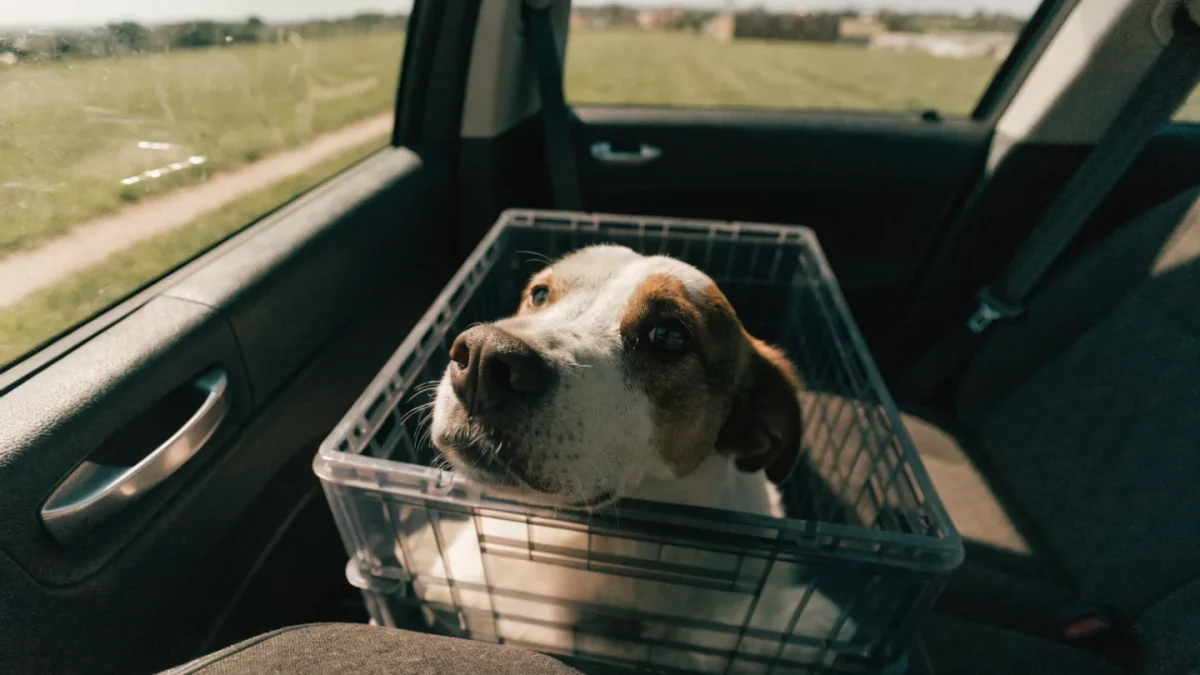
A dog that loves their home crate doesn't automatically love a car crate or an airline carrier. Different size, different smells, different context — the travel crate is a separate training project even for dogs who sleep in their home crate happily.
The good news: the foundation you've built for home crating transfers. You're not starting from zero.
Car Travel in a Crate
Why crate in the car? Uncrated dogs in cars are significantly more dangerous — both for the dog and for passengers. An unrestrained dog in a sudden stop can become a projectile. In an accident, a crated dog is protected and can be found and handled by emergency personnel.
Crate vs. harness/seatbelt: Crash-tested dog seatbelts exist and are an alternative to crating in vehicles. Crates are preferred for anxious dogs who settle better in a contained space.
Setting Up the Travel Crate
Use the same type of crate your dog is familiar with if possible — a familiar visual is helpful. If you're switching from wire to plastic for travel (plastic crates are more enclosed and often preferred for travel), introduce the plastic crate as a new object in the home first.
Put familiar-smelling bedding inside. Let the dog investigate it stationary in your living room before it ever goes in the car.
Building Car Crate Comfort
- Crate in the car, car parked, dog inside, you in the car. Just hanging out. Treats through the door. Five minutes. Done.
- Crate in the car, car running, you and dog inside. Treats. No movement yet.
- Very short drive — around the block. Come home. End session.
- Gradually build trip length. Pair car trips with destinations the dog enjoys (a park, a trail) so the car predicts good things.
A dog that vomits in the car may be motion sick rather than anxious — this is a physical issue separate from crate training. The two can look identical from the outside and even feed into each other over enough bad trips, so don't assume it's a training failure. A vet can advise on motion sickness solutions.
Airline Travel in a Crate
Airline regulations for dog travel vary significantly. If you're planning air travel with your dog, research the specific airline's requirements well in advance — crate dimensions, materials, labeling, documentation. Requirements differ internationally.
Choosing an Airline-Appropriate Crate
Hard-sided plastic crates with ventilation on at least three sides are the standard requirement for most airlines. Measure your dog carefully: they should be able to stand, turn around, and lie down with room to spare.
Preparing the Dog for Airline-Specific Crating
The biggest differences from home crating:
- The crate moves and tilts (during loading/unloading)
- The dog has no visual of you
- Duration is typically longer
- The environment is louder, more stimulating
Build toward this by practicing closed-crate sessions of several hours in a quiet room, separate from you. The dog needs to settle in the crate without your presence within range — different from home crating where you're usually nearby.
Practice wearing a well-fitted, non-chafing collar — it should stay on during transit but shouldn't be a choke or slip collar. (See also: dog anxiety.)
Don't sedate your dog before flying without veterinary guidance — the American Veterinary Medical Association advises against sedating pets for air travel altogether, since it can affect breathing and heart rate at altitude. Most airlines follow that guidance and won't accept a visibly sedated animal anyway.
The crate training foundation remains the base for all of this. A dog that has genuinely learned to enjoy their crate adapts to travel contexts more quickly than one where crating is just tolerated.
Start travel crate preparation early — several weeks before any actual travel. The process can't be rushed the day before a flight. Give your dog time to accept the crate in context, and the journey will go much more smoothly for both of you.