

Biscuit, my four-year-old orange tabby, is a cautionary tale about portion discipline. He eats everything — his bowl, anything left unattended, occasionally things that are not food. When I adopted him at one year old he was already slightly overweight, and it took a strict measured-cup regimen and the complete elimination of free-feeding to get him to a healthy weight. He's maintained it, but only because the structure is rigorous. I measure every morning. He does not get to decide when enough is enough.
I mention Biscuit because the dogs I see struggling with weight are usually in a similar dynamic: well-loved, well-fed, and eating slightly too much every single day with no mechanism to course-correct. The plan that works is not complicated, but it has to be specific, it has to account for everything, and it needs a feedback loop. Here's what that looks like.
Step One: Get a Vet-Established Target
Don't start a weight loss plan without at least one veterinary conversation. There are two reasons for this.
First, your vet needs to confirm the dog isn't overweight due to an underlying condition. Hypothyroidism, Cushing's disease, and certain medications cause weight gain that dietary restriction alone won't fix — and a dog that doesn't respond to appropriate calorie restriction should be evaluated for these before the effort escalates. I've seen owners spend months on a strict diet with a dog who was hypothyroid and never losing appropriately, which is frustrating for everyone and fixable once you know what you're dealing with.
Second, your vet can establish a target weight based on the individual dog's frame, breed, age, and body condition score — not just the breed average from a chart. A target weight set by a professional who's seen the dog is more useful than anything you'll find online.
Once you have a target weight, the calorie math starts from there. The standard veterinary formula for resting energy requirement (RER) is 70 × (body weight in kg)^0.75 per day — this is the established formula used across veterinary institutions and confirmed by the Pet Nutrition Alliance and the Merck Veterinary Manual. For weight loss, the feeding target is typically set at 70–80% of RER calculated at the target weight. Your vet's practice may use software to calculate this precisely, or they may give you a calorie range — either works.
Step Two: Choose the Right Food Approach
Three main options, roughly in order of stringency:
Portion reduction on current food. Reduce daily intake by 20–30% from current. Works for mild overweight (BCS 6, maybe early 7). The risk at significant reduction levels is that the dog may not get adequate micronutrients at the reduced portion of a maintenance-formulated diet. Fine as a starting point; watch for plateaus and hunger.
Weight management formulation. Foods specifically formulated for calorie restriction are designed to be nutritionally complete at the restricted portion size. They typically have higher fiber content to improve satiety, and lower calorie density per gram, which means a larger volume of food for the same calories. Most food-motivated dogs do much better on a larger portion of a lower-calorie food than a tiny portion of their regular food.
Prescription weight loss diet. For dogs significantly overweight (BCS 8–9) or with concurrent health conditions, prescription obesity management diets are the most carefully calibrated option. These are typically high in protein to preserve lean muscle mass during fat loss, with controlled fat content and very specific calorie density. Requires vet prescription, but for dogs that have failed over-the-counter approaches, they're worth pursuing.
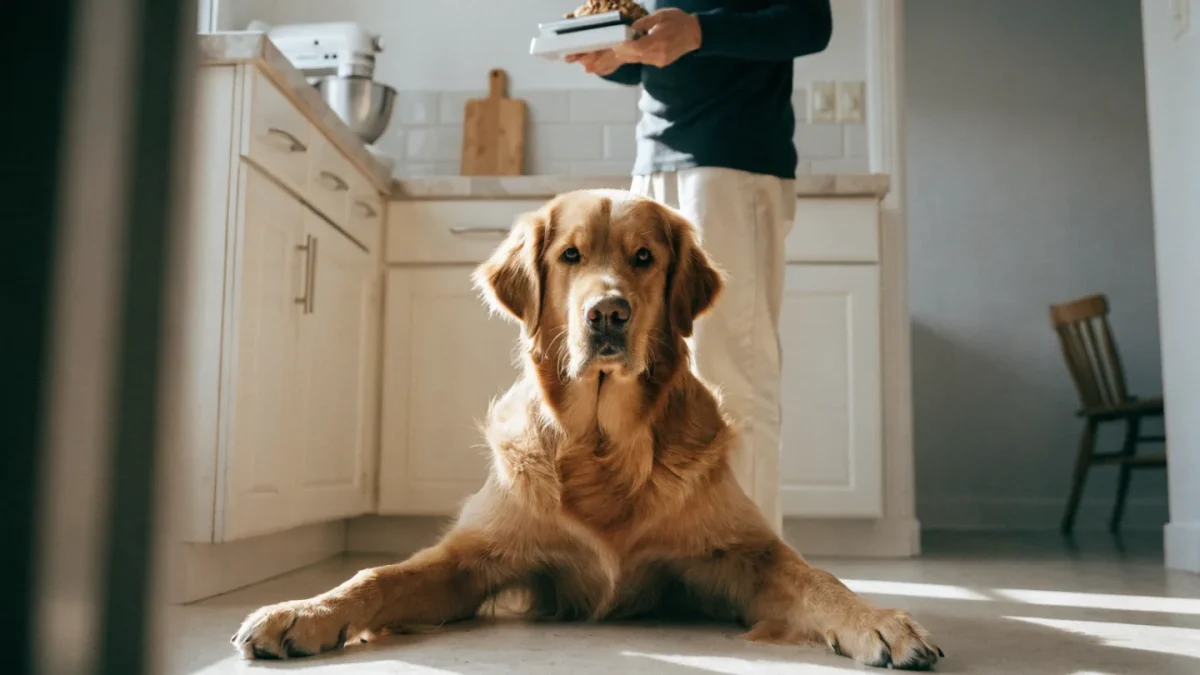
Whichever approach, the critical step: stop using volume measurements and start using a kitchen scale. Feeding guidelines on bags are in cups; cups are imprecise. The difference between a heaped cup and a level cup can be 15–20% more food. For a dog that needs calorie restriction, this gap matters enormously. Weigh to grams from the first day.
Step Three: Build a Treat Budget
Every treat given to a dieting dog comes from a fixed daily calorie budget. There is no "extra" once the budget is spent — treats reduce the meal portion accordingly, or the meal portion is divided to allow for treats.
A practical approach: establish the daily calorie target with your vet, allocate 80% to meals and 20% to treats and extras, and work within that allocation. For a dog on a 600-calorie weight loss budget, that's 480 calories of food and 120 calories of treats — which is roughly 12 to 15 small commercial training treats per day, or three pieces of cooked chicken in addition to training treats.
Do not increase the overall budget to accommodate unchanged treat habits. This is the single most common failure point.
For training-intensive households, use part of the dog's measured daily kibble as training treats. It's nutritionally neutral and it works.
Step Four: Track Biweekly Weigh-Ins
The feedback loop is non-negotiable. Without it, you're flying blind — you don't know if the plan is working, and you'll miss the point where you need to adjust.
Weigh the dog every two weeks for the first two to three months. Use the same scale, same time of day, before feeding. A spreadsheet or a notes app entry is fine — just write down the date and weight each time.
What you're looking for: 1–2% of current body weight loss per week. For a 30 kg dog, that's 300–600 grams per two weeks. Small numbers. Steady and consistent is what success looks like.
If you're seeing faster loss than this, increase food slightly — rapid weight loss in dogs can deplete lean muscle mass, which matters for long-term metabolic health.
If you're seeing no loss after three to four weeks of consistent management, recalibrate. Either the calorie count is higher than tracked (usually due to treats), or the dog's metabolic rate is lower than the formula predicted, and the calorie target needs to come down. Don't keep doing the same thing and expect a different result.
Handling the "Always Hungry" Dog
Some dogs are dramatically food-motivated and don't adapt well to restriction. This is real, and I don't dismiss it — a genuinely hungry dog is harder to live with and the owner's quality of life matters too.
Strategies that help: switch to a high-fiber, low-calorie-density food that allows a larger meal volume at the same calorie count. Feed more frequent smaller meals (three or four per day instead of two). Add plain cooked green beans or plain pumpkin puree to the top of meals — both add fiber and bulk at negligible calorie cost. Use food puzzles and slow feeders to extend meal duration.
For dogs that remain very difficult despite these measures, ask your vet about appetite-modifying medication. It exists, it works in some dogs, and it's not a failure to use it.
Maintaining After Goal Weight
When the dog hits target weight — and this usually takes several months, not weeks — the plan changes but doesn't end.
Recalculate maintenance calories at the new weight (these will be higher than weight-loss calories). Introduce additional food gradually over two to three weeks to reach the new maintenance level. Continue monthly weigh-ins for the first year; if weight stays stable, shift to quarterly.
Most dogs that regain weight do so because the structure of the loss phase is entirely abandoned once goal weight is reached. Keep the scale. Keep the measured portions. Keep accounting for treats. The habits that got the weight off are the habits that keep it off.
Frequently Asked Questions
How do I handle a multi-dog household where one needs to lose weight?
Separate feeding stations and supervised meals are the most reliable approach. Feed the dieting dog in a different room or behind a closed door for the duration of meals. For dogs that eat freely, timed meals (food down for twenty minutes, then picked up) make this manageable. The easiest solution I've seen is feeding the dieting dog first while the others wait, then feeding the others after the first dog is done and closed away.
Can I switch from twice-daily feeding to once-daily to reduce total intake?
This works for some dogs but tends to increase food-seeking behavior and hunger in others. Meal frequency doesn't change calorie math — the same total divided differently is the same total. If your dog does better with multiple smaller meals, that's fine. If feeding twice-daily has been working and you're now reducing portions, keeping the same frequency is simpler.
My dog is losing weight but seems tired and less playful. Is this normal?
Mild reduction in energy can accompany calorie restriction in the early weeks. But significant lethargy, muscle weakness, or dramatic personality change warrants vet evaluation — it may indicate the restriction is too aggressive, or an underlying condition is being unmasked. Loss of lean muscle mass (as opposed to fat) can cause lethargy and weakness; protein-adequate weight management diets are designed to minimize this.
Do I need prescription food or can I just reduce portions of regular food?
For dogs mildly overweight (BCS 6, needing to lose less than 10% of body weight), reducing portions of a regular, complete food is reasonable. For dogs significantly overweight or with other health conditions, prescription or veterinary therapeutic weight management foods offer more precise nutritional control and better outcomes in clinical studies — an international trial of 926 dogs found 97% successfully lost weight on a veterinary weight management diet, with an average of 11.4% body weight reduction in three months. It's worth asking your vet which approach they recommend for your specific dog.