
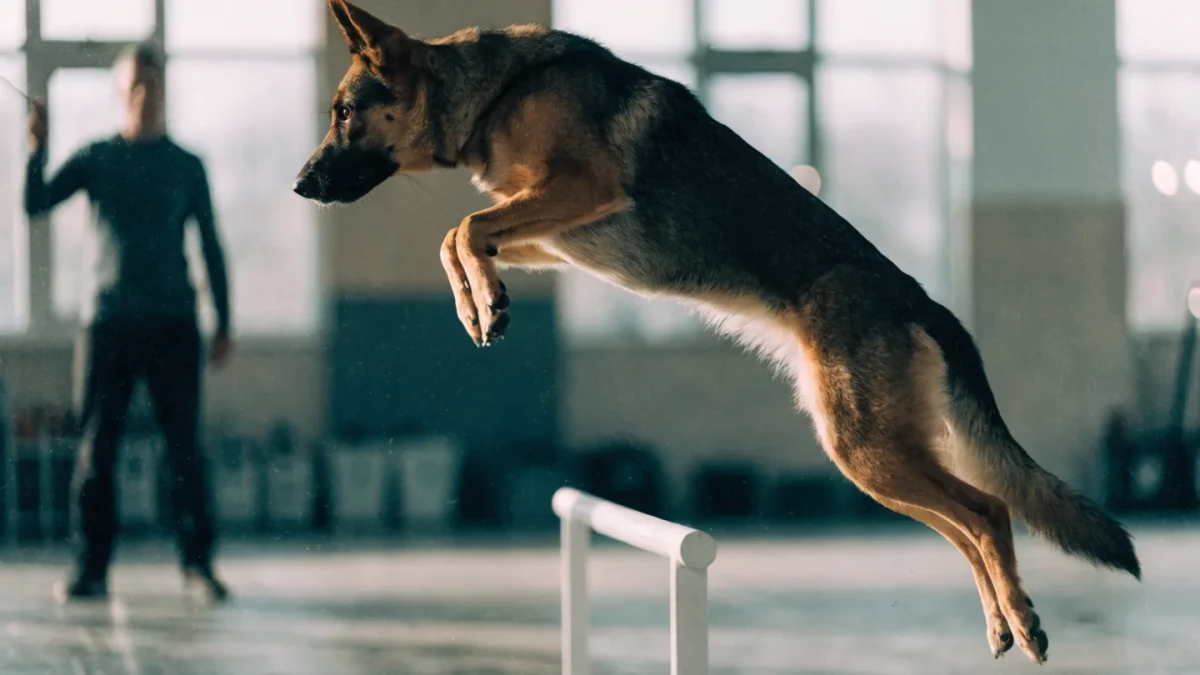
Directed jumping is one of those skills that looks like a party trick until you understand what it actually requires from the dog. The dog goes away from you to a designated spot, turns and faces you, waits, then jumps a specific obstacle on your cue and returns to heel position. It's a combination of distance control, impulse management, directional discrimination, and a reliable recall — all layered together.
It's used in formal obedience competition, but the component skills are genuinely useful for advanced obedience in everyday life, and the training process builds a lot of valuable handler-dog communication.
Prerequisites
Before directed jumping makes sense to teach:
- Reliable recalls: The dog should come when called in varied environments.
- Jump foundation: The dog should be comfortable jumping on cue. Build this separately, without the "directional" element.
- Go-out or send-away: The dog should be comfortable moving away from you to a target. This is often the hardest part.
- Solid front: The dog should be able to sit facing you (a "front" position) on recall before completing the heel finish.
Step 1: Teach the Jump on Cue
Start with a very low jump — barely ground level. Lure the dog over it, then fade the lure to a hand signal or verbal cue. Build the behavior reliably before adding height. The dog should approach and jump on cue, not just when running around randomly.
Once the dog understands "jump this specific obstacle when I cue you," work from different angles. The dog should jump it coming from your left and from your right. Eventually from a distance with you stationary.
Step 2: Teach the Go-Out
The "go-out" or "send away" is the dog moving away from you to a designated spot and sitting. It's counterintuitive for most dogs — they default to wanting to be near you, not to run away on cue.
Start by placing a target (a food bowl, a target plate, a piece of tape on a wall) a few feet away. Send the dog to it, reward them at the target. Gradually increase the distance. Eventually fade the visible target so the dog will go out to a spot in space rather than a visible target.
Step 3: Combine: Go Out, Front, Then Jump
With both skills established, you can chain them. Send the dog to the go-out spot. Pause. Cue a jump. As the dog lands, recall them to front position.
This is the classic directed jumping sequence: go out → front → jump cue → front → finish.
Keep sessions short. This is cognitively demanding — the dog is making a lot of decisions in sequence.
Step 4: Add Directional Discrimination
In formal obedience, there are two jumps (high and bar jump) set up on either side. The handler sends the dog out between the jumps, then cues which one to take. The dog must discriminate between them.
Build discrimination slowly. One jump at a time, with the other jump present but not an option. Introduce directional cues (a hand signal pointing to the correct jump) before adding both as options.
Step 5: Distance and Proofing
Work gradually increasing distance for the go-out. The dog should be able to go out 30-40 feet in competition contexts. Proof the behavior in different locations — the first few times in a new space, the go-out often falls apart.
Add mild distractions only after the behavior is solid. Distance position changes trained separately will help the dog develop comfort with receiving and acting on cues from a distance. (See also: dog sports and enrichment.)
Directed jumping is a long project — expect weeks to months of systematic building before it all comes together reliably. That's normal. The component skills are each worth having on their own, so the training is time well spent even if you never compete.