
I want to be upfront about something: "advanced obedience" means different things to different people.
To a competitive obedience trainer, it means precision heeling, directed jumping, and scent discrimination. To most pet dog owners, it means a dog that walks nicely on a loose leash, stays reliably when guests arrive, and comes back when called at the dog park.
Both are valid. This guide is aimed at the second group — taking the solid basics you've built and making them actually work in real life.
The Prerequisites
Before calling anything "advanced," your dog should have:
- A reliable sit and down in familiar environments
- A basic stay (30+ seconds, with you standing nearby)
- A recall that works in your yard
- Some capacity to work on a loose leash in low-distraction settings
If any of those aren't there yet, go build them first. Advanced training on a shaky foundation produces shaky advanced behaviors.
Heel: Controlled Walking at Your Side
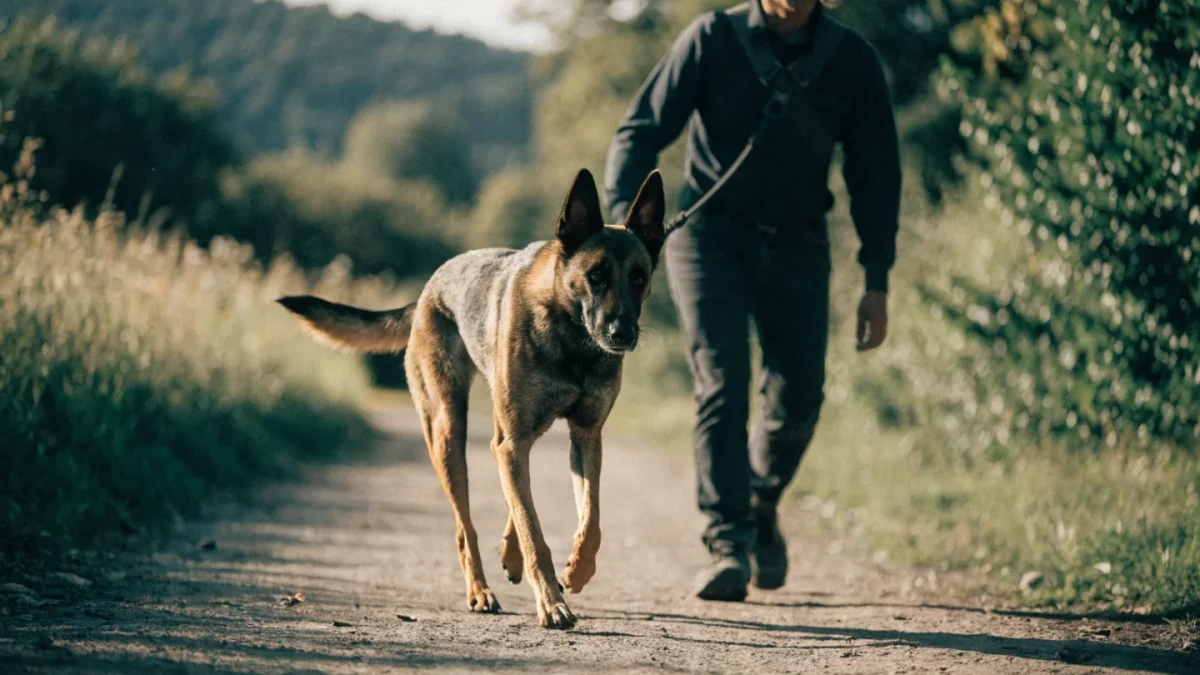
Heel is different from loose-leash walking. Loose-leash walking means the leash is slack and your dog is in the vicinity of you. Heel means your dog maintains a specific position — left shoulder at your left leg, attention on you — and holds it through changes of pace and direction.
Heel is a demanding behavior, and it's not something dogs need 100% of a walk. Think of it as a tool: "heel" is a cue meaning "come into precise position and maintain it." "Walk" or "let's go" means loose-leash walk.
Teaching heel: Start with your dog on your left side. Lure them into position — left shoulder aligned with your left leg, looking up. Take one step, reward immediately if they maintain position. Two steps. Five steps. Reward every two or three steps initially.
Add turns — right turns, left turns, about-turns. The dog's job is to stay glued to your left leg through all of them.
The two keys: Your pace changes are information for your dog. Speed up, slow down, stop suddenly — your dog should respond. And your dog's attention should be on you, not on the environment.
Duration and Distance in Stays
The fundamentals of duration and distance are covered in basic training. At the advanced level, you're combining them with real-world variables:
- 2-minute down-stay while guests arrive
- Sit-stay at a threshold while you walk 30 feet away
- Down-stay while you're out of sight (behind a car, around a corner)
Build each one deliberately. Out-of-sight stays are particularly challenging — most dogs pop up when they can no longer see you. Build it by briefly disappearing (behind a door, around a corner) and immediately returning. Gradually extend the time you're out of sight.
Distraction Proofing at the Advanced Level
Basic proofing means different rooms and mild distractions. Advanced proofing means:
- Sit-stay while a ball rolls past
- Come while another dog is playing nearby
- Heel through a crowd
- Down-stay at the park while kids run by
Each of these requires deliberate, methodical work. Don't throw your dog into a difficult situation and hope they rise to it. Build to it — one distraction level at a time.
The under-threshold rule: Work your dog just below the level where they lose their mind, not in the middle of it. If your dog can't think near other dogs at 20 feet, start at 40 feet and build in. Training above threshold teaches the dog nothing except that training is impossible.
Chaining Behaviors
A behavior chain is a sequence: sit → down → sit → stand → heel → sit. The dog learns to move through a sequence of behaviors on a single cue or hand signal.
Chains are useful for real-world situations where you want smooth behavioral flow rather than waiting for a single behavior at a time.
Build chains backward — teach the last behavior in the chain first, then add the preceding ones. This way the dog is always moving toward a part of the chain they already know.
Off-Leash Reliability
Off-leash reliability is the goal for most people doing advanced training. It requires:
- A recall that works in the specific environment
- Attention behavior — your dog checks in with you frequently
- A clear "with me" cue that brings them back to your side when needed
Build off-leash work on a long line in gradually increasing environments before removing the line. A long line in a park is the bridge between controlled training and true off-leash freedom.
When to Pursue Formal Training
If you want to go further — competition obedience, CGC certification, protection sports, working titles — a club or sport-specific trainer is the way forward. Self-training can get you far, but formalized training programs and experienced coaches accelerate the process and catch problems early.
FAQ
How long does advanced training take?
It depends on your starting point and how consistently you train. Most dogs with solid basics can achieve reliable real-world obedience with 3-6 months of consistent work.
Do I need professional help for advanced training?
Not necessarily, but a good trainer can see things you can't and help you solve problems faster. At minimum, a single assessment session with a qualified trainer can identify where to focus. (See also: reliable dog recall.)
Can all dogs achieve this level?
Most can reach functional real-world reliability. Some breeds are naturally more compliant in training; others require more creativity. Functional advanced obedience is achievable with most dogs with the right approach.
What's the difference between advanced obedience and dog sports?
Dog sports (agility, rally, protection, etc.) use advanced obedience as a foundation but add sport-specific skills. Advanced obedience training aimed at pet dog function is less technically precise than sport obedience but more broadly applicable.
Pick the behavior that would most improve your daily life with your dog — probably heel or a solid stay-while-guests-arrive — and focus there for the next six weeks. Narrow focus produces faster results than spreading attention across many things.