

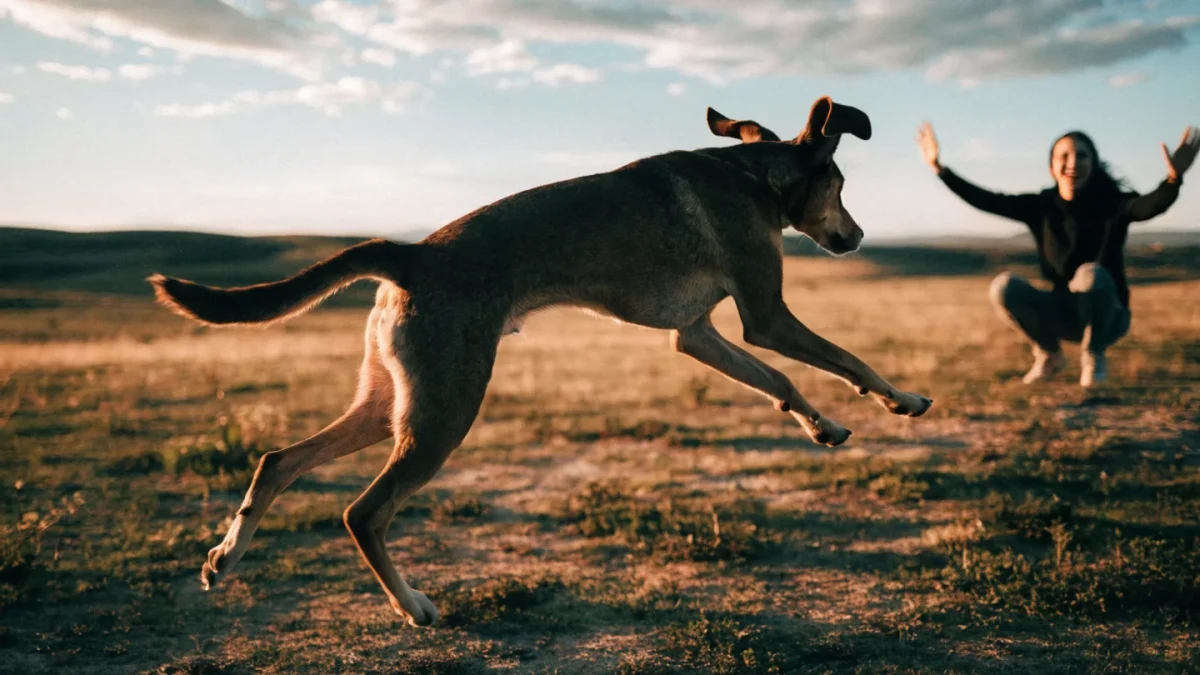
I'll tell you something uncomfortable right at the start: there is no such thing as a 100% reliable recall in every situation. Any trainer who tells you otherwise is selling something.
What there is: a recall that holds in the environments you actually use it in, with the distractions you actually encounter, if you do the work to build and maintain it.
That's the realistic goal, and it's achievable for most dogs.
Why Recall Matters More Than Anything Else
Every other command has an acceptable failure mode. Your dog blows off a sit at the park — you re-cue, they sit, no harm done. Your dog ignores a stay when company arrives — inconvenient, manageable.
Your dog ignores a recall at the wrong moment — near traffic, at the top of a cliff, when another dog runs at them — and the consequences can be catastrophic.
The recall is the only command where the failure mode is potentially fatal. It earns its status as the most important thing you'll teach.
The Core Principle: The Recall Word Always Predicts Great Things
This is not about niceness or positive training philosophy. It's about classical conditioning.
The recall word acquires its value entirely from what it has consistently predicted. If "come" has always meant "something great is happening when you get here," the dog will run enthusiastically every time.
If "come" has sometimes meant getting their nails clipped, getting their ears cleaned, getting put in the crate when they'd rather keep playing — the word no longer predicts great things consistently, and the response deteriorates.
Never call your dog to anything they dislike. Go get them for nail trims, bath time, departure time. Don't call them to you for those things.
Never punish a dog for coming to you, even if they took too long. The dog only knows you're unhappy when they arrived. They associate your anger with coming to you, not with the delay that annoyed you.
The Steps
Stage 1: Build the Response in Safe, Easy Settings
Start at home, in a small space, with no distractions. Say your recall word ONCE (not "come come come come") and back away from the dog as you say it. Movement away from the dog is compelling — their instinct is to follow movement.
When the dog reaches you, deliver a jackpot — multiple treats delivered one at a time, enthusiastic celebration, a quick game of tug if they like that. Make coming to you the single best thing that happens to the dog all day.
Do this 10-15 times per session. Keep sessions short. The dog should be enthusiastic.
I cover this in more depth in my piece on advanced dog obedience training.
Stage 2: Add Distance and the Long Line
Move training outside. Use a long line — 15-30 feet. This allows you to physically ensure the recall happens if the dog is distracted. Never let the recall go unanswered at this stage.
If the dog doesn't respond to the cue, gently reel them toward you with the long line. Don't jerk. When they reach you, still give a big reward — even if you had to guide them. The reward is for reaching you, not for voluntary compliance.
Stage 3: Gradual Distraction Proofing
This is the long part. You need to practice the recall in every environment you'll eventually use it in, against every distraction you'll eventually face.
Add distractions one level at a time. Practice recall when:
- Other dogs are in the area but not close
- Food is on the ground nearby
- Another person is calling the dog
- A squirrel is in the vicinity
Each distraction level is built separately. Success at 50 feet from a dog doesn't mean you're ready for 10 feet.
Stage 4: The Controlled Off-Leash Test
Before removing the long line completely, graduate to shorter versions. A 15-foot line becomes a 10-foot line becomes a 5-foot line becomes just a 6-inch trailing piece of rope (a "ghost line"). Gradually fade the line in environments where the dog has been consistently reliable.
Never go fully off-leash in an uncontrolled environment until the dog is reliable on a ghost line in that environment.
Maintaining the Recall Long-Term
A recall that's trained and then never reinforced will fade. Keep the recall rewarded throughout the dog's life — not every time, but often enough and unpredictably enough that coming when called is always worth doing.
Occasional jackpot recalls — the dog comes in from the yard and gets five treats instead of one — keep the behavior strong on a variable schedule.
What to Do When the Recall Has Been Poisoned
If "come" has been punished, ignored repeatedly, or associated with bad things — you probably need a new word. "Here," "to me," "front," "yes" — pick something fresh and train it from scratch.
The old word carries the old associations. The new word is a clean slate.
FAQ
What age should I start recall training?
As early as 8 weeks. Young puppies naturally want to follow you everywhere — that's the ideal time to start building the recall. Use the instinct while it's strong.
Should I use a special recall word vs. "come"?
Any word works. The key is that it's one specific word used exclusively for recall, and it's never said without a response. Some trainers use an unusual word specifically to prevent contamination.
How long does it take to build a reliable recall?
A solid recall in easy environments can be built in weeks. A recall that holds in high-distraction real-world environments takes 6-12 months of consistent work. Proofing takes longer than initial training.
What if my dog has high prey drive and won't come back when there's a squirrel?
High-prey-drive recall is genuinely harder and requires more work. Recall training in high-prey-drive dogs covers that specifically.
The recall is the one command you can never declare done. It needs maintenance, it needs periodic refreshing, and it needs to stay connected to something valuable. A dog that comes when called is a dog that gets more freedom — because you can trust them with it.