
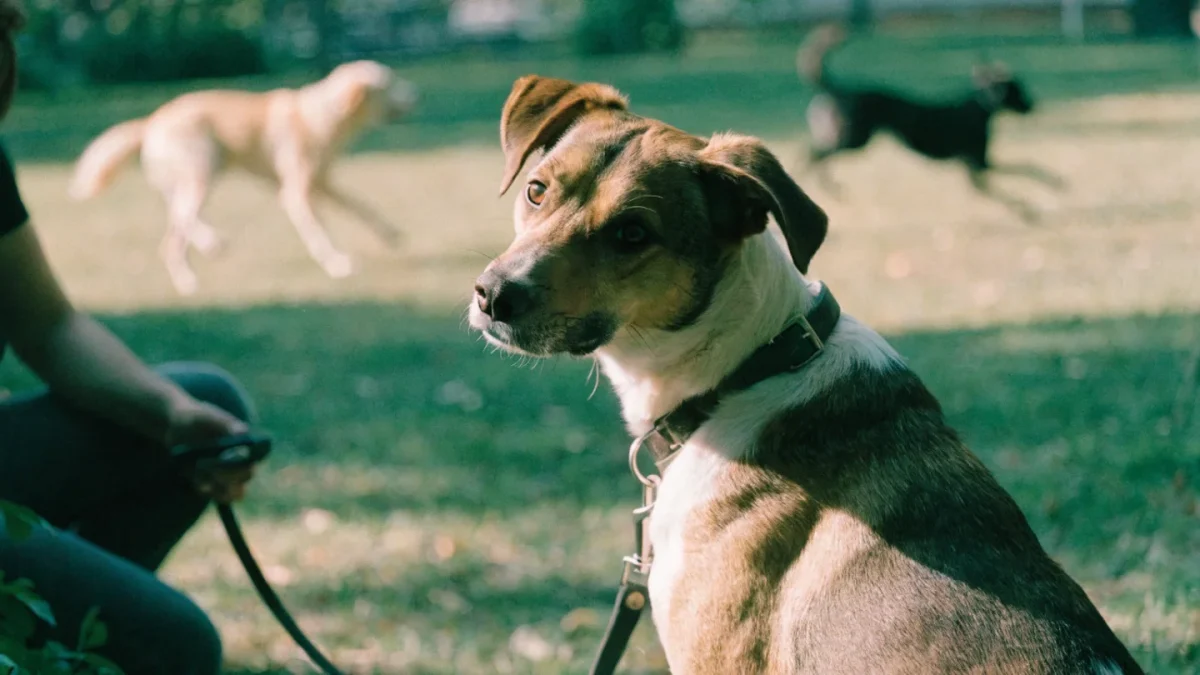
Every trainer I know has been asked some version of this: "My dog is perfect at home. Why does he completely ignore me at the park?"
Because the park is a different classroom. Training in your living room is not the same as training at the park. The behaviors have to be re-taught in each environment, against each type of distraction, until they're generalized enough to hold up wherever you take your dog.
That process is distraction training.
The Threshold Concept
Dogs have a threshold — a level of distraction intensity above which they cannot think clearly. Below threshold: your dog can hear you, process your cue, and respond. Above threshold: fight, flight, freeze, or zone-out. No training is happening above threshold.
Your job is to work just below your dog's threshold for a given distraction. Close enough that the distraction is present (so you're actually training something), far enough that your dog can still function.
Example: Your dog can't ignore another dog at 10 feet — they're above threshold. At 30 feet, they're slightly distracted but can still respond to cues. Work at 30 feet first. When 30 feet is reliable, move to 25 feet. Gradually work your way in.
Categorizing Distractions by Difficulty
Not all distractions are equal for your dog. Know your dog's hierarchy:
Most common high-value distractions for dogs:
- Other dogs (especially playing or running)
- Small animals (squirrels, birds, cats)
- Food on the ground
- Children running
- Bikes and wheeled vehicles
- New people
- Exciting smells
For each distraction type, you have a threshold distance. Train at each level, increasing proximity gradually.
Setting Up Distraction Training Sessions
Choose a specific distraction to work on. Don't try to proof against everything at once. Pick one thing — other dogs, for example — and build resilience against that before adding another.
Find your threshold distance. Observe your dog at various distances from the distraction. The threshold is where you start to lose them — they stop responding to cues, fixate, or pull.
Start 20% farther than threshold. You want the distraction present but not overwhelming.
Practice known behaviors only. Distraction training is not the place to teach new behaviors. Work on things your dog knows well in low-distraction settings.
Reward heavily. High-value treats for working near distractions. The competition is real — your reward needs to be worth competing with.
Progressive Exposure
Session 1: Park perimeter, 50 feet from the nearest dog, asking for sits and attention.
Session 2: 40 feet.
Session 3: 30 feet.
Session 5: 20 feet.
This is simplified, but the principle holds. Progress comes from sessions, not from single exposures.
The Eye Contact Game Under Distraction
One of the most powerful distraction training exercises: teach your dog that looking at you in the presence of a distraction earns a big reward.
"Look at me" or "watch" near a distraction (at threshold distance) is the foundation of all other distraction work. If your dog can orient to you near a distraction, every other behavior becomes easier.
Practice: distraction present at threshold distance → say your dog's name or "watch" → the instant they look at you → mark and jackpot. Build duration: look at me for 2 seconds, 5 seconds, 10 seconds before the jackpot. (See also: reliable dog recall.)
When Progress Stalls
If your dog is stuck at a particular threshold level after several sessions, either:
- You need more distance from the distraction
- The environment has other variables making it harder than you realize
- The distraction is particularly high value for your dog and needs more foundation work
Don't push through by using corrections. Back up and rebuild.
This week: identify your dog's hardest distraction (the thing that most reliably takes their brain offline). Find a controlled environment where you can practice near that distraction at a safe distance. Do five minutes of known behaviors at that distance. That's your starting line.