

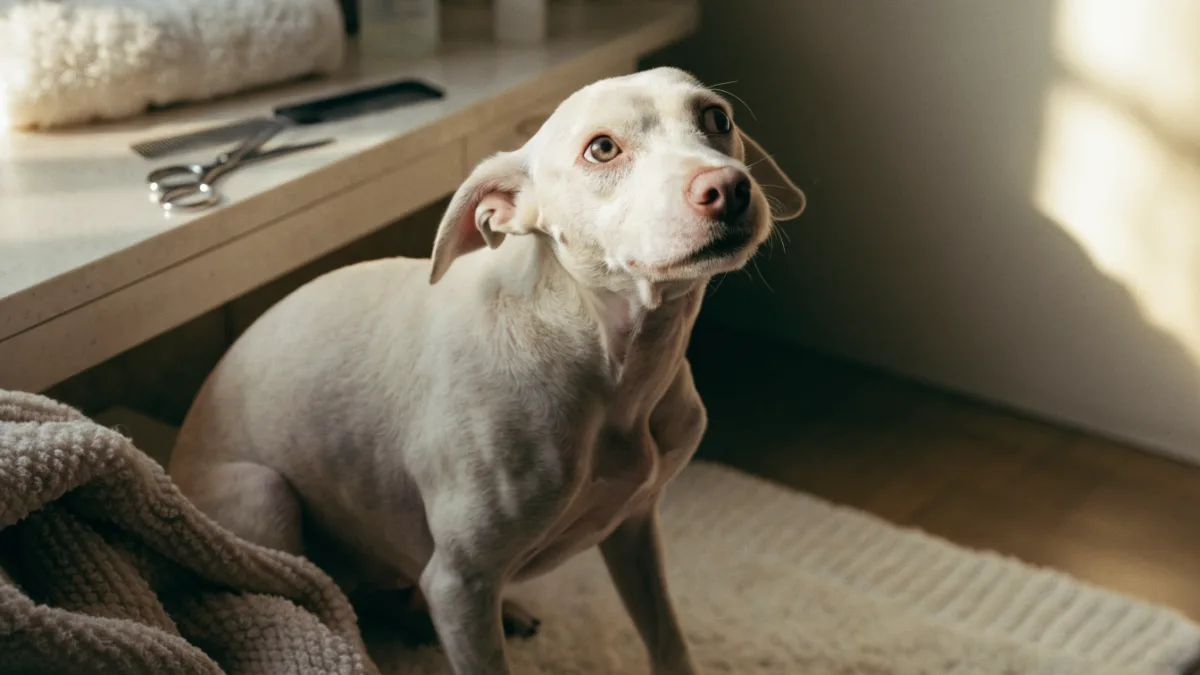
You bring your dog home from the groomer. They look incredible — neatly trimmed, ears cleaned, nails short, smelling like oatmeal and expensive shampoo. And then they disappear under the bed and won’t come out for fourteen hours. Or they pace in circles biting at their feet. Or they shiver on the couch like you’ve abandoned them in a snowstorm. If you’ve got a long-haired breed, you’ve probably seen this and wondered what on earth happened. Some people call it “post-groom depression.” It’s not depression. But it is real, and there are concrete reasons your pet comes home acting like a stranger.
What a Fresh Haircut Actually Feels Like
Here’s the thing most owners don’t think about: your pet’s coat isn’t decorative. It’s a sensory organ. It regulates temperature, detects air currents, and provides constant tactile feedback about the environment. When a groomer takes an Old English Sheepdog from a matted three-inch coat down to a smooth half-inch trim, that dog isn’t just lighter — they’re experiencing the world differently.
The most immediate change is temperature. Long-haired breeds — Poodles, Shih Tzus, Cockers, Havanese, Collies — rely on their coat as insulation. Strip that insulation and they feel every draft in your house. That shivering isn’t dramatic; they’re genuinely cold. I fostered a Cocker named Archie a few years ago who came to me with a coat matted beyond saving. The groomer had to take him down to the skin across his back. He spent three days pressed against the baseboard heater and refused to go outside unless I put a sweater on him. He wasn’t being difficult. He was freezing.
Then there’s tactile sensitivity. Cut hair is sharp at the micro-level. Those tiny clipped ends get trapped against the skin, under collars, between paw pads, and inside the “socks” of long-haired feet. It itches. A lot. Dogs who come home from a groom and immediately start chewing their feet or scooting across the floor are usually responding to those trapped cut hairs. It’s the same sensation as having a prickly shirt tag you can’t reach.
Whiskers and Spatial Awareness
For cats especially, trimming whiskers is a bigger deal than people realize. Whiskers aren’t just long hairs — they’re proprioceptive tools that help an animal understand where their body is in space. A cat who comes home from a lion cut with trimmed whiskers will often walk gingerly, misjudge distances, or act disoriented. Dogs with trimmed face furnishings — Poodles, Doodles, terriers — can show similar temporary clumsiness. It passes as the whiskers regrow, but in the meantime, it’s genuinely disorienting for them.
The Exhaustion Crash Nobody Talks About
Grooming is exhausting. I don’t think people fully appreciate this. A standard groom for a large, long-haired dog takes two to three hours. During that time, the dog is standing on a table, being handled by someone who — however skilled and kind — is not their owner. They’re exposed to clippers that vibrate against their skin, high-velocity dryers that are genuinely loud, and the constant presence of other animals in the salon.
That’s a massive adrenaline load. Your pet’s cortisol and adrenaline are elevated for hours. When they come home and finally relax, they crash. What looks like “sadness” or “depression” is often a tired, overstimulated animal shutting down to recover. A,[1] is full of owners describing exactly this — dogs who are normal at the park but lethargic and withdrawn once they get home. The home is their safe space. That’s where they process the stress.
I’ve seen this in cats too. A friend’s Maine Coon, Luna, comes home from every groom and sleeps for nearly twenty hours straight. She’s not sick. She’s not traumatized. She’s a cat who stood on a grooming table for ninety minutes being blown dry, and she needs to recover from it.
Puppies and First-Time Grooms
If there’s one group that gets hit hardest by the post-groomer funk, it’s puppies. A first groom is a sensory ambush. Everything is new — the clippers, the dryer, the handling, the strange humans, the slippery table surface. Shih Tzu puppies are probably the classic example; their first groom at four or five months often produces the most dramatic reactions owners will ever see. Hiding, trembling, refusing to eat, acting “spooked” by normal household sounds.
[2] are flooded with variations of the same post: “Is this normal after the first groom?” It is. It’s an overstimulated puppy who just had the most intense afternoon of their short life. Subsequent grooms are almost always easier because the puppy learns the routine and the sensory shock fades.
The key with first grooms is managing expectations. Don’t schedule a puppy’s first groom on a day when you need them to be social and happy. Give them a quiet evening. They’ll come back around.
Is It the Groomer’s Fault?
This is where things get tense, and I want to be honest about both sides.
Owners see a pet acting strange and immediately worry something went wrong. Was the groomer rough? Did something happen behind the salon doors? These fears are valid — there are bad groomers out there, and rough handling absolutely happens. If your pet comes home with nicks, clipper burn, raw patches, or suddenly flinches when you reach for their paws or ears, that’s worth investigating. Ask questions. If the answers don’t add up, find a new groomer.
But — and this is important — even the most skilled, gentle, fear-free certified groomer will produce a post-groom funk in some animals. [3] the sensory overload is inherent to the process. Clippers vibrate. Dryers are loud. A stranger touches your pet’s face, feet, and genitals. No amount of gentleness eliminates that entirely.
The pet care industry has shifted significantly in recent years toward “Fear-Free” and “Force-Free” grooming certifications. Groomers trained in these methods learn to read stress signals — lip licking, yawning, whale eye, shake-offs — and take breaks mid-groom to let the animal decompress. This genuinely helps reduce the severity of the post-groom crash. If your pet has intense reactions after grooming, finding a Fear-Free certified groomer is worth the effort.
Practical Steps for Post-Groom Recovery
So your dog or cat comes home from a groom and they’re acting strange. Here’s what actually helps:
- Provide warmth. Offer a blanket, a dog sweater, or a warm bed in a draft-free area. If your pet is shivering, they need insulation while their coat adjusts. This is especially critical for breeds shaved down in cooler months — and yes, I’m side-eyeing anyone who gets their double-coated dog shaved in November.
- Give them space. Don’t force affection. If your pet hides under the bed, let them. They’ll come out when they’re ready. Forcing interaction with an overstimulated animal just extends the stress response.
- Check the skin. Run your hands over their body and look for redness, razor burn, or irritated patches. Pay special attention to the groin, armpits, and belly — areas where clipper burn is most common. If you find raw spots, contact your vet.
- Watch the scratching. Mild itching from loose cut hairs is normal. If your pet is biting themselves raw or scratching to the point of breaking skin, that’s a reaction — either to a grooming product or to clipper irritation. Ask your groomer to switch to a hypoallergenic, fragrance-free shampoo next time, and consult your vet if the scratching doesn’t resolve within a day.
- Skip the welcome-home party. Don’t invite neighbors over to admire the new haircut. Your pet needs a quiet environment to decompress, not more stimulation.
When to Call the Vet
Most post-groom funk resolves within 24 to 48 hours. If your pet is still acting lethargic, refusing food, or scratching obsessively after two days, call your vet. Clipper burn can develop into a secondary skin infection. Allergic reactions to shampoos or conditioners can worsen rather than improve. And in rare cases, a pet who comes home from grooming and acts truly off — uncoordinated, disoriented, or non-responsive — may have experienced an adverse event that needs medical attention. Don’t wait it out if your gut says something is wrong.
The Bigger Picture on Grooming Stress
For some animals, grooming isn’t just unpleasant — it’s genuinely distressing. Cats in particular can enter a state of panic during grooming that borders on medical emergency. I’ve met cats who stop grooming themselves entirely because their coat mats painfully, but who also become nearly feral at the groomer. That’s a catch-22 that requires real management, not just a trip to the salon every few months.
For these animals, there’s an ongoing debate between owners and veterinarians about whether to use anxiety medication before grooms. Vet-prescribed medications like trazodone or gabapentin can take the edge off enough for a groom to happen without panic. Some people feel strongly that medicating for grooming is overmedicating. Others — including many veterinarians — argue that the cortisol damage from repeated panic episodes is worse than a properly dosed anti-anxiety med. I’ve changed my thinking on this over the years. If an animal is genuinely panicking — not just stressed, but in full fight-or-flight — the stress on their cardiovascular system and their relationship with handling is worse than the medication. Talk to your vet about your specific animal.
There’s also been a boom in calming aids aimed at the post-groom recovery window. Pheromone diffusers like Adaptil (for dogs) and Feliway (for cats) can genuinely help some animals settle. Calming treats containing L-theanine have modest evidence behind them. Recovery suits — lightweight body garments that cover the torso after a shave-down — address both the temperature drop and the itchiness from trapped cut hairs. None of these are magic, but for an animal who struggles post-groom, they’re worth trying.
The post-groomer funk isn’t a sign that something is broken in your relationship with your pet, or that you’ve done something wrong by having them groomed. Long-haired breeds need grooming — that’s the deal you signed up for. But understanding what your pet is experiencing, and giving them the space and warmth to recover, turns a confusing, distressing afternoon into something they can bounce back from. The more you understand about what they’re feeling — physically, sensorily, emotionally — the better advocate you’ll be for them at the groomer, at the vet, and at home.
Sources
- Reddit thread on post-groom behavior — reddit.com
- Shih Tzu owner groups — facebook.com
- As PrideBites explains — pridebites.com