

Just last week, a wonderful couple brought an eight-week-old German Shorthaired Pointer puppy into my clinic. They were practically vibrating with excitement, but they also came with a checklist of questions from their breeder. At the very top, circled twice, was the dewclaw question: “Should we have these removed?”
It’s a question I hear constantly. For decades, the standard operating procedure was to simply snip them off a few days after birth. Many breeders and even some older veterinary textbooks treated these digits as useless evolutionary leftovers—vestigial bits of bone just waiting to get snagged on a carpet and cause a bloody mess. But over the past fifteen years, my perspective has shifted entirely. When you really look at the biomechanics of how a dog moves, you realize that those front dewclaws aren’t just decorative extras. They are intricately connected tools that our dogs rely on more than we ever realized. Let’s walk through the science of the dewclaw, the realities of the removal procedure, and why modern veterinary medicine is increasingly leaving them right where they are.
More Than Just a Floppy Nail: The Anatomy of the Dewclaw
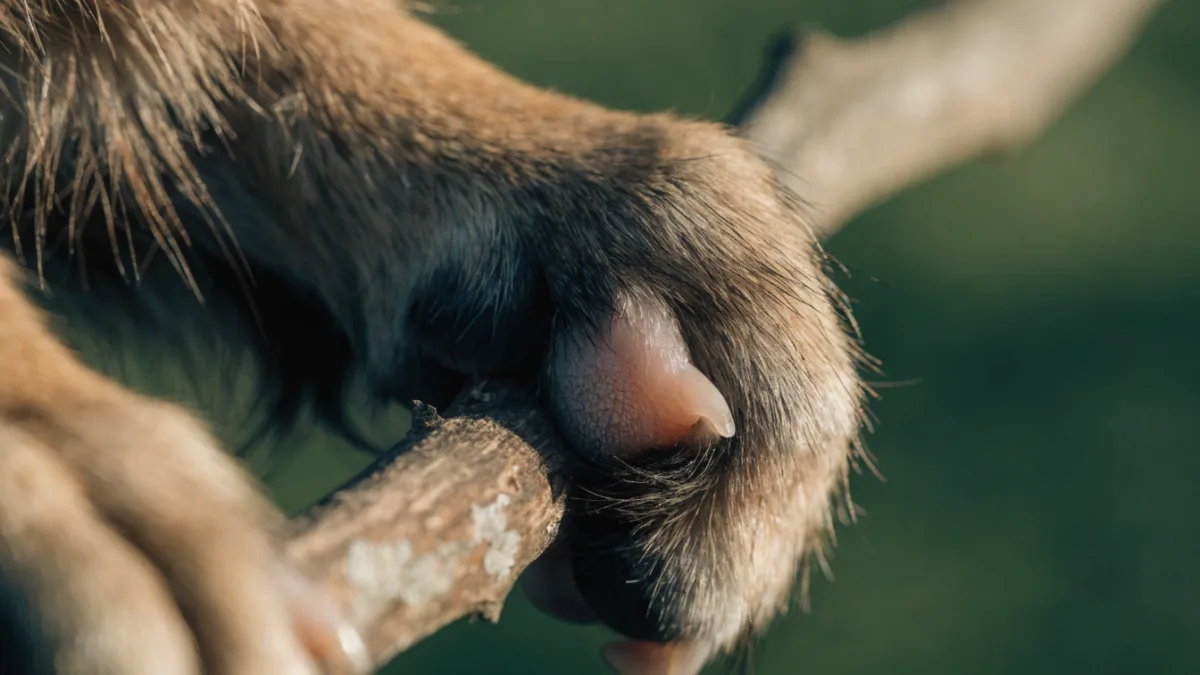
To understand the debate, we first have to look under the hood. If you’ve ever looked at your dog’s front paws, the dewclaw is the “thumb” sitting a few inches up the inside of the leg. Many people assume it’s just a nail dangling from a flap of skin, but that’s often not the case at all.
Front dewclaws are actually fully formed digits. They have their own set of phalanges, which are the bone segments that make up toes. More importantly, in most dogs, these bones are firmly attached to the leg by a network of tendons and ligaments.
I remember examining a three-year-old Labrador named Bella who had torn her front dewclaw while playing fetch. When we took her radiographs (X-rays) to assess the damage before surgery, the images were striking. You could clearly see strong, thick bands of connective tissue anchoring that little toe directly to the bones of her lower leg. It wasn’t an afterthought; it was woven into her anatomy. When Bella eventually healed, we actually saw a noticeable change in how she distributed her weight, proving just how much she relied on that digit to keep her wrist—technically known as the carpal joint—stable.
Front vs. Hind: Knowing the Difference
It’s crucial to make a distinction between front and hind dewclaws. While front dewclaws are typically bony and well-connected, hind dewclaws are often a completely different story. In many breeds, the hind dewclaws really are floppy, lacking any bony attachment to the leg. These are the true vestigial digits, and because they dangle freely, they are at a much higher risk of catching on brush or fabric and tearing.
If a dog is born with loose, unattached hind dewclaws, removal is often a reasonable conversation to have with your veterinarian. But lumping the functional front dewclaws in with the floppy hind ones is a mistake that has led to a lot of unnecessary amputations.
The Mechanics of Movement: Why Dogs Need Their “Thumbs”
If you want to see exactly why a dog needs their front dewclaws, watch a slow-motion video of an agility dog navigating a weave pole, or a hunting dog cutting sharply through a field.
When a dog runs at high speeds and makes a sudden turn, their legs fan out to the side to act as brakes and stabilizers. As the leg extends, the dewclaw makes contact with the ground. It essentially digs into the turf, acting like a cleat to provide traction and preventing the leg from twisting outward. This twisting force is absorbed by the dewclaw and its attached tendons, which in turn stabilizes the carpal joint.
I used to be in the camp that thought removing front dewclaws prevented injuries. I’ve completely changed my mind on this. By removing the dewclaw, we are essentially removing a shock absorber and a structural support beam. Over time, biomechanics experts and sports veterinarians have found that dogs missing their front dewclaws are far more prone to compensatory injuries. Without that digit to stabilize the wrist, the joint takes on undue stress, which frequently leads to degenerative joint disease, arthritis, and even injuries to the wrist ligaments down the road.
Everyday Utility
You don’t have to be a competitive athlete to need your dewclaws, either. Your average house dog uses them every single day. Try giving your dog a durable chew toy or a raw marrow bone. Notice how they pin it down with their front paws? That’s the dewclaw doing the heavy lifting, acting as a makeshift thumb to grip the object. I’ve even seen dogs use their dewclaws to carefully extract a piece of stuck food from their teeth or scratch an itch on their muzzle with surgical precision. Without them, everyday grooming and handling of objects becomes noticeably more clumsy.
The Surgical Reality of Dewclaw Removal
One of the biggest hurdles in this debate is the misconception that removing a dewclaw is the same thing as trimming a nail. I’ve had owners casually ask me to “just clip it off” during a routine visit, thinking it’s a simple, painless procedure. It isn’t.
Whether it’s done on a squirming three-day-old puppy or an adult dog under general anesthesia, dewclaw removal is an amputation. The procedure involves cutting through skin, severing nerves, and sawing or clipping through bone. In neonatal puppies, this is often done without anesthesia or pain control—a practice that we now know causes significant, documented pain, even if the puppies are too young to vocalize it clearly.
When done in an adult dog like a five-year-old Mastiff named Caesar who came to me after repeatedly snagging his loose hind dewclaws, it requires full general anesthesia, surgical cutting, and weeks of bandaging and restricted activity to heal. There is always a risk of infection, excessive bleeding, and regrowth of a nail fragment if a tiny piece of the nail bed is left behind.
The medical risks of the surgery—pain, infection, and potential nerve damage—simply don’t outweigh the theoretical benefit of “preventing” a future snag, especially for the functional front dewclaws.
What to Do if a Dewclaw Gets Torn
Naturally, accidents happen. Even well-attached dewclaws can get caught on something and tear. When this happens, the bleeding can look alarming because the nail bed is full of blood vessels.
Owners often want to immediately pull the torn piece off or pack the foot into a thick paste of homemade herbal remedies they found online. While I understand the urge to use soothing home remedies, a torn dewclaw is a medical issue that needs proper veterinary attention. The quick is highly sensitive, and a torn nail exposes the underlying bone to infection. If a piece is dangling, gently wrapping the paw with a clean bandage to control the bleeding and bringing your dog to the clinic is the best course of action. We can safely trim the loose piece, clean the wound thoroughly, and bandage it to allow healthy regrowth.
A Shifting Paradigm in Animal Welfare
So, where do we stand today? The consensus is rapidly shifting, and for good reason. The American Veterinary Medical Association (AVMA) has officially opposed the routine, cosmetic removal of dewclaws. Major veterinary organizations now state that these surgeries should only be performed if the digit is severely injured, diseased, or poses a constant, unavoidable trauma risk due to a severe deformity.
This isn’t just a veterinary opinion anymore; it’s becoming the law. Across much of Europe, the UK, and parts of Australia and Canada, the non-medical removal of dewclaws has been banned entirely. Several states in the US are currently considering similar legislation to phase out cosmetic animal procedures.
Even the dog show world is evolving. Prominent kennel clubs and canine sporting organizations are actively updating their breed standards to accept, and in some cases actively encourage, dogs with their natural dewclaws intact. [1] and [2] have long argued that performance and health should trump traditional aesthetic preferences, and the data backs them up. A [3] confirms that these functional digits play a vital role in a dog’s musculoskeletal health.
Ultimately, the dewclaw debate highlights a beautiful shift in how we view our pets. We are moving away from modifying animals to fit our aesthetic preferences, and moving toward respecting and preserving their natural biology. When we leave those little “thumbs” intact, we aren’t just preventing unnecessary surgical pain; we are allowing our dogs to run, turn, grip, and play exactly how nature intended.
Sources
- Leading canine experts — facebook.com
- working dog associations — ducks.org
- closer look at the anatomy — en.wikipedia.org