

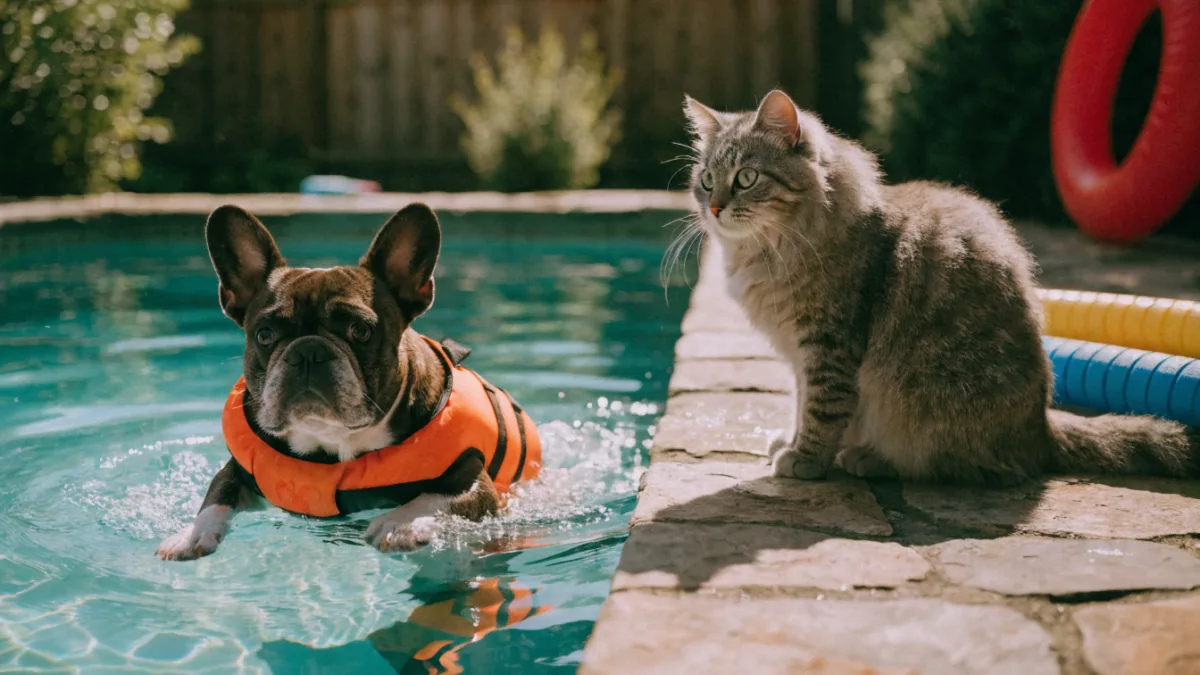
Picture a summer afternoon: a family rushes into a clinic with a six-year-old French Bulldog named Gus. They’d been at a friend’s backyard pool party, and someone had gently placed Gus on the top step to “let him figure it out.” Within seconds, he was underwater. The owner’s husband jumped in fully clothed and pulled him out, coughing but alive. “I thought all dogs could swim,” she said, still shaking. “Isn’t there a whole stroke named after them?”
It’s one of the most common assumptions I encounter. And like a lot of widely held beliefs about animals, it contains a kernel of truth wrapped in dangerous oversimplification. Let’s unpack what’s really going on with our pets and water — because understanding the difference between instinct and ability might save your animal’s life.
The Dog Paddle Myth: Instinct Doesn’t Equal Safety
Yes, the “dog paddle” is a real, instinctual reflex. When you place most dogs in water, their limbs will begin making paddling motions automatically — it’s a locomotor pattern that doesn’t need to be taught. But here’s what that reflex doesn’t guarantee: buoyancy, efficient breathing, or the ability to find an exit. Instinct initiates the movement; it doesn’t make the movement effective or sustainable.
Built to Swim vs. Built to Sink
Dog breeds fall along a spectrum when it comes to physical suitability for water. Water retrievers — Labrador Retrievers, Golden Retrievers, Portuguese Water Dogs, Standard Poodles, Irish Water Spaniels — were literally shaped by centuries of selective breeding to work in water. They typically have water-resistant double coats, webbed toes that act like paddles, and a body proportion that keeps their nose above water when they’re horizontal.
On the other end of the spectrum, you have what I think of as the “engineered for land” crew. Bulldogs, Pugs, French Bulldogs — these are brachycephalic breeds, meaning they have shortened skulls and flat faces. Their airway anatomy is already compromised on dry land; in water, they struggle to keep their nose above the surface while simultaneously fighting to breathe through narrowed nostrils and an elongated soft palate. Add a heavy, barrel-shaped chest that acts like a weight pulling them downward, and you have an animal who can sink surprisingly fast.
Dachshunds and Basset Hounds face a different mechanical problem: short legs paired with long, heavy bodies. They simply can’t generate enough upward thrust to keep their bodies horizontal in the water. They tire quickly, and fatigue is the precursor to drowning in any species.
I always tell owners: if your dog falls into the “built to sink” category, that’s not a personal failing or something to train them out of. It’s physics. Respect the physics.
The “Sink or Swim” Fallacy
There’s still a surprisingly persistent idea in some circles that the best way to introduce a dog to water is to toss them in and “let instinct take over.” I’ve changed my mind on this over the years — early in my career, I might have been more casual about it, figuring dogs would figure it out. What research and clinical experience have shown me is that panic is the real killer here.
When a dog enters water unexpectedly or fearfully, their heart rate spikes, they thrash inefficiently, and they swallow water. That aspirated water can cause what we call secondary drowning or non-cardiogenic pulmonary edema — fluid accumulation in the lungs that can become life-threatening hours after the incident, even if the dog seemed fine initially. Gus, the French Bulldog I mentioned? We kept him on oxygen overnight even though he was breathing normally within an hour of arrival, because I’d seen this delayed presentation too many times to take chances.
Instead, introduce water gradually. Walk into shallow water with your dog on a leash. Let them choose to go deeper. Reward calm behavior. And invest in a properly fitted canine life jacket with a handle on the back and flotation that supports the chest and hindquarters — not just a cute novelty version.
Cats and Water: Why Most Felines Opt Out
The statistic that gets thrown around — that roughly 99% of cats strongly dislike water — lines up with what I see clinically, though I’d frame it slightly differently. Most cats aren’t “afraid” of water in a phobic sense; they simply have no evolutionary or practical reason to engage with it, and several excellent reasons to avoid it.
The Evolutionary Explanation
Domestic cats descended from Near Eastern wildcats — desert-dwelling animals who evolved in arid environments where large bodies of water were rare and offered no survival advantage. Unlike dogs, who were selectively bred for tasks like retrieving ducks from marshes, cats were valued for pest control in granaries and homes. Nobody was breeding a cat to jump into a cold lake.
There’s also a physical reality: a cat’s fur isn’t designed to handle saturation. When a cat gets thoroughly wet, their coat becomes heavy and loses its insulating properties. For an animal whose thermoregulation depends heavily on that fur coat, this is genuinely uncomfortable and potentially dangerous in cool conditions. And unlike dogs, cats don’t shake off water effectively — they lack the loose-skin shake response that helps dogs shed moisture rapidly.
The Exception: Water-Loving Breeds
Here’s where it gets interesting. Certain cat breeds do genuinely seem to enjoy water, and it’s not random. Maine Coons, one of the oldest natural breeds in North America, developed in the harsh, wet climate of New England and have a semi-water-resistant coat that sets them apart from most domestic shorthairs. Turkish Vans are sometimes called “swimming cats” — they originated near Lake Van in Turkey and have a cashmere-like coat that handles moisture differently. Bengals, with their wild Asian Leopard Cat ancestry, often retain an attraction to running water that their owners find either charming or infuriating, depending on how many times the cat has turned on the bathroom faucet.
I had a client once — a Bengal named Suki — who would join her owner in the shower every morning. Not sitting on the edge watching, but actually walking through the water stream. The owner asked me if this was normal. For a Bengal? Absolutely. For most cats? That’s a different conversation.
Should You Bathe Your Cat?
Unless your veterinarian has recommended it for a medical reason — a skin condition requiring medicated shampoo, a flea infestation, or exposure to a toxic substance — most cats don’t need baths. They’re fastidious self-groomers, and their rough, barbed tongues are remarkably effective cleaning tools. Forcible bathing of a water-averse cat causes significant stress, and the stress can trigger physiological responses: elevated cortisol, gastrointestinal upset, even urinary issues in prone individuals.
That said, if you do need to bathe your cat, there are ways to make it less traumatic. Use warm, not hot, water. Keep the water level shallow — just enough to wet the feet. Pour water gently over the body rather than using a loud spray nozzle. And always have a warm towel ready for immediate wrapping afterward.
Reading the Water: What’s Safe and What Isn’t
One of the most frequent questions I get is whether it’s safer to let a dog swim in a chlorinated pool or a natural body of water. The honest answer is: they carry different risks, and neither is risk-free.
Pools and Treated Water
Properly maintained pools with appropriate chemical levels are generally safe for short swimming sessions. The problems arise when dogs drink pool water — chlorinated water can cause gastrointestinal upset, and in larger quantities, the sodium and chemical additives can lead to more serious issues. I advise owners to provide plenty of fresh water nearby and actively encourage their dog to drink from that source instead.
Pool chemicals can also irritate a dog’s eyes and ears. Dogs who swim frequently in pools are prone to otitis externa — inflammation of the outer ear canal — because moisture trapped in the L-shaped ear canal creates an ideal environment for bacterial and yeast overgrowth. Dogs with heavy, floppy ears (think Cocker Spaniels and Golden Retrievers) are particularly susceptible.
If your dog swims in a pool, make rinsing afterward a non-negotiable part of the routine. Plain fresh water, thoroughly worked through the coat and especially around the ears, will remove chemical residue that can cause skin irritation over time.
Lakes, Ponds, and Natural Water
Natural bodies of water avoid the chemical concerns but introduce biological ones. Leptospirosis, a bacterial disease spread through the urine of infected wildlife, thrives in warm, slow-moving water. It can cause kidney and liver failure in dogs, and it’s zoonotic — meaning humans can catch it too. I strongly recommend the leptospirosis vaccine for dogs who regularly swim in lakes, ponds, or rivers. Talk to your vet about whether it’s appropriate for your dog’s lifestyle and local risk factors.
Giardia and Cryptosporidium are parasitic organisms commonly found in natural water sources that can cause persistent diarrhea in both dogs and humans. And in recent years, we’ve seen a troubling increase in toxic blue-green algae blooms — cyanobacteria that produce potent liver and neurotoxins. These blooms are becoming more frequent as water temperatures rise, and they can be fatal within hours of exposure. If you see algae that looks like green paint or pea soup on the surface of a lake or pond, keep your dog out entirely. No amount of rinsing or activated charcoal can reverse the damage those toxins do once they’re absorbed.
Beaches and Oceans
Salt water poses its own risks. Dogs who swallow significant amounts of seawater can develop hypernatremia — dangerously elevated blood sodium levels that cause neurological symptoms ranging from vomiting and diarrhea to seizures. Bring fresh water to the beach and offer it frequently. Rip currents affect dogs just as they affect humans, and not every dog instinctively swims parallel to shore to escape one.
And yes, some dogs eat sand. It sounds improbable until you’ve seen it — usually happens when they’re digging or fetching sandy toys. Sand can cause intestinal impaction that requires surgical intervention. I’ve removed more than my share of sand from dog intestines over the years.
Practical Safety: What Actually Works
Setting the alarming headlines aside, here’s what actually makes a difference in practice:
- Invest in a quality life jacket. Look for one with bright colors for visibility, a chin float to keep the head above water, a top handle for emergency lifting, and adjustable straps that fit snugly without restricting breathing. This applies to cats too — yes, they make feline life jackets, and yes, they can save lives if you’re traveling by boat or near water with a cat.
- Teach pool exits. If you have a pool, spend time training your dog to find and use the steps or ramp. Practice this in calm conditions until it’s automatic. Panic impairs memory, so the exit needs to be muscle memory before it’s ever needed in an emergency.
- Rinse every time. After any water exposure — pool, lake, or ocean — rinse your pet thoroughly with fresh water. This removes chemicals, bacteria, salt, and debris that can cause skin irritation, ear infections, or be ingested during grooming.
- Dry the ears. Use a clean, soft cloth or a veterinarian-recommended ear drying solution after swimming to help prevent infections.
- Know the water before you let them in. Check local advisories for algae blooms or bacterial contamination. If the water looks or smells off, choose another activity that day.
- Never leave pets unattended near water. This seems obvious, but too many near-drownings happen in the three minutes an owner steps inside to grab a towel.
A Note on Shared Waters and Wildlife
One final consideration that often gets overlooked: when we bring our pets into natural water environments, we’re bringing them into ecosystems that belong to other species. Dogs splashing through a shallow creek can disturb spawning fish, damage amphibian habitat, or disrupt nesting water birds. Some beaches and wetland areas have seasonal restrictions specifically to protect breeding wildlife — and those rules apply to pets too, even the well-behaved ones.
I think about this differently than I used to. Early in my career, my focus was entirely on the animal in front of me — keep the dog safe, treat the cat, send them home healthy. But the more time I spend in the field, the more I realize that responsible pet ownership includes being a responsible visitor to the wild spaces our animals love to explore. Keeping your dog leashed near sensitive shorelines, respecting wildlife closures, and preventing your pet from chasing aquatic birds isn’t just good citizenship — it’s part of the same ethic of care that makes you the kind of person who reads articles like this one.
Water can be one of the great joys of life with an animal. I’ve watched retrievers throw themselves into cold lakes with an abandon that’s genuinely moving to witness. I’ve seen a Maine Coon cat paddle contentedly across a backyard kiddie pool while her owner filmed in disbelief. The goal isn’t to make water frightening — it’s to make water engagement informed. Know your animal. Know your water. And when in doubt, choose caution over assumption. The life you’re protecting is worth the extra moment of consideration.