

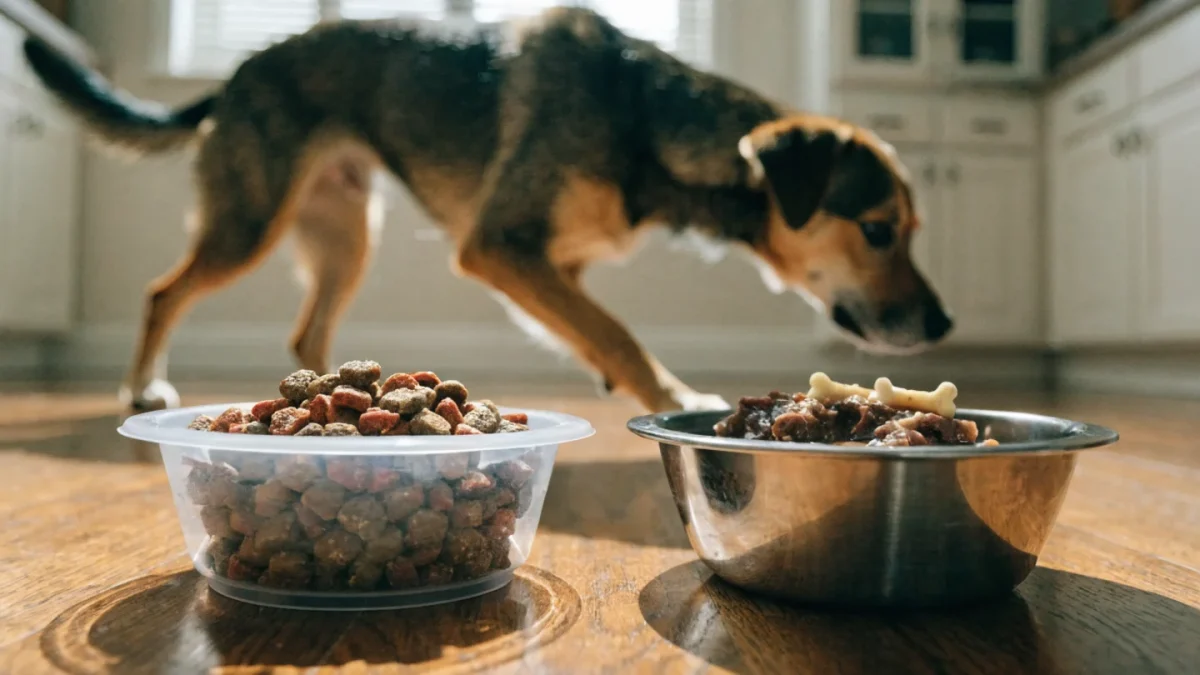
A breeder I know — runs a small kennel of working Weimaraners — once told me she'd never feed wet food because it would "ruin their teeth and make them expect something too good." I hear that kind of strong opinion a lot in both directions. Kibble people are suspicious of wet food; wet food advocates think kibble is essentially junk.
The truth is considerably less dramatic than either camp suggests.
What's Actually in Each Type
Dry kibble and wet food start with similar ingredients in many cases — protein sources, carbohydrates, fats, vitamins, minerals — but the processing methods and moisture levels are completely different, and those differences have real nutritional implications.
Dry kibble is made by extrusion: ingredients are mixed, cooked under high heat and pressure, extruded through a die, and dried. Moisture content typically lands around 8-10%. The heat involved in extrusion degrades some heat-sensitive nutrients — vitamins A, D, E, and several B vitamins are most affected — so manufacturers add vitamins and minerals back afterward, typically sprayed onto the finished kibble before packaging. This is standard and largely effective, though it adds synthetic rather than intact food-form nutrients. Kibble is calorie-dense: a given volume of kibble contains significantly more calories than the same volume of wet food. This makes portion accuracy crucial — measuring by weight rather than cup is worth doing if your dog has any tendency toward weight gain.
Wet food (canned or pouched) has moisture content around 75-85%. The protein profile is often similar to kibble from the same manufacturer, but the calorie density is much lower. A 400g can of wet food might have roughly the same calories as 100-120g of dry kibble. The higher moisture content more closely mirrors what dogs would naturally consume through prey-based eating — this matters more for some dogs than others.
Where They Differ Meaningfully
Hydration. Dogs regulate water intake relatively well compared to cats, but wet food still contributes significantly to total daily water intake. For dogs with a history of kidney issues, urinary crystals, or bladder stones, the hydration benefit of wet food is clinically meaningful — dilute urine reduces the saturation of stone-forming minerals, and wet food is the most practical dietary tool for achieving that dilution in dogs. It's not just about palatability.
Palatability. Wet food almost universally wins here. The smell, texture, and fat content make it more appealing to most dogs. This matters for picky eaters, sick dogs who need appetite encouragement, senior dogs with reduced smell or taste, and dogs on medications that need to be disguised.
Dental health. Kibble has a mild abrasive effect that helps reduce plaque on some teeth. This is real but often overstated — kibble is not a substitute for dental hygiene, and plenty of kibble-fed dogs have significant periodontal disease. Wet food doesn't provide this mechanical benefit, but it also doesn't cause dental disease on its own. The dental argument for kibble is valid but shouldn't be the primary factor in feeding decisions for most healthy dogs.
Cost. Feeding wet food exclusively is typically two to four times more expensive than a comparable-quality dry food, on a calorie-for-calorie basis. This is a real constraint for many owners, especially those with large dogs. Mixing a smaller amount of wet food into kibble as a topper is one way to capture some palatability and hydration benefits at lower cost — more on mixing wet and dry food for dogs in that dedicated piece.
Convenience. Kibble wins clearly. Shelf-stable, no refrigeration, easy to measure, appropriate for puzzle feeders and slow bowls. Opened canned food needs refrigeration and should be used within 48 hours.
For Specific Dog Situations
Some dogs do better on one format than the other:
Dogs with chronic kidney disease benefit from increased moisture intake — wet food or at minimum adding water to kibble. Dogs with a history of urinary stones: same argument.
Dogs who struggle to eat due to dental pain, jaw problems, or reduced sense of smell often do much better on wet food.
Overweight dogs: wet food's lower calorie density can help with satiety and portion management, though you'll need to calculate actual calories, not just serving size.
Working and high-activity dogs: kibble's calorie density is an advantage — smaller volume of food for the same energy load.
Senior dogs: often benefit from wet food's palatability and moisture, especially when appetite starts declining with age.
Puppies of large breeds: kibble formulated for large-breed puppies with controlled calcium and calorie density has specific value here. The wet food equivalent is harder to find in appropriately formulated large-breed puppy versions.
My Actual Opinion
I feed my own dogs a mix of kibble and wet food. The kibble forms the base because it's practical, cost-effective, and nutritionally complete. The wet food gets added as a topper a few times a week because they prefer it, it adds moisture, and there's no meaningful downside to it.
I get mildly frustrated when people turn food format into an identity. The quality of the specific product matters more than whether it's wet or dry. A cheap kibble full of corn syrup and artificial preservatives is not automatically made healthier by its format; a well-formulated wet food with appropriate nutrients isn't made less valuable because it comes in a can.
How this compares to how kibble and wet food compare to other pet food types like raw and fresh-cooked is a broader question worth reading if you're evaluating the whole spectrum.
FAQ
Can I switch my dog from dry to wet food abruptly?
You can, though a gradual transition over five to seven days is gentler on the digestive system and helps avoid the loose stools that sometimes come with sudden dietary changes. Some dogs transition without any GI issues; others are more sensitive. Either way, a slow transition is a good habit.
Does wet food cause diarrhea in dogs?
For some dogs, particularly those accustomed to kibble, switching to or adding wet food causes loose stools initially. This usually resolves within a week as the gut adjusts. The higher moisture content and different fat profile are the typical culprits. If diarrhea persists beyond ten days, that's worth investigating — the food may genuinely not suit that particular dog, or there may be another issue.
Is the protein in wet food better than in kibble?
Not necessarily better — but often less processed. The proteins in wet food haven't been subjected to the high-temperature extrusion process — research confirms that extrusion can reduce digestibility of heat-sensitive amino acids like lysine and cysteine, and freeze-dried and raw foods consistently show higher amino acid digestibility than extruded foods. Whether this translates to meaningful nutritional differences in practice for a healthy dog eating a well-formulated kibble is genuinely debated among researchers. Both formats can provide excellent protein nutrition when properly formulated.
My dog will only eat wet food now and won't touch kibble. What should I do?
A dog who prefers wet food and won't eat kibble isn't in nutritional danger if the wet food is a complete and balanced formula. But if cost or convenience is a concern, you can usually retrain a dog to accept kibble by transitioning gradually — start with a small amount of wet mixed with kibble, and shift the ratio over two to three weeks. Some dogs hold out stubbornly; if after a month they still won't touch kibble, feeding a complete wet diet is a reasonable long-term approach.