

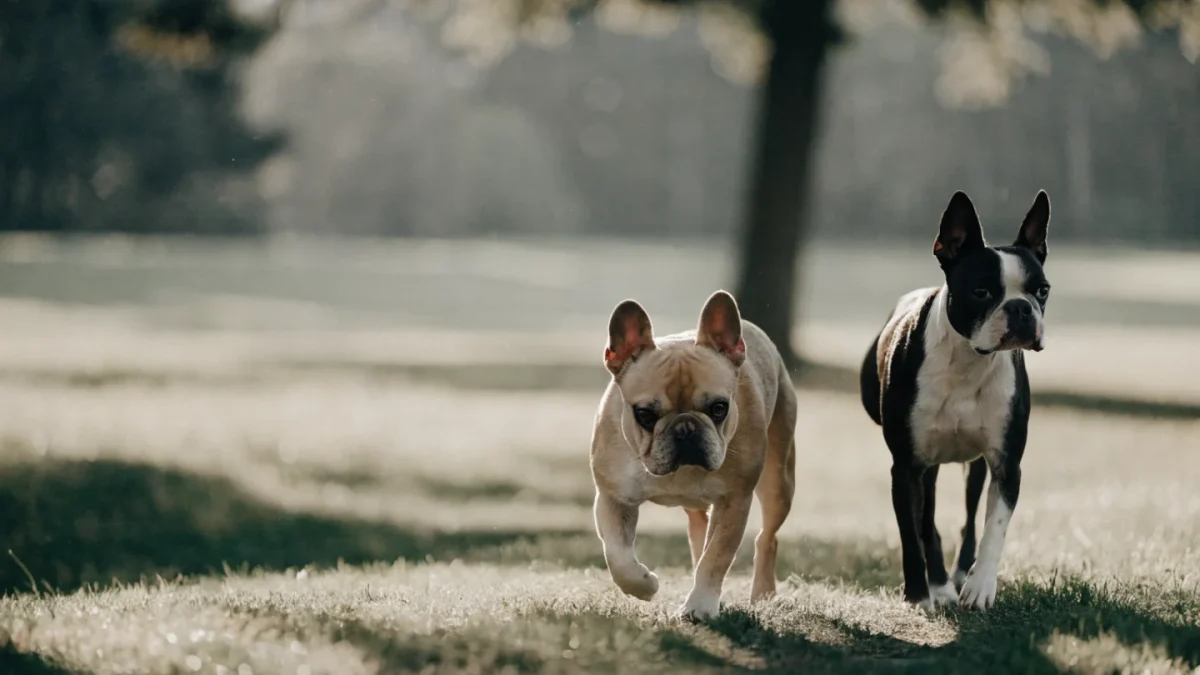
People mix these two up constantly, and I understand why. Both are small, flat-faced, bat-eared companion dogs with big personalities and bigger snoring problems. But the French Bulldog and Boston Terrier have different origins, different builds, different energy levels, and — critically — different health profiles that should influence your decision.
The Frenchie descends from miniaturized English Bulldogs brought to France by lace workers during the 1860s Industrial Revolution. The Boston Terrier was developed in Boston, Massachusetts, around 1870 from crosses between English Bulldogs and English White Terriers. Similar foundation stock, divergent paths. For the full framework on how to compare breeds, see the breed comparisons guide.
Size and Build
| Trait | French Bulldog | Boston Terrier |
|---|---|---|
| Height | 28–33 cm | 38–43 cm |
| Weight | 8–13 kg | 5–11 kg |
| Build | Compact, heavy-boned, wide chest | Lean, square, lighter-boned |
| Ear shape | Large, rounded ("bat ears") | Pointed, erect |
The Boston is taller and leaner — visibly more athletic. The Frenchie is built lower and heavier for its height, with a wider chest and more pronounced muscular shoulders. Pick them up and the difference is unmistakable: the Frenchie is dense.
Temperament
Frenchies are calm, stubborn, and affectionate. They bond intensely with their owners and are content to sit beside you for hours. They can be independent thinkers — "selective hearing" is a Frenchie trademark.
Bostons are higher-energy, more playful, and more eager to engage. The terrier heritage shows: they're quicker, more alert, and more responsive to interaction. Bostons are sometimes called "The American Gentleman" for their tuxedo markings and generally polite disposition, but they can be goofy and clownish in ways the more stoic Frenchie usually isn't.
Both breeds can be territorial about their owners and vocal when they want attention, though neither is a heavy barker compared to true terrier breeds.
Health — The Hard Truth
Both breeds are brachycephalic, meaning their skulls are shortened, compressing the airway and creating structural breathing difficulties. But the severity differs.
French Bulldogs tend toward more extreme brachycephaly. Brachycephalic obstructive airway syndrome (BOAS) is widespread in the breed, and many Frenchies require surgical intervention (soft palate resection, stenotic nares correction) to breathe adequately. They overheat rapidly and struggle with any sustained physical exertion. Spinal issues — particularly intervertebral disc disease linked to their compact, screw-tailed body structure — are also common.
Boston Terriers are brachycephalic too, but their longer muzzle (relative to the Frenchie) generally allows somewhat better airflow. They still face respiratory limitations, but severe BOAS requiring surgery is less common. Bostons are more prone to eye injuries (those prominent eyes) and patellar luxation (slipping kneecaps).
| Health Factor | French Bulldog | Boston Terrier |
|---|---|---|
| BOAS severity | Often severe | Moderate |
| Spinal issues | Common (IVDD) | Less common |
| Eye problems | Cherry eye, corneal ulcers | Corneal ulcers, cataracts |
| Lifespan | 10–12 years | 11–13 years |
| Heat tolerance | Very poor | Poor |
Neither breed handles heat well. Air-conditioned living is not optional — it's a medical requirement in warm climates.
Exercise
Frenchies need 30 to 45 minutes of moderate daily activity. Short walks, gentle play sessions, indoor games. They overheat quickly and should never be exercised in warm or humid conditions.
Bostons can handle more — 45 to 60 minutes of moderate activity, with some Bostons enjoying brief bursts of higher-intensity play. They're more athletic than their flat face suggests, though they still need heat precautions.
Grooming
Both are low-maintenance on grooming. Short, smooth coats that need weekly brushing. Both shed moderately. The Frenchie's facial wrinkles need regular cleaning to prevent moisture-trapped skin infections — a step Boston owners can largely skip, as the Boston's face has fewer deep folds.
Which Fits Your Life?
Choose the French Bulldog if you want a calm, low-energy companion who's happy being a couch potato, and you're prepared for the veterinary costs that come with extreme brachycephaly. Budget accordingly — Frenchies are among the most expensive breeds to insure and treat.
Choose the Boston Terrier if you want a slightly more active flat-faced companion with a playful terrier streak and somewhat fewer respiratory extremes. Bostons still need brachycephalic-aware care, but they can generally do more physically.
If you're also considering the Pug in this category, the Pug vs French Bulldog comparison covers that pairing. For a dedicated look at the Boston's full history and health profile, see the Boston Terrier complete breed guide. For an in-depth look at the French Bulldog's history, respiratory anatomy, and ownership costs, the French Bulldog complete breed guide covers the breed fully.