

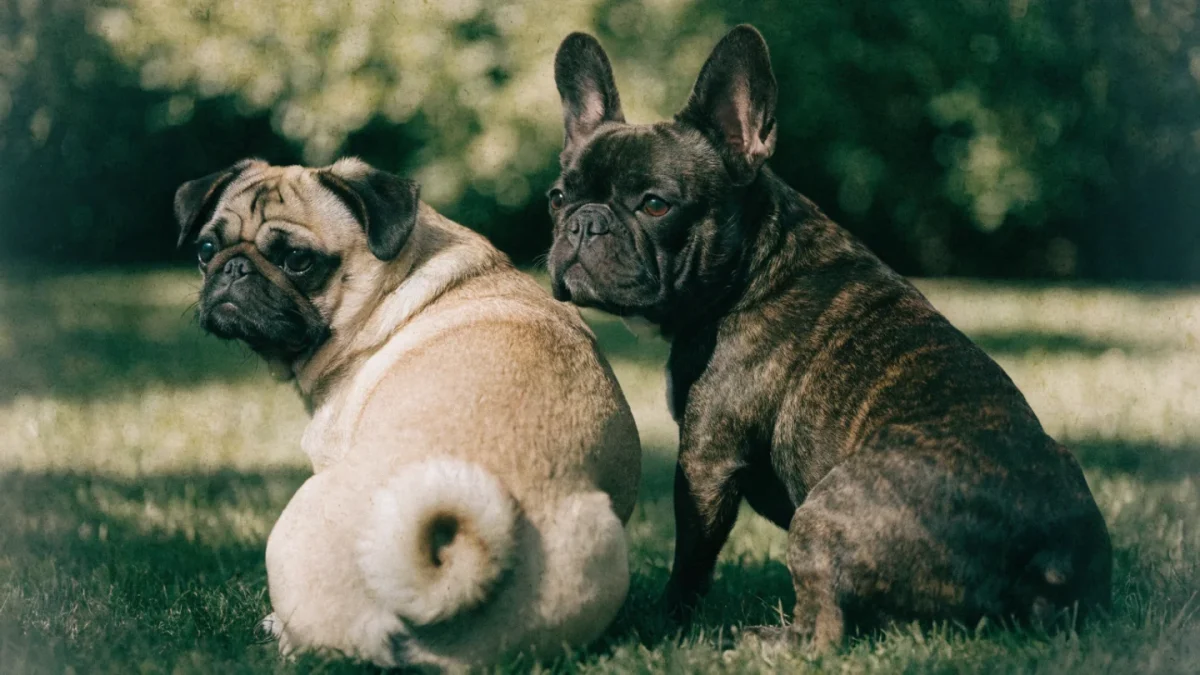
The Pug has been a companion dog for at least 2,000 years — Chinese imperial records document small flat-faced dogs matching the Pug's description as far back as the Han Dynasty (206 BCE to 220 CE). The French Bulldog didn't exist until the 1860s. That difference in history shows up in their temperaments: the Pug has millennia of breeding for pure companionship, while the Frenchie retains traces of its Bulldog ancestry's stubbornness and physical confidence.
Both breeds sit squarely in the brachycephalic companion category, and both face serious health considerations tied to their skull structure. Here's how they compare across the factors that matter. For the full framework, see the breed comparisons guide.
Size and Build
| Trait | Pug | French Bulldog |
|---|---|---|
| Height | 25–33 cm | 28–33 cm |
| Weight | 6–8 kg | 8–13 kg |
| Build | Compact, round, cobby | Compact, muscular, heavy-boned |
| Tail | Tightly curled | Short, stumpy (screw tail or straight) |
The Frenchie is the bigger dog — sometimes nearly double the Pug's weight. Where the Pug is round and soft in outline, the Frenchie is muscular and broad through the shoulders and chest. You feel the difference when you pick them up: the Frenchie is surprisingly dense and heavy for its size.
Temperament
Pugs are social butterflies. They love everyone — family, strangers, other dogs, cats, the mail carrier. Their entire purpose for two millennia has been to charm humans, and they're exceptionally good at it. Pugs are also clowns. They do ridiculous things for attention and seem fully aware of the comedic effect.
French Bulldogs are more reserved. They bond deeply with their owner but aren't as indiscriminately social. Frenchies have a stubborn, independent streak that Pugs mostly lack. A Pug wants to please you. A Frenchie wants to decide whether pleasing you is worth the effort.
Both breeds are prone to separation anxiety — neither does well left alone for long periods.
Grooming and Shedding
Here's a surprise that catches many people: Pugs shed significantly more than French Bulldogs. The Pug has a dense double coat that sheds constantly and heavily. Frenchies have a single, smooth coat with moderate shedding. If fur on furniture bothers you, the Frenchie is the better choice on this factor alone.
Both breeds need regular facial wrinkle cleaning. The Pug's deeper facial folds trap more moisture and debris, making skin fold dermatitis more common if cleaning is neglected.
Health
Both breeds are brachycephalic, and both pay a price for it. But the specifics differ.
| Health Factor | Pug | French Bulldog |
|---|---|---|
| BOAS severity | Moderate to severe | Often severe |
| Spinal issues | Pug dog encephalitis (PDE), hemivertebrae | IVDD, hemivertebrae |
| Eye problems | Proptosis, corneal ulcers, dry eye | Cherry eye, corneal ulcers |
| Skin issues | Skin fold dermatitis | Skin fold dermatitis, allergies |
| Lifespan | 12–15 years | 10–12 years |
| Obesity risk | Very high | High |
The Pug has a longer average lifespan, but Pug Dog Encephalitis — an inflammatory brain disease specific to the breed — is fatal when it occurs. The Frenchie's shorter lifespan reflects its higher incidence of severe respiratory compromise and spinal problems related to its screw-tail vertebral structure.
Neither breed tolerates heat. Air conditioning is mandatory in warm climates. Neither breed can swim safely — the Frenchie's top-heavy build makes drowning a real risk, and Pugs lack the endurance and muzzle length for sustained swimming.
Exercise
Pugs need 30 to 45 minutes of daily activity — moderate walks and play sessions. They're slightly more active than Frenchies on average, partly because they're lighter and slightly less respiratory-compromised (though still limited).
Frenchies need 30 to 45 minutes as well but tire faster and overheat more easily. Short walks with rest breaks work better than sustained activity.
Both breeds gain weight rapidly if overfed and under-exercised. Portion control is critical for both.
Which Fits Your Life?
Choose the Pug if you want a gregarious, social companion that's good with everyone, and you can handle the shedding. Pugs are the easier of the two breeds to integrate into multi-pet, multi-person households. Their longer average lifespan is a genuine advantage.
Choose the French Bulldog if you want a slightly more independent, calmer companion with less shedding, and you're prepared for the veterinary costs associated with more extreme brachycephalic anatomy. Be honest about budget — Frenchies are expensive to care for medically.
If you're comparing the Frenchie against the Boston Terrier instead, that comparison is here. For an encyclopedic look at the Pug's 2,000-year history and full health profile, see the Pug complete breed guide. For a full profile of the French Bulldog covering its respiratory anatomy, spinal risks, and ownership costs, the French Bulldog complete breed guide covers the breed in depth.