

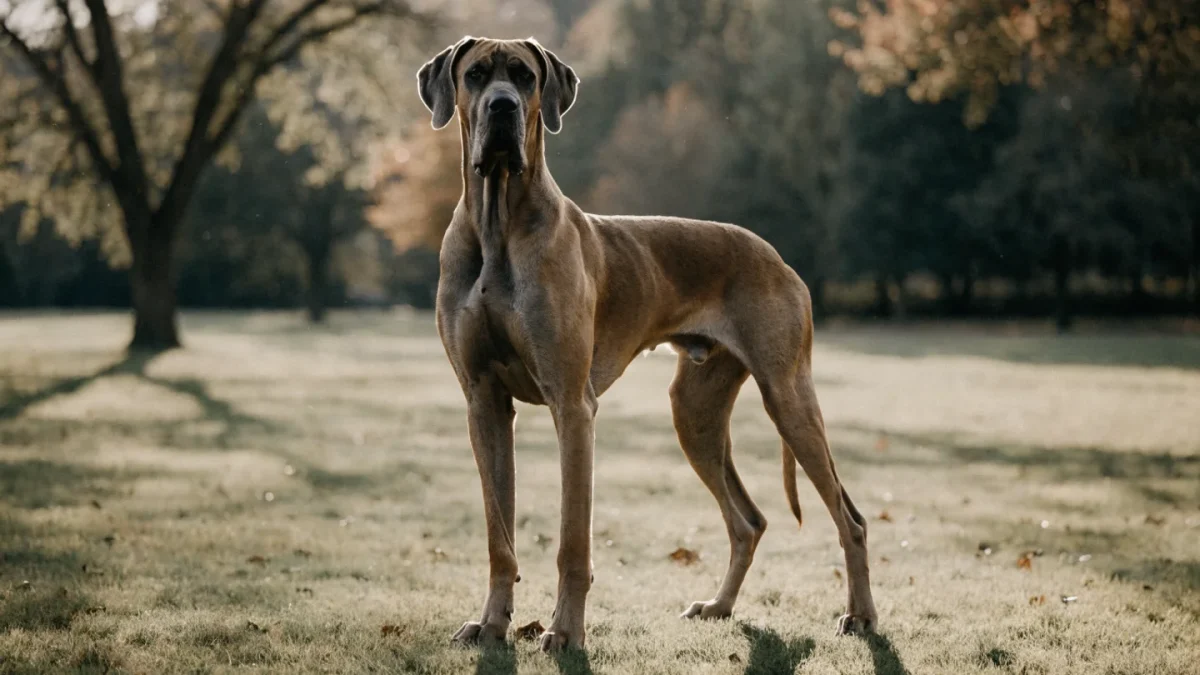
Romeo was a seven-month-old Saint Bernard who came in for his neuter consult looking, as his owner put it, "like a small horse." He'd tripled his weight since his eight-week vaccines. The owner was delighted — joking about the food bill, taking photos. After the exam I sat down with her and we talked about what the next ten years might actually look like. Bloat. Joint disease. Bone cancer. A lifespan that, for his breed, would likely run eight years if they were lucky.
She hadn't been prepared for that conversation. Most giant breed owners aren't. Giant breed dogs — Great Danes, Mastiffs, Saint Bernards, Irish Wolfhounds, Newfoundlands, and others over 90–100 pounds — give you fewer years, and those years carry more medical complexity than most owners expect. Average lifespans range from 6 to 10 years. Honest care starts with honest expectations.
The Growth Problem
A Great Dane puppy gains roughly 100 pounds in its first year. Think about what that means for developing bones, joints, and growth plates. The speed of that growth creates a window of extreme vulnerability — overfeeding, over-exercising, or providing the wrong calcium-to-phosphorus ratio during this period can cause permanent orthopedic damage.
I've seen owners — well-meaning, loving owners — feeding their giant breed puppy adult dog food, or worse, supplementing with extra calcium because they assumed bigger dogs need more. Too much calcium in a growing giant breed puppy can actually cause skeletal abnormalities. The body can't regulate the excess the way a small breed's body can.
Giant breed puppies need specifically formulated large-breed puppy food that controls growth rate. Not faster growth — controlled growth. The bones need time to develop properly.
And exercise during the first 12-18 months should be moderate. No forced running, no jumping off heights, no repetitive high-impact play until those growth plates close. Swimming is excellent if you have access to it. Leash walks on soft surfaces work well. But the dog park free-for-all where a 9-month-old Great Dane is sprinting and cutting sharp turns? That's asking for trouble.
Bloat: The Emergency That Kills in Hours
Gastric dilatation-volvulus (GDV) — bloat — is the condition that keeps giant breed owners up at night, and it should be taken seriously. The stomach fills with gas and then twists on its axis, cutting off blood supply. Without emergency surgery, it's fatal. Even with surgery, mortality rates run 15-33% depending on how advanced the torsion is when the dog reaches the operating table.
Great Danes have the highest lifetime risk, estimated at over 40%. Irish Setters, Weimaraners, Saint Bernards, and Standard Poodles also carry significant risk.
The signs are urgent: unproductive retching (trying to vomit but nothing comes up), a distended abdomen that feels tight like a drum, restlessness, drooling, and visible distress. If you see this combination, you don't call your vet — you drive there. Minutes matter.
Prophylactic gastropexy — surgically tacking the stomach to the abdominal wall to prevent torsion — is something I discuss with every giant breed owner. It can be done during spay or neuter surgery and dramatically reduces GDV risk. It doesn't prevent the stomach from filling with gas, but it prevents the life-threatening twist. I'm a strong advocate for it in high-risk breeds.
Joint Disease and the Weight Burden
Hip dysplasia, elbow dysplasia, and osteochondritis dissecans (OCD) are all overrepresented in giant breeds. The physics are straightforward: more weight on joints that may already have structural abnormalities means faster deterioration and earlier clinical signs.
A 130-pound Mastiff with mild hip dysplasia is going to show lameness earlier than a 50-pound dog with the same hip scores. There's just more force going through those joints with every step.
Weight management in giant breeds is more impactful than in any other size category. Every extra pound translates to more stress on joints that are already predisposed to problems. I'm blunt with owners about this: keeping a giant breed lean isn't cosmetic, it's structural. A lean Great Dane health concerns profile looks dramatically different from an overweight one, and the difference in mobility outcomes is striking.
Cruciate ligament tears are also common, and in a dog this size, surgical repair is essentially mandatory — the joint can't stabilize itself under that much body weight.
Heart Disease: Dilated Cardiomyopathy
DCM causes the heart muscle to thin and weaken, reducing its ability to pump blood effectively. It's particularly prevalent in Great Danes, Dobermans (which overlap with the giant category in some lines), Irish Wolfhounds, and Newfoundlands.
The frustrating thing about DCM is that early stages are often silent. A dog can have significant heart changes before showing any outward symptoms. By the time owners notice exercise intolerance, coughing, or fainting episodes, the disease has progressed.
Annual cardiac screening — ideally with echocardiography, not just a stethoscope exam — is something I recommend for all giant breeds starting at age two. Early detection allows for medication that can slow progression and extend quality life.
I had a Newfoundland patient whose owner agreed to annual echos. We caught DCM at an early stage — the dog was completely asymptomatic — and started medication immediately. That dog lived another four years with good quality of life. Without screening, we might not have caught it until he was already in heart failure.
Bone Cancer: Osteosarcoma
Osteosarcoma is the most common bone tumor in dogs, and giant breeds are dramatically overrepresented. Bernese Mountain Dog health carries some of the highest cancer risks of any breed, and Rottweilers, Great Danes, and Irish Wolfhounds follow closely.
The typical presentation is sudden, progressive lameness in a leg — usually a front leg, usually near a joint. Radiographs often show a characteristic "sunburst" pattern of bone destruction. By the time lameness appears, the cancer has usually been growing for weeks to months.
Treatment options include amputation (dogs do surprisingly well on three legs), limb-sparing surgery, chemotherapy, and palliative care. The prognosis is guarded — median survival with amputation and chemotherapy is around 10-12 months — but some dogs exceed that significantly.
The emotional weight of an osteosarcoma diagnosis in a four-year-old dog is enormous. I sit with families through these conversations regularly. There's no easy answer, but there are choices that can preserve comfort and quality of time.
The Lifespan Question
A Great Dane's average lifespan is 7-10 years. Irish Wolfhounds average 6-8. Bernese Mountain Dogs 7-10. These numbers hit hard when you're used to hearing about 13-year-old Labs or 16-year-old Beagles.
The shorter lifespan isn't a single-cause problem. It's the cumulative effect of cancer risk, cardiac disease, joint deterioration, and the body simply wearing down under its own mass. Smaller dogs have lower metabolic rates relative to their body size, slower cell division, and less oxidative stress — all factors that contribute to longevity.
That said, individual variation is real. I've known Great Danes that made it to 12 and Irish Wolfhounds that reached 10. Genetics, care, diet, weight management, and screening all influence where a specific dog falls in the range.
My advice to giant breed owners is always this: don't focus on how many years you'll have. Focus on making every year as good as it can be. Consistent vet care, proactive screening, lean body condition, and smart management of growing puppies — that's how you get the most and the best from these magnificent dogs.
Frequently Asked Questions
Should I get prophylactic gastropexy for my giant breed dog?
I recommend it for breeds with the highest GDV risk — Great Danes, Irish Wolfhounds, Weimaraners, Saint Bernards, and Standard Poodles. It's a relatively straightforward surgery when done alongside spay/neuter and reduces the risk of the stomach twisting by roughly 90%. The stomach can still bloat (fill with gas), but the torsion — which is the life-threatening part — becomes far less likely.
How much exercise should a giant breed puppy get?
The old rule of "5 minutes per month of age, twice a day" is a reasonable starting framework, though not every orthopedic specialist endorses it as exact science. The principle is right: moderate, low-impact exercise on soft surfaces, avoiding forced running and jumping until growth plates close (typically 14-18 months in giant breeds). Swimming is ideal if available. Free play in a yard is fine as long as the puppy can self-regulate — most puppies will rest when they're tired, though some need help.
Why do giant breed dogs age so much faster than small breeds?
The exact mechanism is still debated, but leading theories focus on the faster rate of cell growth and division that giant breeds undergo, which may accumulate DNA damage more quickly. Their higher metabolic demands relative to their organs, faster aging of the cardiovascular system, and increased oxidative stress all likely contribute. A fascinating ongoing study — the Test of Rapamycin in Aging Dogs (TRIAD), a randomized placebo-controlled trial funded by the National Institute on Aging — is investigating whether rapamycin can extend lifespan in healthy middle-aged dogs, with giant breeds among the most studied groups.