

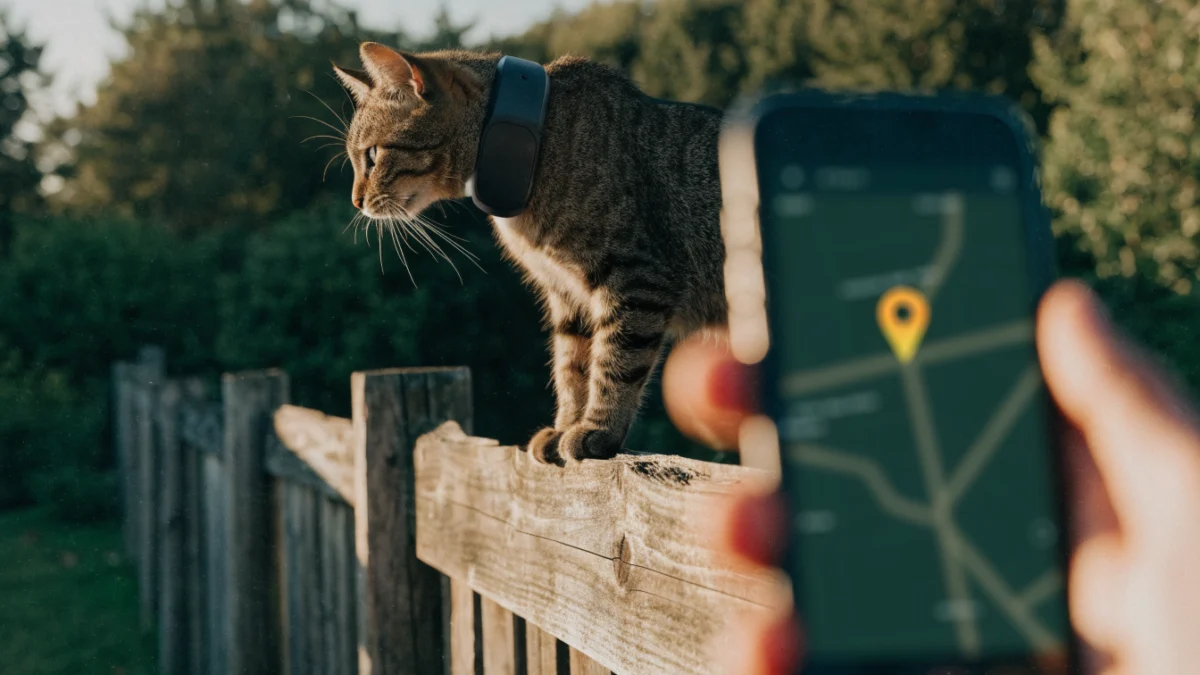
Last summer, my cat Mochi decided that the screen window was, in fact, not a barrier but a suggestion. I was on a work call when I heard that telltale ripping sound, and by the time I turned around, she was gone — a blur of orange fur vanishing into the hedge. I spent four hours walking the neighborhood with a bag of treats, feeling like the world’s worst pet parent. We found her napping under a neighbor’s porch, completely unbothered by my panic. That was the night I started researching GPS collars. Not because I’m paranoid (okay, maybe a little), but because the realization that my indoor cat could disappear in seconds — and that I’d have zero way to track her — genuinely changed how I thought about pet safety.
What These Devices Actually Do (And Why They Need a Subscription)
Here’s the thing that confused me at first: not all “trackers” are created equal. Those little Bluetooth tags you stick on your keys? They only work within about 30 feet. Useful if your cat is hiding in the closet. Useless if she’s three blocks down. True GPS pet trackers work differently — they connect to satellite networks to pinpoint your pet’s actual location, then use cellular networks to beam that information to your phone. And that cellular bit is why basically every quality GPS tracker requires a monthly subscription. You’re paying for that data pipeline.
I know, I know. Subscriptions are annoying. But when you understand the engineering, it makes sense. The device isn’t just talking to your phone — it’s communicating through cell towers, sometimes across miles, to tell you exactly where your wandering genius ended up. Without that cellular connection, you’d just have an expensive pedometer attached to your dog’s neck.
The 2026 Landscape
If you’ve looked at pet trackers recently, the market has shifted dramatically. The [1] crowned the Tractive Dog 6 as the top contender, specifically for its location accuracy and connection speed. And that speed piece matters more than you’d think. When my friend’s husky jumped the fence last spring, her tracker took nearly three minutes to send the alert — by which point the dog was already a mile out. The newer devices are cutting that delay down significantly, which can genuinely be the difference between finding your pet quickly and spending the night searching.
It’s Not Just About Location Anymore
This is where I got genuinely excited. Modern trackers are becoming full health hubs, not just location finders. A [2] found that only 8 out of 21 devices actively monitored physical activity — meaning fewer than half were doing anything beyond basic location tracking. But the ones that do? They’re fascinating.
Some advanced trackers now monitor specific behaviors. Not just steps, but patterns — excessive scratching, licking, changes in sleep duration. These seem like small things, but they’re often the first indicators of skin allergies, anxiety, or underlying illness. One tracker manufacturer uses AI to establish a baseline for your individual pet. So if your dog normally sleeps eleven hours and suddenly starts sleeping fourteen, or your cat’s activity drops by 30 percent, the app flags it.
Mochi has a habit of over-grooming when she’s stressed. I didn’t realize how often she was doing it until I started paying attention. A tracker that could quantify that — could say “she’s licked herself 40 percent more today than her baseline” — would’ve caught her anxiety spike last year before it turned into a bald patch on her belly.
Preventative Care, Not Just Emergency Response
The shift toward health monitoring represents something bigger in pet care: catching problems early instead of reacting late. Dogs and cats are evolutionarily wired to hide discomfort. By the time a cat stops eating or a dog starts limping, something’s been wrong for a while. Activity and behavior data gives us a window into subtle changes we’d otherwise miss. That said — and I want to be clear about this — a tracker doesn’t replace veterinary care. It just gives you better information to bring to your vet.
Cats Are Finally Getting Their Due
For years, pet tech was laughably dog-centric. Every tracker was bulky, heavy, and designed for a Labrador’s neck. Putting one on a seven-pound cat was basically asking her to wear a brick. The recent push toward feline-specific designs is long overdue.
Leading brands now offer lightweight, adjustable collars engineered for cats’ unique body mechanics and behavior patterns. And cat tracking is different from dog tracking — cats sleep differently, they’re more active at dawn and dusk, and their “normal” activity levels look nothing like a dog’s. The best feline trackers account for that, with algorithms calibrated to interpret cat-specific movement data rather than just porting over dog metrics and calling it a day.
Mochi adapted to her collar surprisingly fast. I expected drama. I expected the “freeze and refuse to move” protest that cats do so well. Instead, she wore it for about twenty minutes of offended stillness and then went back to her routine. Whether she’s forgiven me for the indignity remains unclear.
The Honest Conversation: Risks and Concerns
I’d be doing you a disservice if I only talked about the benefits. There’s an active debate in the veterinary and pet care community about the health implications of wearable tech for animals, and it’s worth understanding before you strap electronics to your pet’s neck.
Electromagnetic Exposure
The most discussed concern involves radiation and electromagnetic fields. GPS trackers that use cellular networks are essentially tiny phones, and some pet owners worry about continuous EMF exposure so close to an animal’s head and neck. Research is still emerging, and formal health risk assessments are ongoing. I’m not here to tell you this is definitely dangerous or definitely fine — but it’s a legitimate question worth discussing with your vet if you have concerns.
Physical Comfort and Safety
Electronic housings are bulkier than standard collars, which means potential for skin irritation, chafing, or hot spots, especially if the fit isn’t right. Mochi’s first tracker sat too low on her neck and rubbed slightly behind her ear before I adjusted it. Fit matters enormously. And there’s the snagging risk — a bulkier collar is more likely to catch on branches, fences, or furniture. Breakaway safety releases are non-negotiable for cats.
Battery and Chewing Hazards
This one genuinely worries me. Lithium-ion batteries are dangerous if ingested, and some pets will chew on anything. A [3] highlighted real-world cases of dogs damaging their trackers by gnawing on them. If your pet is a chewer — and you know who you are — this is a serious consideration. Device placement, durability ratings, and your pet’s own habits all factor in.
What I’ve Learned
After months of using a tracker on Mochi, here’s my honest take: the peace of mind is worth it, but these devices work best as part of a broader safety strategy. Microchipping is still your foundation — permanent identification that works even if a collar falls off or a battery dies. A GPS tracker adds a layer of real-time awareness that a microchip can’t provide.
If you’re considering one, think about what you actually need. Live in an apartment with an indoor cat who occasionally makes a break for it? A lightweight tracker with solid safe-zone alerts might be perfect. Have a dog who clears fences like an Olympic hurdler? Prioritize fast connection speeds and reliable real-time tracking. Every pet’s situation is different.
The technology will keep evolving. Trackers will get smaller, smarter, and more integrated into preventative health care. But the core value doesn’t change — it’s about knowing where your animal is and catching health changes early. Because at the end of the day, whether they’re a daredevil husky or a screen-window-escaping orange cat, our pets depend on us to pay attention. And if a small device on their collar helps us do that a little better, I think that’s worth the monthly subscription fee.
Sources
- Wirecutter's 2026 testing — nytimes.com
- 2021 analysis of the pet tracking market — pmc.ncbi.nlm.nih.gov
- Lost and Found Pets community discussion — facebook.com