

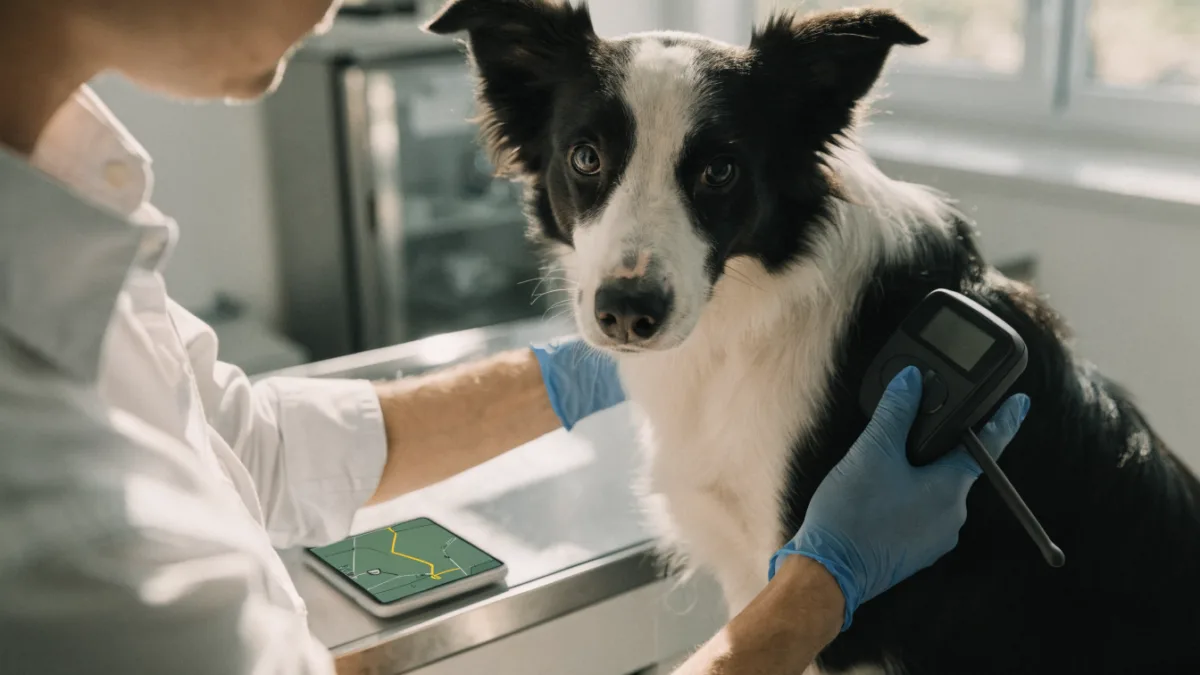
Picture a woman named Carla rushing into a clinic clutching her six-year-old Border Collie mix, Bandit. She was halfway through a move to Germany and had just learned that Bandit’s microchip — implanted three years earlier — didn’t meet international standards. The airline wouldn’t accept it. The German authorities needed documentation she didn’t have. And to top it off, when she called the microchip company to sort things out, she discovered the phone number attached to Bandit’s chip was from an apartment she’d left two states ago.
Carla looked at me, exasperated, and said the thing I hear at least twice a month: “But I thought the chip was basically a GPS. Can’t they just… find him?”
I don’t blame her for the confusion. The marketing around pet technology has gotten incredibly sophisticated, and the lines between identification, tracking, and recovery have blurred in most owners’ minds. So let me clear this up early and plainly: a microchip is not a GPS tracker. It never has been. And understanding the difference — along with the updated international standards now governing microchips — might be the single most important thing you do for your pet’s safety.
What a Microchip Actually Does (And Doesn’t)
A pet microchip is a passive Radio Frequency Identification device — usually called an RFID chip. The word “passive” is the key here. There’s no battery inside. No power source. No signal being broadcast into the world. The chip is essentially a tiny glass capsule, about the size of a grain of rice, containing a microcircuit and an antenna coil. It sits dormant under your pet’s skin, between the shoulder blades, doing absolutely nothing.
That is, until a scanner comes along.
When a veterinary clinic, animal shelter, or animal control officer passes a handheld scanner over your pet, that scanner emits a low-frequency radio wave. The wave provides just enough energy to momentarily power the chip, which then transmits its unique identification number — typically 9, 10, or 15 digits — to the scanner’s screen. Think of it like a barcode on a grocery item. The barcode doesn’t do anything on its own. It only becomes useful when someone scans it and a database connects that number to information.
That number is your pet’s permanent, unalterable identifier. It can’t be lost like a collar tag. It can’t fade or fall off. But it also can’t tell anyone where your pet is. It can only confirm who your pet is.
The ISO Standard Shift: Why 15 Digits Now Matters More Than Ever
What ISO 11784 and 11785 Actually Say
The International Organization for Standardization established two protocols — ISO 11784 and ISO 11785 — that define how animal microchips should work globally. The standards specify two things that matter enormously: the chip must operate at a radio frequency of 134.2 kHz, and it must use a 15-digit numeric format.
Why does this matter? Because before these standards became widely adopted, microchip manufacturers were essentially doing their own thing. Some companies produced chips that operated at 125 kHz. Others used 128 kHz. Some used 10-digit numbers, others used 9. The result was a fragmented mess where a scanner in one clinic couldn’t read a chip implanted in another. I’ve stood in shelter exam rooms running three different scanners over a frightened stray cat, hoping one of them would pick up whatever frequency the chip happened to use. It was frustrating for us and potentially life-threatening for the animal.
The push toward universal ISO compliance is changing that. Most developed nations now require — or strongly recommend — the 15-digit, 134.2 kHz chip as the standard. The International Committee for Animal Recording (ICAR) provides additional oversight, ensuring that microchips meet quality benchmarks and that the numbers are properly registered in traceable databases.
If You’re Traveling Internationally, This Is Non-Negotiable
Here’s something I’ve seen derail more travel plans than I can count: most countries require an ISO-compliant microchip for pet entry. The European Union, the United Kingdom, Japan, Australia, and many others specifically mandate the 15-digit ISO chip. And critically, that chip usually needs to be implanted before any required rabies vaccinations are administered.
The logic is about traceability. Rabies certificates are often linked to the microchip number. If the chip goes in after the rabies shot, some countries won’t recognize the vaccination as valid because they can’t definitively prove the vaccinated animal and the microchipped animal are the same individual. I had a client last year, Mark, who had to have his Labrador, Daisy, completely revaccinated for rabies and restart her import paperwork because his original vet had chipped her two weeks after the rabies shot. It cost him three months and a postponed job relocation.
If you have any intention of traveling internationally with your pet — even hypothetically, years down the road — ask your veterinarian specifically for an ISO 11784/11785 compliant chip. If your pet already has an older non-ISO chip, you may need to have a second chip implanted alongside it. It’s not ideal, but it’s legal and solves the compatibility problem.
The GPS Illusion: Why AirTags and Smart Collars Can’t Replace a Chip
I’ll be honest — I love what GPS technology has done for pet recovery. Consider an owner who tracked her runaway Beagle, Pepper, through a neighborhood using a cellular-enabled collar. The dog had slipped through a garden gate, and within twenty minutes, the owner had followed a real-time map signal to a neighbor’s shed where Pepper was cornered and frightened. That’s remarkable technology, and these devices are well worth considering as proactive recovery tools.
But here’s where I see owners make a critical error: they assume that because they’ve invested in a GPS collar or attached a Bluetooth tracker to their pet’s harness, they don’t need a microchip. Or they figure the chip is redundant — old technology replaced by newer options.
This thinking misses something fundamental about how these devices actually function.
Bluetooth Trackers: Proximity, Not Position
Devices like Bluetooth key-finders weren’t designed for pets, though people attach them to collars constantly. They work by communicating with nearby smartphones via Bluetooth. If your lost dog wanders past someone whose phone is running the right app, you’ll get a location ping. That’s genuinely useful in dense urban or suburban areas where lots of people carry smartphones. But in rural areas? On a hiking trail? At night when fewer phones are active? The tracker goes silent. It has no independent ability to locate your pet.
GPS Collars: Powerful, But Fragile
Dedicated GPS collars are more robust. They use satellite positioning and often cellular networks to transmit real-time location data to your phone. Some are excellent. But they all share the same vulnerabilities: they depend on battery power, they require cellular coverage in areas where signal may be spotty, and — perhaps most obviously — they’re attached to a collar. Collars come off. They break. They get caught on fences and pulled free. A frightened dog escaping a thunderstorm can slip a collar in seconds.
When that collar is gone, every bit of that sophisticated technology goes with it. Your pet is now anonymous.
A microchip can’t fall off. It can’t run out of battery. It doesn’t depend on a cellular network or a nearby smartphone. It will still be there, silently carrying that 15-digit number, ten years from now. When a stranger finds your dog without a collar and brings them to a shelter or veterinary clinic, the staff will scan for a chip. If that chip is registered with your current contact information, your pet comes home.
The Step Most Owners Skip: Registration
I want to talk about the part of microchipping that fails most often, and it has nothing to do with the technology itself. It’s the registration.
A microchip is only as good as the information attached to it. When I implant a chip, I give owners the registration paperwork and explain exactly what to do. I’d estimate that maybe half of them complete the process. Of those who do register, many never update their information when they move, change phone numbers, or rehome the pet.
When Bandit’s microchip number is scanned at a shelter in Germany, that number needs to connect to a database that leads to Carla’s current phone number. If the database still lists her old apartment and a disconnected phone, the chip is functionally useless. The shelter has a number, but no way to reach the owner.
Here’s what I tell every client: treat your microchip registration like you treat your driver’s license or emergency contact list. Update it every time something changes. Many microchip registries now offer online portals where you can update your information in minutes. Some even let you add secondary contacts, veterinary clinic information, and medical notes about your pet — things like insulin-dependent diabetes or severe allergies that could save an animal’s life in an emergency situation.
If you’re reading this and you can’t remember whether your pet’s chip is registered — or when you last updated the information — please stop and check right now. Most registries allow you to look up your pet’s number using their microchip ID. If you don’t know the number, any veterinary clinic can scan it for you in about ten seconds.
What I’ve Changed My Mind About
I’ll admit something. Ten years ago, I used to tell clients that GPS collars were gimmicky and unnecessary. I rolled my eyes at the first Bluetooth trackers people attached to dog collars. I thought microchips were sufficient and that the additional technology was just anxious pet owners spending money on anxiety relief.
I was wrong.
The recovery stories I’ve heard from clients using GPS collars have changed my perspective. Used together — a GPS collar for active tracking and a registered ISO-compliant microchip as permanent backup identification — these technologies give pets the best possible chance of coming home. They’re not competing tools. They serve different purposes at different moments in a lost-pet scenario. The GPS collar helps you find your pet before anyone else does. The microchip helps a stranger return your pet to you when the collar is gone.
That said, if you can only choose one, choose the microchip. Every time. Without question.
One Final Thought
The same RFID microchip technology we use in companion animals is deployed by wildlife conservationists working with endangered species. Captive breeding programs for snow leopards, sea turtles, and black rhinoceroses rely on ISO-compliant chips to track individuals, maintain genetic diversity records, and prevent illegal trafficking. When a confiscated animal arrives at a sanctuary, staff can scan for a chip and determine whether that animal was bred in a legitimate facility or taken from the wild. The technology is small, but its impact — from a lost Labrador in Ohio to a trafficked pangolin in Vietnam — is genuinely significant.
Your pet’s microchip is a tiny piece of glass with a number inside it. That’s all it is. But that number, properly registered and kept current, is the thread that connects your animal back to you when everything else has been lost. Don’t let it be the thing you meant to get around to.