

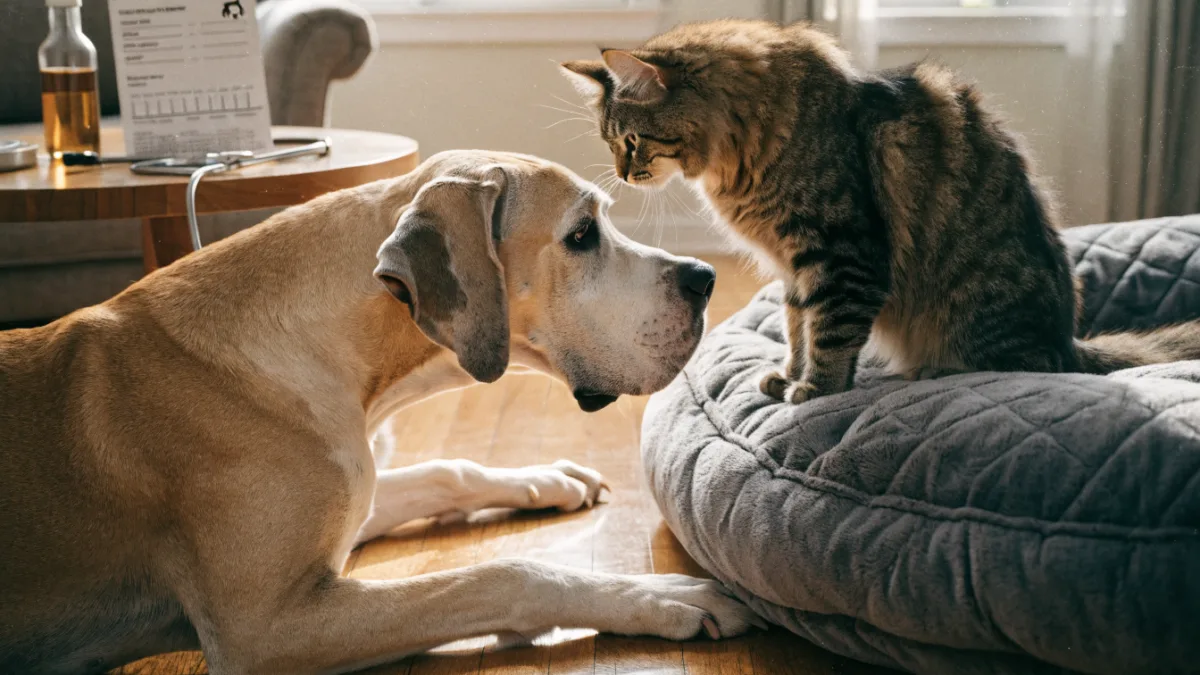
There’s a corner of the internet right now devoted to Great Danes being impossibly gentle with Maine Coon kittens —,[1] who fell head over paws for a new litter, and [2] pull millions of views. I understand the appeal completely. I’ve slept on couches with a 23-pound Maine Coon draped across my chest like a heated blanket with opinions, and I’ve leaned against Danes who lean back with the full commitment of a horse. But the videos never show the follow-up: the echocardiogram, the orthopedic surgery estimate, the dog who’s a senior citizen at six. If you’re seriously considering a giant of either species, you deserve the whole picture — because the whole picture is still worth it, and you should know exactly what you’re signing.
The Temperament Sales Pitch Is (Mostly) True
Start with the good news, because it’s real. Great Danes are shy and non-confrontational to a degree that surprises people who expect a guard dog. A well-socialized Dane is one of the better big-dog choices for households with kids, cats, and other dogs — not because he’s tough, but because he’d honestly rather not. A friend of mine had a blue Dane named Otis, 165 pounds, who was afraid of the kitchen trash can for three years and let the neighbor’s kitten eat out of his bowl while he waited, politely, on the other side of the room.
Maine Coons get described in the breed literature as “low-key, affable and confident,” which is the least cat-like string of adjectives ever applied to a cat. They follow you room to room, chirp and trill instead of meowing, and many of them retrieve. A confident cat matters enormously if you’re pairing the species, by the way — a nervous cat and a 140-pound dog is a management project; a cat who assumes he’s the largest animal in the house regardless of evidence is a much easier roommate.
Now the part that annoys me. “Gentle giant” is honest marketing that leaves out the fine print. Danes are not furniture. They need real daily exercise — long walks, honest play — and a giant dog who pulls on leash, jumps on guests, or bolts at a noise isn’t gentle, he’s a 140-pound physics problem. The shyness that makes Danes sweet also makes socialization non-negotiable: a frightened 150-pound animal is a serious situation no matter how friendly his intentions. If a breeder or a shelter bio sells you the temperament and never mentions the training workload, keep shopping.
The Arithmetic Nobody Puts in the Caption
Here’s the number that matters: Great Danes live 7 to 10 years, against 10 to 13 for medium-sized dogs. Maine Coons land roughly three years short of the average cat. Both breeds pay the same tax for the same reason — bigness is biologically expensive. More skeletal load per joint, more cardiac workload, and, in giant dogs, cancer rates that climb with height. Osteosarcoma, bone cancer, is overwhelmingly a disease of large and giant breeds; the taller the dog, the higher the risk.
There’s a live ethics argument about this, and I think it deserves to be stated plainly: when humans select for maximum size, we select toward the short end of the lifespan curve. Bismarck’s Danes in the 1880s were lighter animals than today’s show winners, and the breed’s health markers have not improved as the silhouette grew. I’m not telling you not to own one — I’ve loved every Dane I’ve known, and I’d do it again tomorrow. I’m telling you that when you choose a breeder, you’re voting for what they select for. Longevity and health testing should be the sales pitch, and size should be the afterthought. Otis made it to seven and a half. The hardest math in giant-breed ownership is the kind you do afterward.
What Their Bodies Will Ask of You
The hearts come first. Danes carry a serious predisposition to dilated cardiomyopathy, and Maine Coons to hypertrophic cardiomyopathy — the same theme in two species. For Maine Coons there’s a DNA test for the most common HCM mutation (MyBPC3), and every breeding cat should have documented results; know that a negative test isn’t a full cardiac clearance, so echocardiograms — roughly every year or two starting around age two — remain the real standard. Danes deserve the same heart monitoring, because DCM can quietly erode heart function long before a dog looks sick. Dr. Sarah handles the treatment side of cardiac disease on the medical end of things; my job is to tell you that screening is a budget line, not an option.
Then there’s bloat. Gastric dilatation-volvulus is the classic Dane emergency: the stomach fills with gas and twists, and it kills in hours. Know the signs — unproductive retching, a swollen, drum-tight abdomen, restlessness — and treat every occurrence as a drive-now situation. Two things worth doing in advance: discuss prophylactic gastropexy with your vet when your Dane is spayed or neutered, and skip the elevated feeder. Elevated bowls were standard advice for decades, but the research didn’t back it up, and one large study associated them with higher bloat risk. Old habits die hard in dog care; let that one die.
Add hip dysplasia, which affects both breeds — yes, cats get it, and big Maine Coons are overrepresented — plus spinal muscular atrophy in Coons (a DNA test exists) and the ever-present osteosarcoma risk in Danes. Even caught early and treated with amputation and chemotherapy, osteosarcoma gives most dogs about a year. I say that not to be grim but because you should meet this breed with open eyes.
Growing Them Slow on Purpose
The single best thing you can do for a giant animal’s joints happens before he’s grown. Feed a large-breed puppy formula — the point isn’t more nutrients, it’s controlled calcium, because oversupplementation drives the too-fast growth that wrecks developing joints. Keep puppies lean; you should be able to feel ribs. And no forced exercise — no jogging, biking, or agility — until the growth plates close, which in Danes means somewhere around 12 to 18 months. Free play, walking, and swimming are fine and good. Add traction on slick floors while they’re young, since a sliding puppy is a hip’s worst day. For adults, omega-3 supplementation has decent evidence behind it; the glucosamine aisle promises more than the studies deliver, so talk to your vet before spending. Whatever you do, keep the weight off — every extra pound loads those joints several times over.
The Bill Arrives by the Pound
“The bigger the dog, the bigger the bills” isn’t a stereotype, it’s arithmetic. Medications are dosed by weight, so heartworm prevention for 140 pounds costs a multiple of the 40-pound dose. Anesthesia scales by weight. Surgical quotes for big dogs run higher across the board — a GDV surgery that hits at 2 a.m. lands somewhere in the $3,000–$6,000 range before complications. Echocardiograms run a few hundred dollars apiece, and these breeds need them repeatedly.
Food is its own line item: a grown Dane eats 6 to 8 cups of kibble a day, which turns a 30-pound bag into a two-week supply. Gear scales too:
- XXL crates cost roughly double a large one, and there’s no skipping it
- Beds the size of a twin mattress, replaced more often because they’re actually used
- Jumbo high-sided litter boxes — a 20-pound cat does not fit a standard box, and the evidence ends up everywhere
- Heavy-duty collars and leashes rated for a dog who can drag you into traffic while chasing a leaf
The sticker prices are their own story. [3] with most landing between $2,000 and $3,000. The top of that range is rare-color markup, and I’ll say it flatly: a five-figure cat is a fashion purchase, not a health guarantee. Price tracks trendiness; it has never tracked health testing. Whatever you pay, insist on documentation — HCM screening of the parents, DNA results for the MyBPC3 and SMA mutations, and honest answers about hips. And know that both breeds end up in rescue; adoption sidesteps the markup, though not one cent of the veterinary bills. Pet insurance is priced by breed and size, and giant-breed premiums reflect that — enroll early, because a diagnosis that lands before the policy makes everything after it a pre-existing condition.
Sharing a House With Both
The Dane-plus-Coon household works better than the size difference suggests, for the reasons above: he’s non-confrontational, she’s unbothered. The best pairings start as babies, raised together, with introductions done slowly and supervision that never fully ends — not because of aggression, but because a Dane can injure a cat by stepping on her or lying down wrong. Give the cat vertical escape routes, feed them separately, and don’t leave food unattended. One honest note on Coon upkeep while you’re planning: that coat isn’t maintenance-free. Brush thoroughly three times a week, with special attention behind the ears and under the legs, or the mats arrive and they do not negotiate.
What you’re really running is two giant-health programs in parallel — two heart-screening schedules, two joint-preservation plans, two weight-scaled budgets. People do it and love it. Just go in knowing the cute video is the highlight reel, not the workload.
So here’s the honest ledger. Giant animals cost more, wear out faster, and leave sooner — three years sooner on average, which is exactly as heavy as it sounds. In exchange you get a decade of a companionship that’s simply bigger in every direction: a dog whose lean can pin you to a wall with affection, a cat who supervises your entire life from the highest available shelf. If you take the plunge, do it in a way that pushes the breeds forward: buy from lines where hearts are screened and longevity is selected for, or adopt with your eyes open, insure early, grow them slow, and budget like an adult. These breeds exist in the form they do because a century of people chose size above everything — the most powerful thing you can do as an owner is choose differently, and love the big ones long after the bill is forgotten.
Sources
- Parade Pets covered one Dane — paradepets.com
- the TikTok "giant dog, giant cat" chaos videos — tiktok.com
- Maine Coon buyers report paying anywhere from $450 to $10,000 — facebook.com