

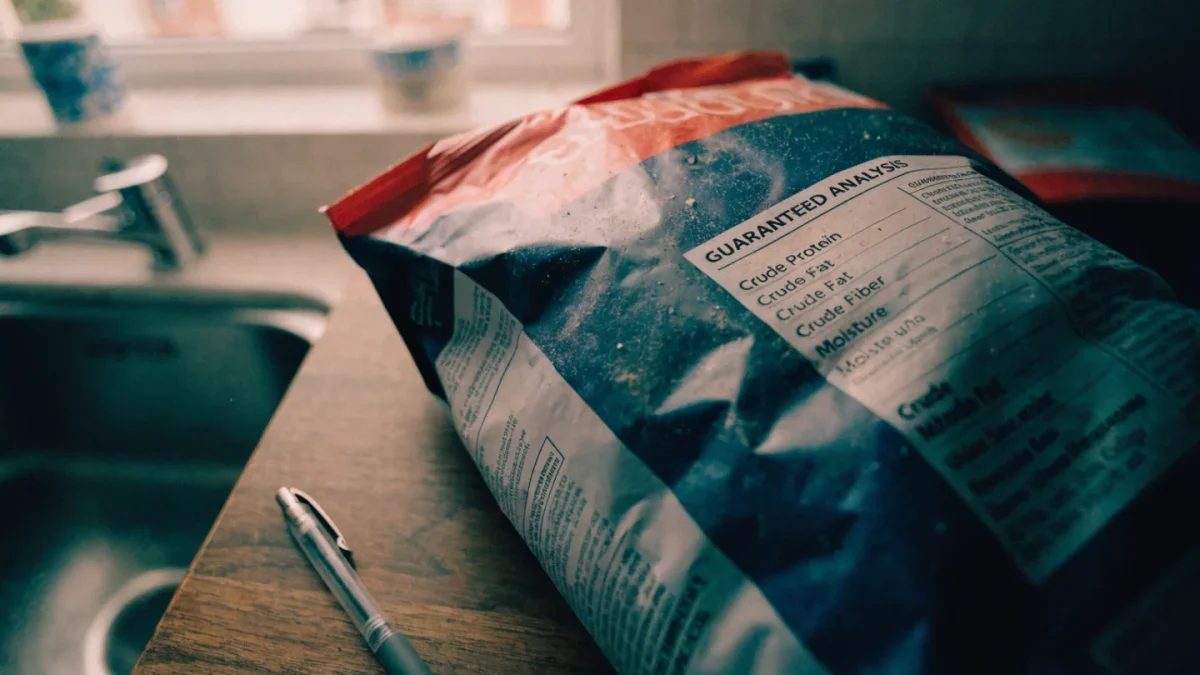
The guaranteed analysis section is probably the least-read part of a pet food label. People look at the front, scroll through the ingredient list, and stop there. The guaranteed analysis, which is tucked on the side panel, looks like a table of dry percentages and feels like an afterthought.
It shouldn't. It's actually the section that lets you make quantitative comparisons between foods — if you know what you're looking at.
What the Guaranteed Analysis Contains
Every pet food sold in regulated markets must include a guaranteed analysis listing at minimum: crude protein (minimum), crude fat (minimum), crude fiber (maximum), and moisture (maximum). Some manufacturers voluntarily include additional values — ash, specific omega fatty acid percentages, taurine, individual amino acids. More information is usually better, though not all of it requires action.
The word "crude" is worth noting. Crude protein, for example, is measured by nitrogen content, which is a proxy for protein but not a direct measurement of digestible protein. A food could technically have high crude protein from poorly digestible sources. It's an imperfect measure, but it's what regulation requires and what we have to work with.
The values are expressed as percentages of the total food as packaged — which is where the moisture variable creates comparison problems.
The Dry Matter Basis Calculation
Here's the issue: dry food contains roughly 8-12% moisture. Wet food contains 75-80% moisture. If a wet food shows 10% protein and a dry food shows 30% protein, you cannot directly compare those numbers — they describe foods with dramatically different water contents.
To compare fairly, you need to convert both to dry matter basis: what the food contains if you removed all the water.
The formula:
- Subtract moisture percentage from 100 to get the dry matter percentage.
- Divide the nutrient percentage by the dry matter percentage.
- Multiply by 100.
Example with wet food: 10% protein, 78% moisture.
- Dry matter = 100 – 78 = 22
- Protein on dry matter basis = (10 ÷ 22) × 100 = 45.5%
Example with dry food: 30% protein, 10% moisture.
- Dry matter = 100 – 10 = 90
- Protein on dry matter basis = (30 ÷ 90) × 100 = 33.3%
In this case, the wet food actually provides more protein on an equivalent-moisture basis, despite the as-fed number looking lower. This is exactly why looking at wet food's protein percentage and dismissing it as "only 10%" misses the point.
Do this calculation for both foods whenever you're comparing a wet to a dry or semi-moist option. It takes about 30 seconds and gives you a real comparison.
What Numbers to Look For
There's no single right answer for protein percentage — it depends on the species, life stage, health status, and activity level of your pet. But here are rough guidelines:
Dogs:
- Adult maintenance: typically 18-25% protein on a dry matter basis is adequate, though many foods run higher
- Active or working dogs: 25-35%+ is reasonable
- Dogs with kidney disease: protein restriction under veterinary guidance (often lower than maintenance levels)
Cats:
- Adult maintenance: cats have higher protein requirements than dogs — 30-40%+ on a dry matter basis is appropriate
- Cats are obligate carnivores and suffer more from protein restriction than dogs
Fat:
- Adult dogs: roughly 10-20% on a dry matter basis for most
- Dogs with pancreatitis history: often 8-10% or lower, under veterinary guidance
- Adult cats: 20-40% is a typical range; cats are more tolerant of dietary fat than dogs in terms of pancreatitis risk
Fiber:
- Most adult dogs and cats do fine with 3-5% crude fiber
- Dogs with certain digestive conditions may need higher fiber
For the full label-reading context, reading pet food labels in full integrates the guaranteed analysis with the ingredient list and AAFCO statement. And ingredient list order and what it means explains why the protein number from guaranteed analysis often tells you more than ingredient position.
Calorie Density and the Energy Calculation
Many labels also include a metabolizable energy (ME) statement, expressed as kcal per kilogram and often per cup (for dry food) or per can (for wet). This is extremely useful for managing your pet's weight.
Two foods with similar protein percentages might have very different caloric densities. A higher-fat food delivers more energy per gram. If you're trying to feed a specific calorie target for weight management, the ME number lets you calculate exactly how much to feed rather than relying on the manufacturer's serving size guide, which is usually calibrated for an average dog and often overshoots what a sedentary or overweight pet actually needs.
Frequently Asked Questions
Why does the label show minimums and maximums instead of exact amounts?
Regulatory convention requires manufacturers to guarantee certain values — meaning they won't deliver less than the stated minimum for protein and fat, or more than the stated maximum for fiber and moisture. Actual values may be higher or lower within a range. Some manufacturers voluntarily list exact typical values alongside the required minimums and maximums, which is more useful for comparison.
My dog's food shows 30% protein. Is that too high?
For a healthy adult dog, 30% crude protein on an as-fed basis in a dry food is not too high — it's actually in the normal range for many quality dog foods. Concerns about high protein causing kidney disease in healthy dogs are not well supported by current evidence — research reviewed at the WSAVA 2017 Nutrition Symposium explicitly states there is no evidence that high-protein diets are harmful to the kidneys in healthy animals, and studies including dogs with experimentally reduced kidney function have not shown high protein intake to significantly accelerate disease progression in otherwise healthy dogs. Dogs with existing kidney disease are a different situation, where protein levels should be managed under veterinary guidance.
How do I compare two wet foods with different can sizes?
Use the kcal per kilogram figure from the ME statement, not the per-can figure. Per-can varies with can size; per-kilogram is standardized. For nutrient comparison, the dry matter basis calculation works the same regardless of can size.
The food I want to try doesn't list a calorie statement. Is that a red flag?
Calorie statements are now required in many regulatory environments but implementation varies. A missing calorie statement isn't necessarily a red flag about quality, but I'd contact the manufacturer to request the information. Any reputable company should be able to provide it. If they can't or won't, that tells you something about their quality control transparency.