

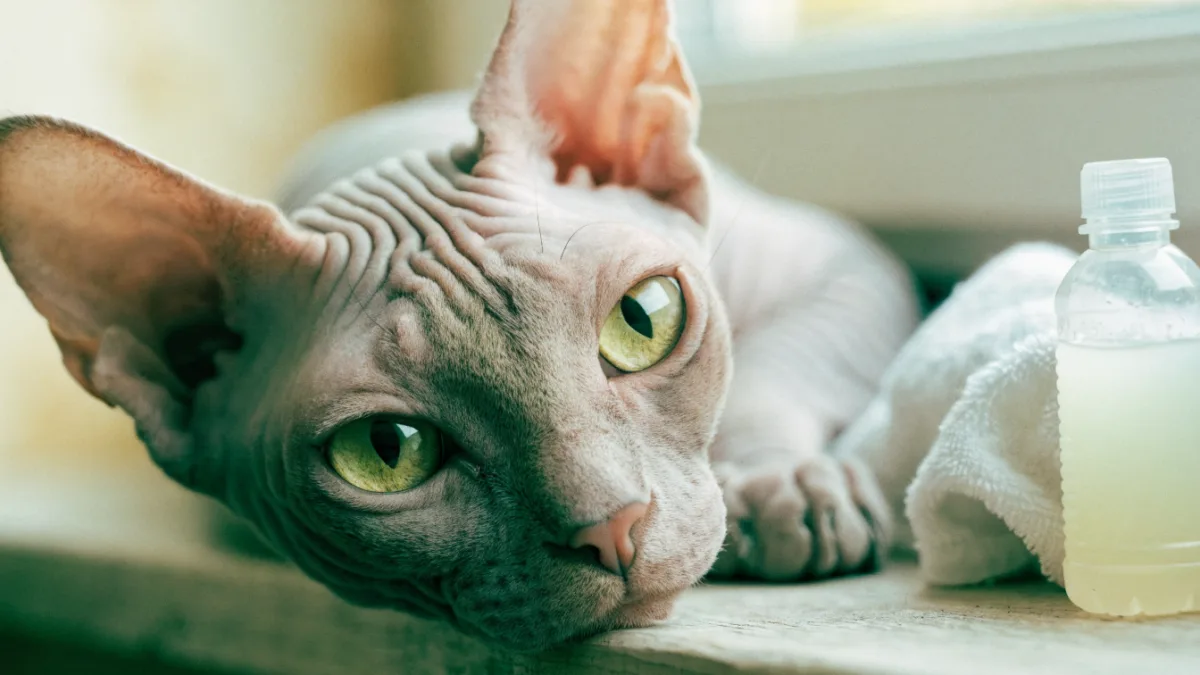
The first time I held a Sphynx cat at a show in Pennsylvania, my hand came away looking like I’d just eaten fried chicken. That’s not dirt — it’s sebum, the same oil every cat and dog produces. The difference is that most animals have fur to absorb and distribute it. A Sphynx, a Chinese Crested, a Xoloitzcuintli — they don’t. The oil just sits there, building up, oxidizing, turning rancid, and eventually leaving a brownish residue on everything the animal touches. That’s the part nobody tells you in the breeder’s brochure.
People buy hairless pets assuming “no fur, no grooming.” The opposite is true. A furred dog or cat is, in many ways, a self-maintaining system. The coat sheds dirt, wicks moisture, and regulates temperature. Strip the coat away and you’ve taken away the animal’s built-in HVAC and filtration. What’s left is one of the highest-maintenance grooming routines in the companion animal world. Hairless cat care, Chinese Crested dog skin maintenance, and the broader world of specialized pet skincare routines aren’t optional add-ons — they’re the entire relationship.
Why “Hairless” Is a Misleading Word
The Sphynx isn’t actually bald. Most Sphynx cats have a fine peach-fuzz coat, like chamois leather, that you can feel but barely see. Chinese Cresteds come in two varieties — the Hairless (with hair only on the head, tail, and feet) and the Powderpuff (fully coated) — and even the Hairless type has that soft down on the body. The Xoloitzcuintli, the Mexican Hairless Dog revered by the Aztecs and nearly lost to extinction before mid-20th-century breeders rebuilt the population, has a similar texture.
What all three breeds share is a functioning sebaceous system with nowhere for the oil to go. The glands don’t know the fur is gone. They keep pumping. I’ve fostered a Sphynx for two weeks while a friend was hospitalized, and by day four my sheets had a permanent brown halo where the cat liked to sleep. The grease also oxidizes against the skin itself, which is why an unbathed hairless pet smells — not terrible, but distinctly different from a furred animal. It’s the same process that makes unwashed human hair smell after several days, just concentrated on a much smaller body.
That sebum is also why acne happens. Both cats and dogs get acne — feline acne is well-documented around the chin and lips, and canine acne shows up on the muzzle and chest. In furred breeds it’s usually mild and self-limiting. In hairless breeds, the clogged pores have no hair shaft to push the sebum out, so it pools, oxidizes, gets colonized by bacteria, and turns into the kind of blackhead-and-pustule breakout you’d associate with a teenager.
Bath Day, Every Week or Two
The standard recommendation is a bath every 7 to 14 days. That frequency isn’t arbitrary — it’s the window where sebum has built up enough to cause problems but hasn’t yet caused real damage. Bath more often and you strip the skin’s moisture barrier, leading to flaking, cracking, and a compensatory overproduction of oil that makes everything worse. Bath less often and you’re looking at blackheads, body odor, and that greasy residue on every surface in your home.
The right frequency depends on the individual. I’ve met Sphynx cats whose skin looked perfect at 10-day intervals and others that needed weekly bathing without exception. You read the skin, not the calendar.
The Actual Routine
Water temperature is the first thing people get wrong. Hairless pets cannot thermoregulate the way furred animals do. Water that feels comfortably warm to a human — around 100°F (38°C) — is too hot for them. Aim for lukewarm, around 90°F (32°C), and test it on your wrist the way you would for a baby’s bottle.
Use a mild, hypoallergenic, pet-specific shampoo. There are now commercial acne shampoos formulated for the pH of hairless dog and cat skin, and the pet cosmeceutical market has exploded in the last decade with products designed specifically for this niche. Wet the animal thoroughly, lather gently with your hands — do not scrub — and rinse until the water runs completely clear. Shampoo residue on hairless skin causes more itching and irritation than it does on furred skin because there’s nothing to trap the suds and pull them away from the body.
For Sphynx cats specifically, two areas demand extra attention. Those enormous ears collect sebum and debris at a rate that would horrify you, and the nail beds — where the claw meets the toe — accumulate a dark, waxy buildup that needs to be gently wiped away with a damp cloth or pet-safe wipe during every bath. Chinese Cresteds and Xoloitzcuintlis need the same attention to ears and nails, plus routine checks of the exposed skin on the back, belly, and legs for dryness.
Dry the animal thoroughly with a warm towel. Do not let a hairless pet air-dry in a cool house. They get cold fast.
Acne Prevention Between Baths
Bathing handles the heavy lifting, but acne prevention is a daily practice. Pet-safe grooming wipes — unscented, pH-balanced for dogs or cats — are the single most useful tool in a hairless pet owner’s kit. A quick wipe-down of the chin, ears, belly, and any skin folds once a day removes fresh sebum before it has a chance to oxidize and clog pores.
For Sphynx cats with active feline acne, the chin and lip area may need more targeted care. Warm compresses followed by a gentle wipe can help open clogged pores. Do not squeeze blackheads — I know it’s tempting, but you’ll push bacteria deeper and risk a localized infection that requires veterinary attention. Severe breakouts may need a prescription medicated wash; talk to a vet rather than improvising with over-the-counter human products.
Chinese Crested dog skin follows similar rules, with added attention to the legs and chest where the exposed skin rubs against furniture, clothing, and itself. Friction plus sebum equals hotspots. A thin layer of dog-safe, non-comedogenic lotion after bathing helps prevent the cracking that Cresteds are prone to, especially in dry winter air.
The Sun and Wardrobe Question
Hairless pets sunburn. This isn’t a minor concern — veterinary dermatologists have been running awareness campaigns over the last few years specifically because UV-related skin cancers in hairless breeds are more common than most owners realize, and the damage is cumulative over the animal’s lifetime.
If your Sphynx, Crested, or Xolo goes outside, animal-safe sunscreen on exposed areas (ears, nose, back, belly) is mandatory. Reapply every couple of hours during direct exposure. A friend’s Xolo got a nasty sunburn across the bridge of her nose during what was supposed to be a 20-minute potty break on a sunny spring afternoon — UV doesn’t care about your schedule.
[LOCALIZATION CHECK] Some regions have breed-specific legislation or import restrictions on certain hairless breeds — verify local regulations before acquiring one.
Clothing isn’t optional either. In winter, hairless pets need sweaters indoors if your house runs cool, and they need them outdoors always. In summer, a light shirt provides both sun protection and a barrier against scratches and insect bites that hairless skin can’t defend against. You’re going to spend real money on a wardrobe. Budget for it.
The Product Trap
Here’s where I see owners get into trouble. A Sphynx cat has a breakout. The owner reaches for a 2% salicylic acid acne wash from the drugstore. Or they grab their own sunscreen — it’s got zinc oxide, which is fine for humans, and they assume it’s fine for the cat.
It’s not. Zinc oxide is toxic to dogs and cats if ingested, and hairless pets groom themselves constantly. A cat licks every accessible inch of its own body multiple times a day. Anything you put on that skin gets ingested. Salicylic acid, tea tree oil, benzoyl peroxide, certain essential oils — all common in human skincare, all potentially dangerous when licked off by a 8-pound animal.
The veterinary consensus on this is unambiguous: pet-formulated products only. Yes, they’re more expensive. Yes, the selection is smaller. The alternative is a trip to the emergency vet, which is more expensive still. I’d rather spend $24 on a bottle of dog-safe sunscreen than $1,200 on zinc toxicity treatment.
What You’re Actually Signing Up For
A Sphynx cat, a Chinese Crested, or a Xoloitzcuintli is not a low-maintenance pet dressed up as one. The skincare routine is the pet. The weekly baths, the daily wipe-downs, the sunscreen, the sweaters, the ear cleanings, the acne monitoring, the constant temperature management — that’s the deal. If that sounds exhausting, the breed isn’t for you, and there’s no shame in admitting it.
I’ll be direct about something else. The intentional breeding of animals genetically predisposed to skin infections, temperature sensitivity, dental issues (the hairless gene in Cresteds and Xolos is linked to tooth abnormalities), and lifelong discomfort is a real ethical question. The Xoloitzcuintli existed for thousands of years as a functional, revered animal before European colonization nearly erased it — that history deserves respect. The Sphynx as we know it dates to a single genetic mutation in 1966 in Toronto. The Chinese Crested’s exact origins are debated, but the modern breed was standardized in the late 19th and early 20th centuries largely for the show ring. None of these animals asked to be hairless. They exist because humans found the look interesting. Owning one means accepting a particular kind of responsibility for that choice — doing the skincare right, every week, for 12 to 15 years.
So before you bring one home, be honest with yourself about the time and money involved. High-quality pet-safe skincare products, specialized shampoos, sunscreens, a rotating wardrobe, and routine dermatology vet visits are recurring costs on top of standard care. If you can do all of that and you still want one — really want one — hairless pets are extraordinary companions, and the bond you build over a decade of weekly bath days is unlike anything else in the animal world. Just go in with your eyes open and your wipes stocked.