

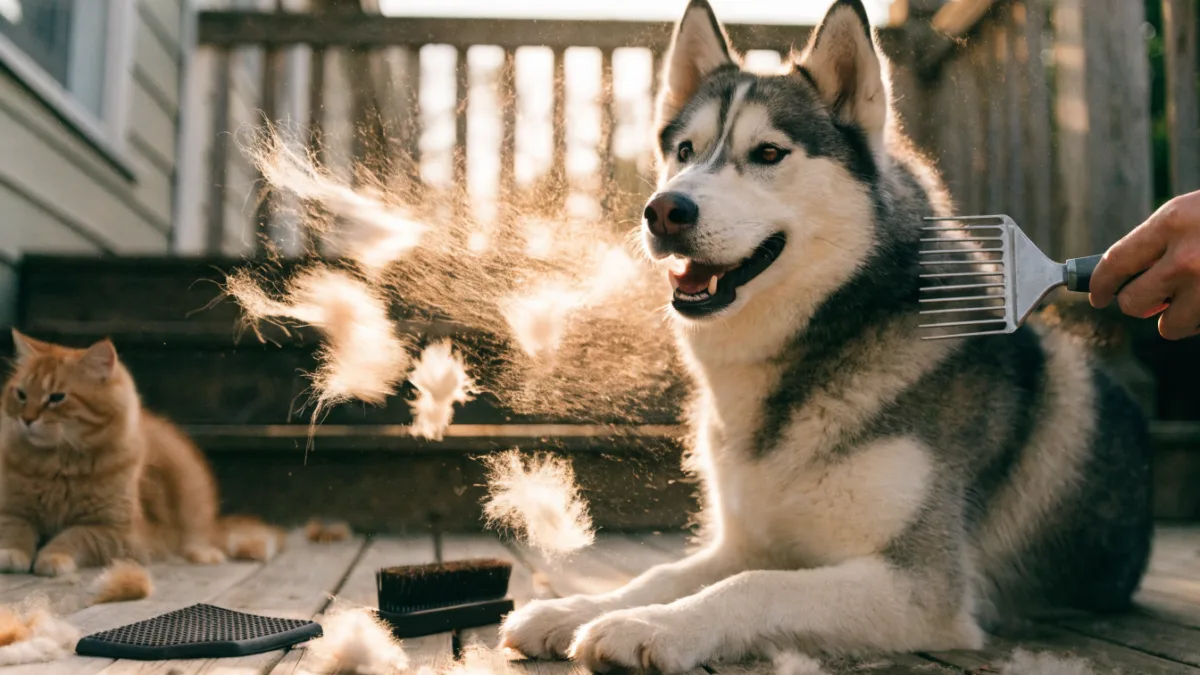
I once fostered a Great Pyrenees mix named Bishop during what his previous owner called “fur-nado season.” I thought I understood shedding. I’d lived with Labs, seen Huskies blow coat, watched my share of cat hair drift across living room floors like dust in a Western standoff. Bishop was different. Bishop produced fur in volumes that defied physics. I’d brush him six passes with an undercoat rake, fill a grocery bag, turn around, and he’d look like he’d rolled through a cloud. That dog taught me that managing a double coat isn’t about winning — it’s about strategy, the right tools, and accepting that your vacuum cleaner is now a family member.
What Makes a Double Coat (And Why It Sheds Like Crazy)
Double-coated dogs and cats have two distinct layers of fur. The outer layer — called guard hair — is coarser, longer, and water-resistant. Beneath that sits the undercoat: a dense, soft, woolly layer designed to trap air and regulate body temperature. This is the fur that explodes twice a year, usually in spring and fall, when seasonal shifts trigger the coat to shed its undercoat en masse. Dog people call it “blowing coat.” Cat people just call it everything is covered now.
Breeds and types most likely to turn your home into a fur-nado include Huskies, Malamutes, German Shepherds, Golden Retrievers, Great Pyrenees, Bernese Mountain Dogs, Newfoundlands, Samoyeds, and Pomeranians. On the cat side, Maine Coons, Norwegian Forest Cats, and Siberians carry the same heavy double coat architecture. These animals were built for harsh climates. Their coats are doing exactly what they evolved to do. The problem is that most of us don’t live in the Arctic — we live in climate-controlled houses with dark furniture.
Tools That Actually Work
The single biggest mistake people make with double-coated pets is using the wrong grooming equipment. A soft bristle brush feels nice. It does nothing for a double coat. You need tools engineered to reach through the guard hairs and into the dense undercoat where the loose fur is trapped.
What to Use
- Undercoat rakes — These have long teeth that penetrate to the undercoat layer and pull out dead fur. This is your primary weapon during shedding season. Ridgeside K9 Grooming recommends these specifically for double-coated breeds during heavy shed periods.
- Deshedding tools — Tools with a curved blade design (you know the brand) grab loose undercoat fur before it ends up on your couch. Use these with caution on sensitive-skinned dogs; they’re aggressive.
- Steel combs — A good steel comb works through tangles and mats and catches finer loose fur that rakes miss. Every double-coated pet owner should own one.
- Rubber curry brushes and grooming mitts — Excellent for short-coated double breeds like Labs, and great for cats who won’t tolerate rakes. The rubber grabs loose fur through static friction. Cats often prefer this sensation over metal tools.
How Often Is Enough?
For double-coated breeds, brushing needs to happen 4 to 7 times per week during active shedding. That’s not a suggestion — it’s the baseline. Medium shedders can get away with 2 to 3 sessions weekly. Low-shedding or short-coated breeds need a once-weekly pass. If you’re brushing a Husky once a week during April, you’ve already lost. The fur is in your carpets, your vents, your pasta water. It’s everywhere. Commit to daily during the blow.
Bathing and the Drying Ritual Nobody Talks About
Bathing helps loosen dead coat and makes brushing more effective. The sweet spot for double-coated pets is every 4 to 6 weeks — frequent enough to manage shedding and skin health, not so frequent that you strip natural oils and cause dryness. Use a quality pet shampoo, work it down to the skin, and rinse thoroughly. Any residue left behind causes itching and flaking.
But here’s where most people fail: the drying. A double coat that isn’t dried completely becomes a moisture trap. That warm, damp environment against the skin is exactly what bacteria and yeast love. The result is hotspots — those painful, oozing, infected patches of moist dermatitis that spread fast and require veterinary treatment. Haarstad Veterinary Dermatology flags incomplete drying as a significant risk factor for skin complications in double-coated breeds.
High-Velocity Drying: The Game Changer
If you’re serious about managing shedding, a high-velocity pet dryer is the most effective tool you can own. These dryers don’t just warm air — they blast it at high speed, separating the guard hairs and shooting loose undercoat out in clumps. It’s deeply satisfying if your dog tolerates it. Some dogs hate the noise. Introduce it gradually, start at a distance, and pair it with treats. For cats, this is a harder sell — though I’ve met a few Maine Coon owners who pull it off.
The rise of affordable, professional-grade grooming equipment for home use has changed the shedding game. Five years ago, high-velocity dryers were a groomer-only tool. Now you can find solid units at reasonable prices, and they pay for themselves in fewer groomer visits and less time vacuuming.
Nutrition: Shedding Starts From the Inside
You can brush all day, but if your pet’s diet is poor, the coat will suffer. Excessive shedding beyond normal seasonal blows is frequently linked to nutritional deficiencies — specifically inadequate protein, essential fatty acids, or zinc.
A balanced, high-quality diet supports healthy skin and a strong coat follicle, which means fur stays in longer and sheds more predictably rather than constantly drifting out. Omega-3 and omega-6 fatty acids are particularly important — they reduce inflammation, support skin barrier function, and improve coat texture. If your dog’s coat looks dull, greasy, or brittle, or if they’re scratching constantly, the problem may not be grooming. It may be what’s in the bowl.
I’ve seen dogs transform coat quality in 6 to 8 weeks after a diet change. It’s not magic. It’s biology. The fur you see is made of protein, and the skin it grows from needs lipids to function. Feed the coat and you’ll shed less of it onto your floor.
The Shaving Debate: Just Don’t
Every summer, without fail, someone asks me if they should shave their double-coated dog to keep them cool and reduce shedding. The answer is no. Not maybe. Not “well, in some cases.” No.
Shaving a double-coated dog doesn’t keep them cooler. That undercoat and guard hair system is insulation — it works against both cold AND heat. It regulates temperature in both directions. Remove it and you’ve stripped the dog’s natural climate control. You’ve also exposed their skin to UV radiation, which means sunburn risk on areas that were never meant to see direct sunlight.
Worse, the coat may not grow back correctly. Double coats have a specific growth cycle where guard hairs and undercoat grow at different rates. Shaving disrupts this cycle. The coat can grow back patchy, with the soft undercoat outcompeting the guard hairs — a condition groomers call “coat funk” or post-clipping alopecia. Once that happens, the coat’s insulation and water-shedding properties are permanently compromised. I’ve seen it in Samoyeds, Huskies, and Golden Retrievers. It’s heartbreaking and largely irreversible.
For cats, the same logic applies, though long-haired cats are sometimes given a “lion cut” for matting management. That’s a different conversation — but for a healthy double-coated cat, shaving is unnecessary and carries the same coat-damage risks.
If heat is your concern, provide shade, fresh water, fans, and limit exercise during the hottest parts of the day. If shedding is your concern, brush more. Those are the answers. Shaving is neither.
Building a Routine That Survives the Blow
The people who handle fur-nado season best aren’t the ones with the most expensive tools or the most free time. They’re the ones who groom year-round. Consistent, weekly grooming through the quiet months means that when shedding season hits, the coat is already in good condition — no mats trapping loose fur, no dead undercoat accumulated from months of neglect.
Establish a routine. Brush 2 to 3 times weekly during normal shedding, ramp to daily during seasonal blows. Bathe every 4 to 6 weeks. Dry completely. Feed well. Check the skin for redness, flaking, or hotspots during every grooming session — early catch prevents expensive vet visits later.
The Dogspotting Society community shares endless photos and stories during fur-nado season, and the recurring theme among owners who keep their sanity is the same: they treat grooming as maintenance, not emergency response. The fur-nado comes whether you prepare or not. Preparation is the only variable.
Double-coated dogs and cats are magnificent animals — bred for some of the harshest environments on Earth, carrying a coat system that took thousands of years of natural and human selection to perfect. That coat serves them. Our job is to work with it, not against it. Respect the fur. Manage the fur. Don’t try to eliminate it. And maybe invest in a really good vacuum.