
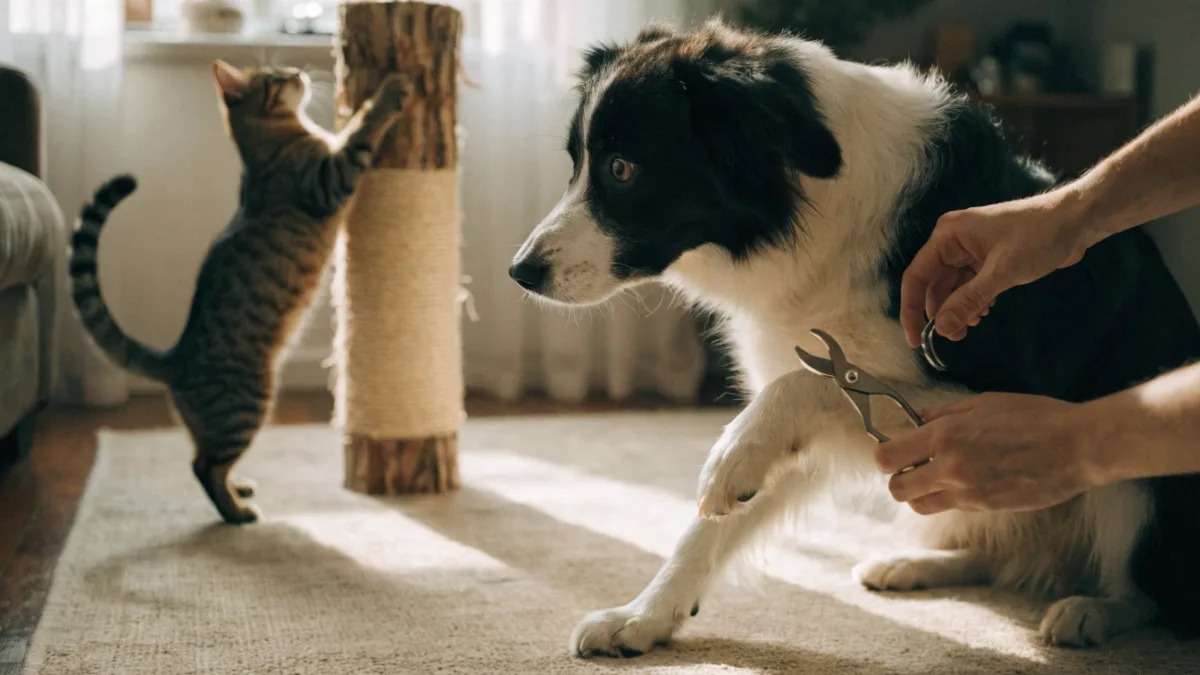
You’re hiding the nail clippers in a drawer, hoping your dog doesn’t hear you rummaging through the junk. Meanwhile, your cat is currently stripping the side of your brand-new couch down to the foam. Welcome to the pedicure predicament.
We all want our pets to have healthy paws, but the actual process of maintaining them often feels like a full-contact sport. You might think your dog is just being dramatic when they whip their paw away from you, or that your cat is acting out of spite when they shred your furniture. But there is actual biology and biomechanics driving this behavior. Once you understand what’s happening inside those paws, the whole struggle starts making a lot more sense.
The Anatomy of a Panic Attack
If your dog acts like nail trims are a form of medieval torture, they aren’t entirely wrong. The root of the problem is a bundle of nerves and blood vessels inside the nail called the quick. Because the quick is loaded with sensitive nerve endings, cutting into it doesn’t just cause a little bleed—it causes sharp, shooting pain.
Here’s what usually happens: an owner waits a little too long between trims, the quick grows long inside the nail, and then the clippers inevitably catch the edge of it. The dog yelps, bleeds everywhere, and the owner panics. It is a perfectly normal reaction. But for the dog, that single experience creates a lifelong association. Every time they see the clippers come out, their brain screams danger. Once that negative association is locked in, you’re dealing with a true phobia, not just an inconvenience.
There’s also an evolutionary piece to this puzzle. In the wild, a damaged paw is a death sentence. It means an animal can’t hunt, and more importantly, they can’t run from danger. Because of this, dogs and cats have a built-in, innate aversion to having their paws restrained. When you grab a foot and hold it still, you are triggering a deeply wired survival instinct.
Add breed-specific quirks to the mix, and things get even more complicated. Flat-faced breeds—like Pugs, French Bulldogs, and Boston Terriers—often have a much harder time with physical restraint and handling than other dogs.,[1] combined with their tendency to breathe heavily when stressed, means a simple pedicure can quickly spiral into an exhausting physical and emotional workout for everyone involved.
The Hidden Cost of Skipping Trims
It’s tempting to just give up on the nail trimmer and let nature take its course. I get it. The struggle isn’t worth the stress, right?
Here’s the problem: overgrown nails fundamentally change how a dog walks. When a nail is too long, it hits the ground at an awkward angle. You can use the 90-degree rule to check this. If your dog is standing flat on a hard floor, and their nails touch the ground at a strict 90-degree angle, they are officially too long.
When those nails constantly push into the floor, they act like lever arms. That backward pressure forces your dog’s toes upward or twists their foot to the side. To compensate for that discomfort, your dog will shift their weight. Over time, this completely ruins their natural posture. I’ve seen dogs adjust their gait so severely that they end up with irreversible joint issues, arthritis, and torn ligaments in their wrists and knees—all because their nails were too long.
Then there are the acute emergencies. Neglected nails will eventually curve downward and grow directly into the paw pad. It is painful, it gets infected easily, and it requires a vet to cut it out. Even if they don’t curl into the pad, long nails easily catch on carpets, sweater threads, or crate wires. When a dog panics and pulls back against a snagged nail, the nail tears completely off the toe. It bleeds profusely and hurts like hell.
The Three-Step Fix for Dog Nail Phobias
If your dog currently melts into a puddle of panic when you grab the clippers, you have to throw out your old approach. You can’t force your way through a phobia..[2] around paw handling. This is a slow process, but it actually works.
1. The Touch Phase
Put the clippers away. You won’t need them for days, maybe even weeks. Sit on the floor with your dog and a handful of high-value treats—real meat or cheese, not dry biscuits. Gently touch your dog’s shoulder, slide your hand down to their paw, and immediately give them a treat. You are pairing the sensation of touching with a massive reward. If they pull their foot away, let them. Don’t restrain them. You are teaching them that you touching their foot makes good things happen, and they always have the choice to opt out.
2. Tool Introduction
Once they are practically begging you to hold their paw, bring the tool out. Do not use it. Just set it on the floor near you. Let them sniff it. Treat them for looking at it. Pick it up, touch the handle gently to the side of their foot, and give them a jackpot of treats. You’re showing them that the tool isn’t a weapon.
3. Micro-Trims
This is where [3] Forget about getting the whole nail done in one sitting. Snip off a microscopic sliver of the very tip of one nail. Treat. Stop. Walk away. Later that day, or the next morning, do one more sliver. By only taking off tiny dust-sized bits, you virtually guarantee you will never hit the quick, and your dog gets to experience a stress-free trim.
Remember: the goal isn’t to finish the pedicure today. The goal is to make sure your dog isn’t terrified of the clippers tomorrow.
Clippers vs. Grinders
During this process, you’ll need to choose your weapon. Traditional scissor-style clippers are fast, but they carry a higher risk of pinching the nail or hitting the quick if your dog jerks their foot. Rotary tools are excellent because they file the nail down gradually, making it much easier to avoid the quick. They also leave a smooth edge. But rotary tools make noise and vibrate, which can be incredibly aversive to noise-sensitive dogs. If you go the rotary route, you’ll need to spend extra time desensitizing your dog to the sound and the feeling of the vibration before you ever touch it to a nail.
Feline Pedicures: Why Scratching Posts Are Non-Negotiable
While you’re busy fighting your dog over the clippers, your cat is across the room tearing up the arm of your sofa. They aren’t doing this because they hate your interior design. Scratching is an essential, biological need for cats.
When a cat sinks their claws into something and pulls back, they are shedding the dead outer husks of their nails. It’s how they keep their claws sharp and healthy. It’s also a massive full-body stretch for their back and shoulder muscles. And on top of the physical benefits, cats have scent glands tucked between their paw pads. Every time they scratch, they are leaving behind chemical signals that mark their territory and make them feel secure in their home.
Because scratching is so vital to a cat’s physical and mental health, providing heavy-duty scratching posts isn’t an optional accessory. It is a mandatory part of their care. Flimsy posts that wobble or tip over when the cat pulls on them are basically useless. If a post falls over while a cat is using it, the sudden thud can spook them, and they’ll avoid that post forever. Look for heavy, sturdy posts, or tension-mounted poles that stretch from the floor to the ceiling. They need to be able to throw their entire body weight into the stretch without anything shifting.
Of course, providing posts is also the ethical alternative to a terrible practice: declawing. Declawing a cat isn’t like trimming a fingernail. It is the surgical amputation of the last bone of each toe. It changes how the cat walks, often leads to chronic arthritis, and can cause lifelong litter box aversion when their feet hurt too much to dig into litter. In many parts of the world, the procedure is entirely banned. Providing a proper vertical scratching post respects the cat’s anatomy and lets them be a cat without destroying your house.
Changing the Game with Modern Gear
If you’ve tried the slow, force-free training and your dog still completely shuts down at the vet’s office, you aren’t out of options. The animal care industry has shifted massively toward reducing stress during routine procedures.
Many clinics are now embracing fear-free handling techniques. They use pheromone diffusers that release calming scents only dogs and cats can smell, specialized anti-anxiety mats that provide secure footing so pets don’t slip on the exam table, and gentle tilting stands that allow the groomer to work on the nails without forcing the dog onto their back or side.
There has also been a boom in anti-anxiety wearables. You might see groomers use a soft snood—a gentle fabric tube that slips over the dog’s head to lightly compress their ears. This muffles loud sounds and applies a subtle, steady pressure that calms the dog’s nervous system. Weighted body wraps apply the same kind of deep-touch pressure therapy, helping an anxious dog feel grounded and secure while their feet are being handled.
If the fear is so severe that your dog risks injuring themselves or the staff, don’t let anyone tell you that using temporary, vet-prescribed pharmaceutical intervention is the easy way out. Medication isn’t a cure-all, but it can lower the panic threshold just enough to allow you to safely get those nails trimmed without compounding the dog’s trauma.
At the end of the day, whether you’re teaching a dog to accept a nail file or buying a floor-to-ceiling cat tree, it all comes down to respecting your animal’s nature. Paws are sensitive, survival is instinctual, and our pets rely entirely on us to navigate a human world. When we replace force with patience, and frustration with understanding, we give our pets the exact same courtesy they give us every single day.
Sources
- Their sensitivity to handling — quora.com
- You have to completely rebuild their trust — facebook.com
- patience becomes your best tool — dogsthat.com