

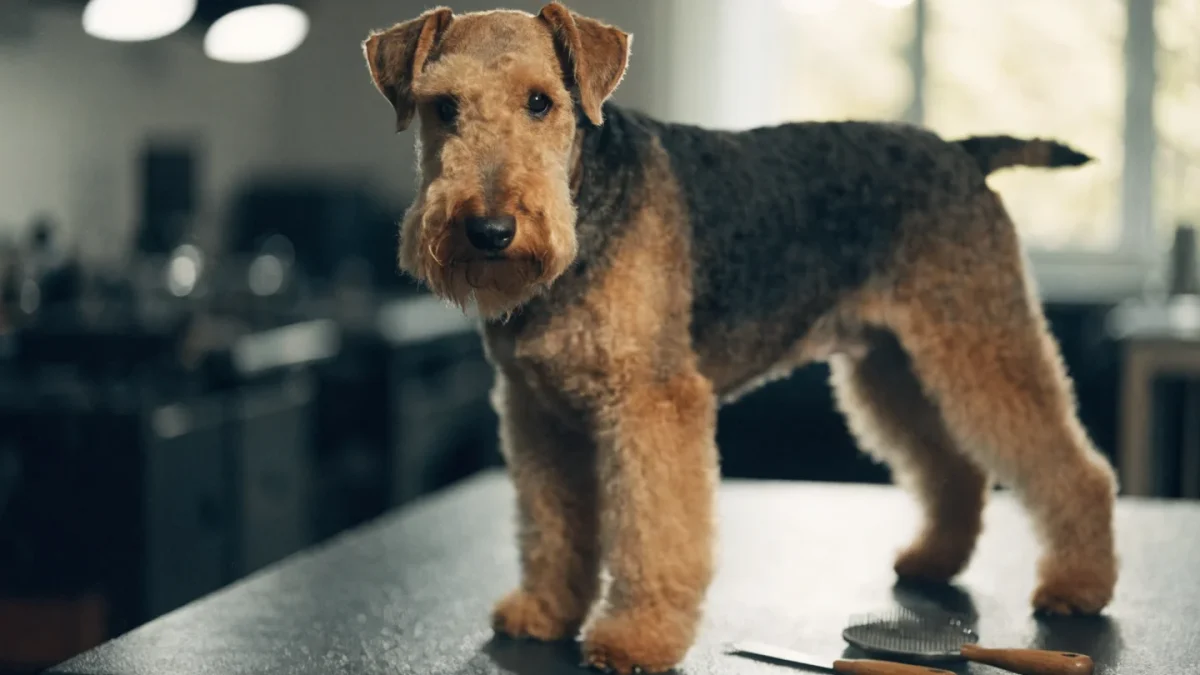
Of all the coat types in the dog world, the wire coat is the one most misunderstood — and most commonly managed incorrectly. The error most people make is thinking it's just a rough-textured coat that behaves like any other coat with a different feel. It's not. Wire coats have a specific structure and a specific lifecycle that determines how you need to approach maintenance, and getting it wrong has real consequences for the coat and the dog.
I've spent time around terriers at every level — backyard pets to championship Schnauzers to Airedales doing earthwork — and the ones with correct, functional coats all share one thing: their owners or handlers understand what a wire coat actually is and what it needs.
What Makes a Wire Coat Wire
The wire coat, also called a broken coat or rough coat, is a double-layer coat structure in which the outer guard hairs are harsh, dense, and stand away from the body. The individual guard hairs have a specific growth cycle: they emerge from the follicle, grow to full length, reach the "dead" phase where they stop growing but haven't shed, and then gradually loosen and fall out as new growth pushes them out.
The problem is that in most terrier and wire-coated breeds, the dead guard hairs don't fall out cleanly on their own. They stay in the follicle, blunting the coat's texture, blocking new growth, and gradually changing the coat from its correct harsh, weather-resistant texture to a softer, less functional one.
This is what hand stripping addresses. By manually removing the dead outer coat at the right point in the hair's growth cycle, you allow the new guard hairs to grow in correctly — maintaining the coat's proper harsh texture.
The Two Management Approaches
Hand Stripping
The traditional method for wire-coated breeds. Dead guard hairs are removed by pulling them out from the root — either with the fingers, a stripping knife, or a stripping stone — at the point in the growth cycle when they're ready to come out. Done correctly at the right time, it's neither painful nor difficult. Done incorrectly on coat that isn't ready, it's slow, uncomfortable, and ineffective.
Hand stripping:
- Maintains correct coat texture (harsh outer coat, correct color)
- Required for show competition in most terrier breeds
- Takes more skill and time than clipping
- Must be done on a consistent schedule
Clipping
Cutting the guard hairs with electric clippers, which cuts them at a point along the shaft rather than removing them from the root. Fast, easy, widely available from any groomer.
Clipping:
- Changes coat texture over time — the coat becomes progressively softer, less dense, and often changes in color
- The characteristic "wire" texture is gradually lost, replaced by a cottony or soft coat
- Suitable for pet dogs whose owners aren't concerned with show coat texture or working coat function
- Requires the same frequency as hand stripping in terms of timing
The choice between them depends on what the owner wants from the coat. For a pet dog, clipping is practical and humane. For a show dog or working terrier, hand stripping is the correct approach. The coat changes that clipping causes are real and progressive — a Wire Fox Terrier that's been clipped for 3-4 years will have a dramatically different coat texture and color than one that's been correctly hand stripped throughout its life.
Wire-Coated Breeds: What They Share
The breeds that carry wire coats span a remarkable range of sizes and types, but they share several coat characteristics:
Terriers: Wire Fox Terrier, Airedale Terrier, Schnauzer (all sizes), Border Terrier, Welsh Terrier, Lakeland Terrier, Jack Russell Terrier (rough), West Highland White Terrier, Cairn Terrier, Scottish Terrier, Irish Terrier
Spaniels and gundogs: German Wirehaired Pointer, Spinone Italiano, Wirehaired Pointing Griffon
Small companion breeds: Brussels Griffon (rough variety), Affenpinscher
The specific grooming approach varies by breed (Airedales require a different schedule and technique than a Border Terrier; Schnauzers have their own classic clipped outline), but the underlying principle — managing the outer coat's growth cycle — applies to all of them.
Routine Maintenance Between Strips or Clips
Whether you hand strip or clip, regular maintenance between sessions is necessary:
Brushing: Two to three times per week. Wire coats don't mat the way double coats or curly coats do, but regular brushing removes dead loose hairs and debris and keeps the coat in condition. A stiff bristle brush or a slicker brush works for most wire coats.
Tidying: Between full strips or clips, some owners do "rolling" the coat — removing dead hairs in stages from different areas so the coat is never all at the same growth stage at once. This produces a more even coat and reduces the length of full stripping sessions.
Bathing: Every 6-8 weeks. Wire coats are somewhat water-resistant and generally don't require frequent bathing. After field work or hunting, more frequent baths are appropriate.
The Timing of Hand Stripping
This is where hand stripping technique knowledge matters. Strip too early and the hairs aren't ready — they resist removal and cause discomfort. Strip too late and the dead hairs have been in the follicle too long, affecting new growth.
The right time to strip is when the outer coat is "blown" — when the dead hairs can be pulled loose easily with minimal resistance when you grip and pull a small section. You can test readiness by gripping a small amount of coat between thumb and forefinger and pulling in the direction of hair growth. If it comes out with minimal resistance, it's ready. If you feel significant resistance or the dog shows discomfort, it needs more time.
For the complete technique breakdown, hand stripping technique guide covers the full process.
Breed-Specific Grooming Schedules
Strip or clip schedules vary considerably:
- Wire Fox Terrier: Full strip every 8-10 weeks for show condition; maintenance every 4-6 weeks for working coat
- Airedale Terrier: Full strip every 10-12 weeks
- Schnauzer (Standard): Full clip or strip every 8-10 weeks; pattern clipping between sessions
- Border Terrier: Full strip every 6 months for working coat; more frequently for show
- West Highland White Terrier: Full strip every 8-10 weeks for show; clip as needed for pet
FAQ
My groomer says they can't hand strip my dog — should I find another groomer?
Many groomers clip because hand stripping is time-consuming and requires specific skill. For a pet dog, clipping is entirely acceptable if you're not concerned with preserving coat texture. For a show dog or a dog where correct coat texture matters, finding a groomer or handler experienced with your breed's coat is worth the effort.
Does hand stripping hurt?
When done correctly — on coat that's at the right stage of the growth cycle — hand stripping is no more uncomfortable than the dog would experience from normal coat change. Dogs with coats that are correctly stripped on schedule generally show no discomfort. Pain during hand stripping usually indicates the coat isn't ready, the technique is too aggressive, or the skin is particularly sensitive.
Can I hand strip my dog at home?
Yes. Hand stripping is a learnable skill. Start by watching demonstrations specific to your breed (technique varies), practice on small areas first, and learn to assess when the coat is ready. With a patient dog and consistent practice, home hand stripping is achievable.
Why does my clipped terrier's coat look so different from other terriers at dog shows?
Show dogs are hand stripped, maintaining the correct harsh outer coat. Clipped coats go soft over successive clips — the texture changes permanently at a follicle level over time. The color also often changes, particularly in black-and-tan terriers where the saddle color lightens with repeated clipping.
What's the difference between a stripping knife and a stripping stone?
A stripping knife has a serrated edge that grips the hairs as you pull; it's more efficient for larger areas. A stripping stone is a pumice-like block used for finer work in detailed areas like the face. Both are tools that grip the hair to assist the pulling action — neither actually cuts the hair.