

Every owner of a double-coated dog has tried something to manage the shedding. The vacuum that runs twice a day. The lint roller by every door. The deshedding shampoo that promised to reduce shedding by 90% and did approximately nothing. The groomer who told them the dog just "sheds a lot" and didn't explain why or what to do about it.
Here's what I've learned from watching this problem get solved and not solved across dozens of breeds over a decade: the shortcuts don't work. The bath-and-blow-dry process does work. And understanding why it works changes how you approach the whole thing.
The Biology First
A double-coated dog sheds in a specific pattern. The soft, wool-like undercoat grows in dense layers close to the skin. When the undercoat cycle turns — triggered primarily by light exposure, secondarily by temperature — individual hairs complete their growth phase and detach from the follicle. But they don't fall out. They get trapped.
The guard coat — the coarser outer layer — holds the shed undercoat suspended above the skin. Under normal conditions, some of this makes its way out through everyday activity, mechanical friction, contact brushing. A lot of it doesn't. It accumulates. Compresses. Eventually felts against the live undercoat beneath it, creating the dense felt-like mats that cause hot spots, skin issues, and genuine discomfort for the dog.
Deshedding isn't about removing the hairs that are falling out. It's about removing the hairs that have already disconnected but haven't escaped yet. That's an important distinction, because it changes the approach. You're not chasing shed hair with a vacuum and a lint roller. You're getting into the coat, below the guard layer, and physically extracting what's already gone dormant.
What Doesn't Work (And Why People Keep Trying It)
I'll be direct about this because there's a lot of marketing noise around deshedding products.
Deshedding shampoos and conditioners do soften the coat, which makes it easier to brush — that's real. They don't reduce shedding. The undercoat cycle is hormonally and neurologically controlled; a shampoo doesn't affect it. What it might do is make the post-bath brushing process slightly more effective, which is a legitimate but modest benefit.
Daily brushing alone — without bathing — keeps surface debris out and picks up loose undercoat that's already migrated to the coat surface. It doesn't reach the undercoat that's still compressed below the guard hairs. This is why a dog can look groomed on the outside while carrying months of compacted shed undercoat underneath.
Deshedding "tools" used on unwashed coat move some loose fur but miss the deeper layers that are still dry-bonded together. The water penetration from a proper bath is what loosens and separates trapped undercoat. Tools used on dry coat before a bath are useful for removing the loose surface layer — and should be used — but they're the opener, not the main event.
Blowing out a dry coat with a high-velocity dryer without a preceding bath gets some undercoat out, and it's better than nothing. It's not as effective as bath-then-blow, because the warm water and shampoo work together to break the surface tension holding dried undercoat compressed against adjacent hairs.
The Process That Actually Works
Step One: Pre-Bath Dry Brush
Before any water touches the dog, run through the coat with a slicker brush and then an undercoat rake. The purpose here isn't to deshed — you won't complete that job until after the bath. The purpose is to remove surface tangles, loosen the outer layer, and prevent dry tangles from becoming wet mats once water hits.
This step takes 10-15 minutes for most double-coated dogs, longer for denser coats. Don't rush it. Any mat that goes into the bath comes out worse.
Step Two: The Bath
Water temperature matters. Warm water — not hot, not cold — opens the coat and allows the shampoo to penetrate to the skin level. Cold water resists penetration; hot water can strip too many coat oils and irritate skin.
The shedding action starts here. As warm water saturates the undercoat, you'll see fur beginning to come out during the rinse. This is the undercoat loosening from adjacent hairs — the water breaks the surface tension that was holding compressed shed fur in place.
Work shampoo thoroughly to the skin. Don't just work the surface. Part the coat, press your fingers through, get the shampoo deep. The primary job of the bath in a deshedding context isn't cleaning — it's saturation. You need every part of the undercoat to be wet, soapy, and loosened.
Rinse completely. Incomplete rinsing leaves residue that causes itching and reduces the effectiveness of the blow-dry. When you think you're done rinsing, do another 30 seconds on the densest areas — the back, the neck, the chest.
Step Three: The Blow-Dry — The Critical Variable
This is where good deshedding and bad deshedding diverge.
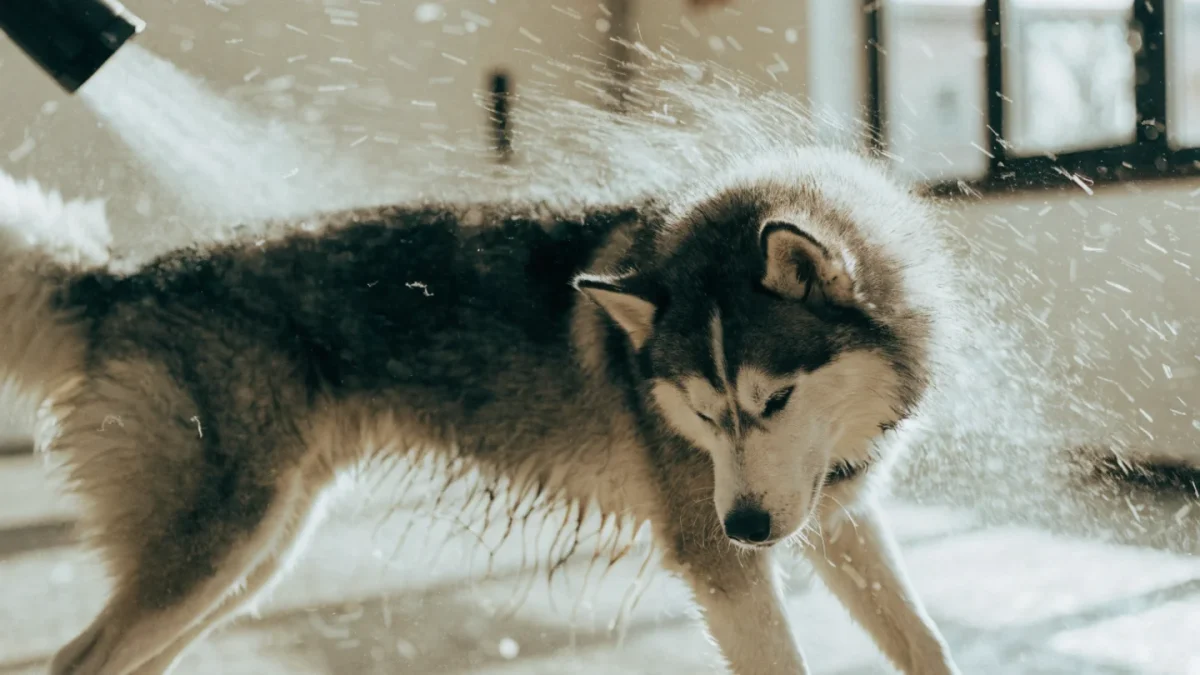
A high-velocity dryer doesn't just dry the coat. Directed correctly, it physically propels loose undercoat out of the coat on a stream of forced air. The expelled fur comes out in visible clouds, particularly in thick-coated breeds during coat blow. It's immediate and dramatic.
Start while the dog is still dripping. Direct airflow in the direction of coat growth. Work section by section, moving the dryer head in slow passes that penetrate through the guard coat. The density of fur in each expelled cloud tells you how much loose undercoat you had in that section.
Keep going until the coat is completely dry. Not damp — completely dry. Damp undercoat that gets brushed will compress slightly rather than releasing cleanly, and the dog will still smell musty.
Without a high-velocity dryer, the bath-and-towel-dry approach still helps because the bath loosened the undercoat — but the blow-out is what physically removes the bulk of it. A regular hair dryer on low heat can do some of this work, but it takes much longer and produces weaker airflow. If you have a Husky, Samoyed, or Malamute, a high-velocity dryer is worth buying.
Step Four: Post-Bath Brush and Rake
Once fully dry, go through the coat with the slicker brush first — the drying process separates the coat layers and surfaces additional loose fur. Follow with the undercoat rake. You'll get a second wave of undercoat coming out in this pass that the blowout loosened but didn't fully eject.
Finish with a metal comb throughout to confirm you've reached skin level. If the comb moves freely, you're done. If it stalls, more rake work needed in that section.
This entire four-step process — done properly on a dense double-coated dog — takes two to four hours. I've spent six hours on a particularly coat-heavy Samoyed at a show prep situation, including two bath cycles. That's the reality of managing serious double coats. It's not a chore you can cut short and get the same result.
The Coat Blow: When Deshedding Becomes Full-Time Work
Twice a year, the math changes entirely. During a coat blow — the mass shedding that happens as seasons shift — the volume of loose undercoat in the coat at any given time increases dramatically. A dog that normally requires weekly maintenance suddenly needs daily brushing and bath-and-blow sessions every one to two weeks just to keep up.
The coat blow typically lasts three to six weeks. Some breeds finish it quickly; Huskies seem to do it in phases; Chow Chows can feel like they're perpetually mid-blow in spring. Daily brushing during this period isn't optional — it's the difference between a manageable situation and a matted one.
This is also the appropriate time to incorporate a deshedding blade (Furminator-type tool). On clean, dry coat after the blow-dry, used for a few minutes in each session, the fine-toothed blade strips out loose undercoat aggressively and efficiently. Don't use it year-round and don't use it for more than five minutes per session — the blade can damage guard hairs if overused.
Seasonal Expectations and the Long Game
Managing shedding in a double-coated dog is a year-round commitment with two intense periods. Owners who accept this upfront and build the routine into their schedule manage it well. Owners who resist it until the situation becomes a problem then spend more time and money fixing it than maintenance would have cost.
The payoff for doing it right is a coat that looks and functions the way it was designed to — the guard hairs separated, the undercoat dense but not compacted, the dog comfortable and able to thermoregulate properly. A well-maintained double coat is genuinely one of the more magnificent things in the dog world. A neglected one causes real suffering.
For the full picture of undercoat raking technique — which is the backbone of the maintenance between full baths — and how raking and deshedding work together across the year, that's worth reading in detail. The two processes are complementary, not interchangeable.
The full double coat grooming guide covers the complete system, from tool selection through seasonal scheduling.
FAQ
How often should I deshed my double-coated dog?
A full bath-and-blow deshedding session every four to six weeks is appropriate for most double-coated breeds in normal coat phase. During coat blow, every one to two weeks. Maintenance brushing and raking between full sessions keeps the coat from deteriorating between appointments.
Does diet affect shedding in double-coated dogs?
The shedding cycle itself is primarily controlled by light exposure and hormonal factors — not diet. However, a diet deficient in omega-3 fatty acids, specifically EPA and DHA, can produce a dry, brittle coat that sheds more irregularly and breaks more easily. Good nutrition won't stop coat blows, but it does affect the health and quality of the coat year-round.
My dog sheds year-round, not just seasonally. Why?
Dogs that live entirely indoors under artificial lighting don't get the seasonal light cues that regulate coat blows in outdoor dogs. Many indoor dogs shift to a low-level continuous shed rather than two major seasonal blows. This is normal and usually produces a manageable situation — consistent but not overwhelming. It also means you don't get the obvious "it's coat blow season, increase everything" signal, so regular maintenance becomes even more important.
Will spaying or neutering affect shedding?
Hormonal changes from spay and neuter do affect the coat in some dogs. Intact dogs experience coat changes tied to hormonal cycles. Spayed females in particular sometimes develop a softer, denser undercoat called "spay coat" that's more prone to matting and harder to deshed. It varies a lot by individual and breed. Something to be aware of if you notice coat quality changes after surgery.
Should I brush my double-coated dog every day?
Daily brushing is only necessary during coat blow. Outside of that period, every five to ten days is sufficient for most breeds. Daily brushing year-round can actually damage the coat if you're using a deshedding blade — you'll strip more coat than needed. For regular maintenance, a slicker and rake every week or two keeps most double coats in good condition without overdoing it.