

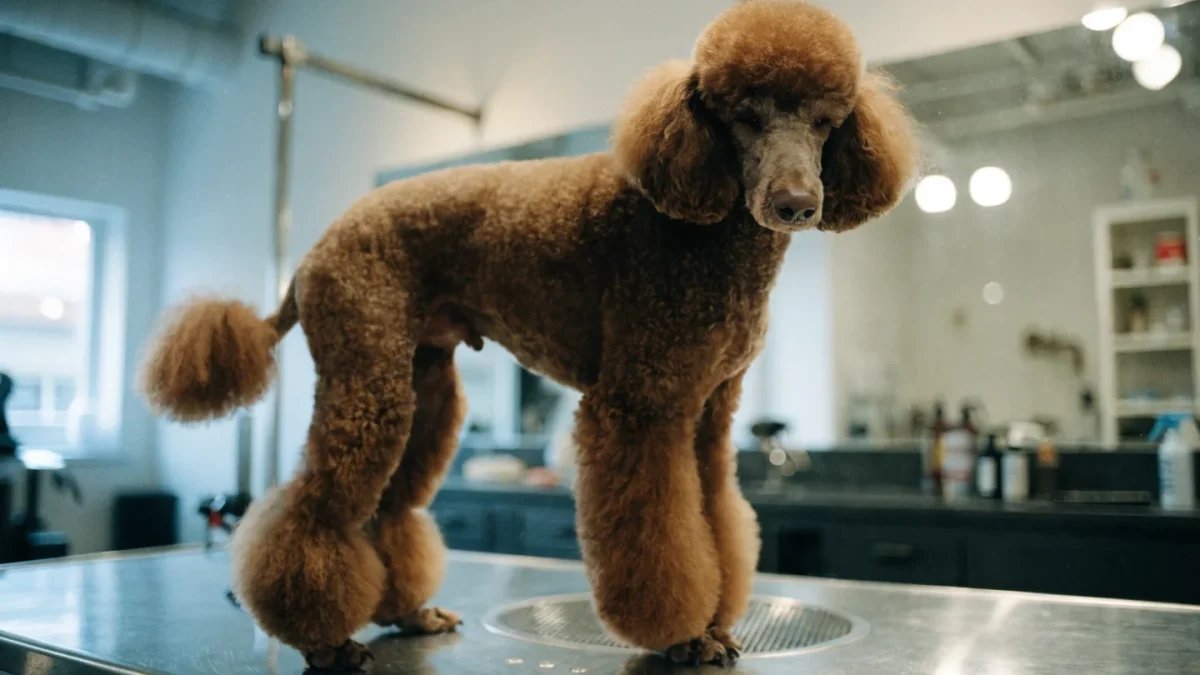
A Standard Poodle taught me to respect the limits of home grooming. Specifically, a 14-month-old silver Standard named Beau — owned by a very determined woman in Connecticut who had watched approximately forty hours of YouTube tutorials before attempting his first scissor trim. Beau wasn't difficult. He stood perfectly still, took treats calmly, and couldn't have been more cooperative. The haircut was, charitably, sculptural. One side of his topknot sat three inches higher than the other. His feet looked like four different dogs had contributed them.
She laughed about it. Beau didn't care. But she asked me the question I've heard a hundred times since: "Is it worth trying to do this myself?"
The honest answer is: sometimes yes, sometimes no, and the correct answer depends on factors most articles skip entirely. If you're leaning toward home grooming, the pet grooming tools and equipment guide covers every equipment category — what each tool does, which coat types need it, and what to buy first.
The Real Variables
Forget the generic advice about "saving money" or "bonding with your dog." Those aren't the variables that determine whether home grooming works. These are:
Coat type. This is the single most important factor. A short-coated Beagle needs a bath, nail trim, and ear check — tasks any reasonably patient person can learn. A Poodle, Bichon Frise, or Portuguese Water Dog needs precise clipper work, scissors finishing, and knowledge of breed-specific patterns. The skill gap between those two dogs is enormous.
Coat condition. A well-maintained coat in good condition is manageable at home. A matted, neglected coat is not — not because you lack equipment, but because badly matted coats require decisions about dematting vs. shaving that have skin and welfare consequences. The wrong call can pull skin into the mat as you work.
Your dog's temperament. A dog who tolerates handling, stays reasonably still, and responds to treats is a good home grooming candidate. A dog who panics at the sight of clippers, spins, bites, or shuts down completely is not — regardless of your skill level.
Frequency of maintenance. Breeds requiring trims every six to eight weeks are expensive to maintain professionally. If your budget can't absorb $80 to $120 every two months, learning basic maintenance becomes a financial necessity, not a preference.
Your own hands and patience. Grooming is physical work. Scissoring a large dog takes time — sometimes 90 minutes to two hours for a thorough finish. If you find detailed handwork tedious, your dog will sense the impatience.
What Professionals Bring That You Can't Buy
Equipment, yes — professional-grade clippers, high-velocity dryers, raised tables with restraints. But that's not primarily what you're paying for.
You're paying for practiced pattern recognition. A groomer who has bathed and finished five hundred Cocker Spaniels knows, before the first snip, exactly how this dog's coat will behave, where the mats hide, how tight the ear canal is, which angles will make the trim look balanced. That knowledge is not learnable from a single dog or a video tutorial. It accumulates through repetition.
You're also paying for the restraint setup. A properly equipped grooming table with a grooming arm holds the dog at a comfortable working height and limits sudden movements. This matters for safety — your dog's and yours. A dog who shifts suddenly on a slippery bathtub floor is a sprain risk. A dog on a professional table, properly secured, isn't.
Professional groomers also notice things owners miss. Lumps, skin irregularities, ear odor, nail abnormalities — these appear during grooming before they appear during a casual pet. It's not a substitute for veterinary care, but it's a useful second set of eyes.
What You Can Realistically Learn at Home
The skills that transfer well to home grooming, in rough order of learnability:
Brushing and combing. Every dog owner should do this regardless of professional appointments. Weekly brushing on most coats, daily on long or curly coats prone to matting. This is low-skill, high-value, and non-negotiable.
Bathing. Manageable for most dogs if you have a handheld showerhead and a non-slip mat. The technique — thorough wet-down, proper shampoo application, complete rinse — takes a few attempts to optimize.
Nail trimming. High on the fear list for most owners, but genuinely learnable. The main skill is reading the quick, which is easier on light-colored nails and requires confidence on dark ones. Most dogs resist initially; consistent handling from puppyhood reduces this dramatically.
Basic clipper maintenance. Short-coated breeds needing a sanitary trim — paws, belly, groin — can be maintained with a simple clipper and a steady hand. Not breed-specific patterning, but maintenance between professional appointments.
Ear cleaning. Routine cleaning with an appropriate solution is owner-maintainable. Ear hair plucking (for breeds that need it) requires practice and judgment about when plucking helps vs. irritates.
Eye and face cleaning. Daily for flat-faced breeds prone to tear staining. A slightly damp cloth, careful technique around the eyes, done.
Where Home Grooming Breaks Down
There are scenarios where home grooming stops being a reasonable option, and I've seen owners push past those limits with poor results.
The matted double coat. Golden Retrievers, Border Collies, Australian Shepherds — their undercoats can compress into dense, felt-like mats that pull on skin and restrict movement. Attempting to demat these at home with a dematting comb is often painful for the dog and leaves the coat in worse condition. A professional can assess the mat severity and either demat safely or recommend a shave-down, which at least starts fresh.
Breed-specific pattern cuts. If you own a breed whose standard (or common owner preference) involves specific scissored shapes — Schnauzers, Westies, Cairn Terriers, any Poodle variety — the learning curve for achieving those shapes is genuinely long. Clippers can get close; scissors finishing is another discipline entirely.
Anxious or reactive dogs. A dog who has had a bad grooming experience, or who was never properly desensitized to handling as a puppy, often does better with a professional — specifically, a groomer experienced with anxious dogs, ideally one who uses fear-free or low-stress techniques. The environment matters, the patience matters, and the skill of reading canine stress signals matters.
Thick or long coats on large dogs. Bathing a Great Pyrenees or Bernese Mountain Dog at home — actually getting the undercoat fully wet, fully shampooed, and fully dried — is a multi-hour project. High-velocity dryers are loud, expensive, and not household items. Doing it inadequately leaves moisture trapped against the skin.
The Hybrid Approach
Most experienced dog owners land here eventually: professional grooming for the complex work, home maintenance between appointments.
Concretely, that looks like: bath and full groom at the salon every six to eight weeks, weekly brushing and face cleaning at home, monthly nail check with a touch-up between professional appointments if nails grow fast, ear checks after every bath.
This approach costs less than exclusive professional grooming, keeps the dog in better condition than exclusive home grooming (for most people), and distributes the workload sensibly.
The transition point — what you take on at home vs. what stays at the salon — shifts as your skill builds. Some owners start with brushing only, add nail trims after six months, graduate to basic clipper maintenance in year two. That progression is completely reasonable.
Breed-by-Breed Reality Check
Smooth-coated breeds (Beagle, Boxer, Dalmatian, Vizsla): Home grooming is fully viable. Bath, brush, nails, ears. Professional appointments optional.
Wire-coated terriers (Airedale, Westie, Border, Welsh Terrier): Needs hand-stripping for show coats, clipper trims for pet coats. Home maintenance between appointments is workable; full pattern cuts require professional skill.
Drop-coated breeds (Afghan Hound, Maltese, Shih Tzu): Daily brushing is non-negotiable and owner-maintainable. Trim work benefits from professional experience.
Double-coated shedding breeds (Labrador, German Shepherd, Corgi): Bathing and deshedding are manageable at home with the right tools — specifically, a good undercoat rake and patience. High-velocity drying helps significantly.
Curly and wavy coats (Poodle, Bichon Frise, Doodle mixes): Professional grooming strongly recommended unless you're committed to learning clipper and scissor technique properly. These coats mat fast and require regular attention.
Heavily coated working breeds (Great Pyrenees, Samoyed, Newfoundland): Bath and brush possible at home if you have time and equipment. Professional grooming reduces the time investment significantly.
The Cost Calculation
Professional grooming costs range broadly — $40 for a small smooth-coated dog to $150 or more for a large curly-coated breed in a high-cost-of-living area. Frequency matters: a Labrador who doesn't need trimming might go twice a year; a Bichon needs every six to eight weeks.
Home grooming equipment — quality clippers, professional shears, a good brush set, nail grinder, grooming table — runs $300 to $600 for a solid starter setup. The payback period depends entirely on your dog's size and coat type. For a large Poodle mix going to a groomer every eight weeks at $100 per visit, the equipment pays for itself in under a year.
What the math misses: the time cost, the learning curve, and the mistakes made during that curve. Factor those in honestly.
Making the Decision
Answer these questions directly:
Does your dog's coat require pattern cutting or specific breed styling? If yes, professional grooming is the baseline; home maintenance is the supplement.
Does your dog have anxiety or reactivity around grooming? If significant, a professional experienced with difficult dogs will often achieve better outcomes than an owner the dog is comfortable testing.
Are you willing to brush multiple times per week, every week, indefinitely? If not, high-maintenance coats don't belong on your list of home grooming candidates.
Do you have two hours to groom a large dog, when that time comes? If not, professional grooming is a practical necessity.
The answer to "professional vs. home" is almost never absolute. It's a spectrum, and the right place on that spectrum depends on your specific dog, your specific skills, and your specific willingness to build those skills.
FAQ
At what age can I start grooming my dog at home?
Start handling exercises from the first day home — touching paws, ears, mouth. Actual grooming (brushing, bathing) can begin immediately with appropriate products for your puppy's age. The earlier you build positive associations with grooming tools and handling, the easier everything becomes.
What's the minimum equipment needed to start home grooming?
A good slicker brush and metal comb, nail clippers or a grinder, a gentle shampoo, and a non-slip mat for the tub. Add a handheld showerhead if you don't have one — it transforms bathing. Clippers come later, once you've assessed whether your dog's coat actually needs them.
How do I know if my groomer is doing a good job?
Your dog should come back calm or at least not traumatized — some stress is normal, but a dog who shakes, cowers, or shows persistent fear after appointments needs a different groomer. The coat should be clean, free of mats, and styled consistently with what you requested. Nails should be visibly shorter. Ears should be clean.
Can I switch between professional and home grooming depending on the season?
Absolutely. Many owners handle maintenance baths and brushing at home during winter (when outdoor mess is high) and rely more heavily on professional appointments before summer or during shedding seasons. The flexibility is one of the benefits of developing basic home grooming skills.
What if my dog hates the groomer?
Look for a groomer who uses fear-free or low-stress handling techniques. Ask about their process for anxious dogs specifically. Some groomers do one-on-one appointments without other dogs present, which helps. If the problem is severe, a veterinary behaviorist's input on the anxiety itself may be necessary before grooming can be productive.