

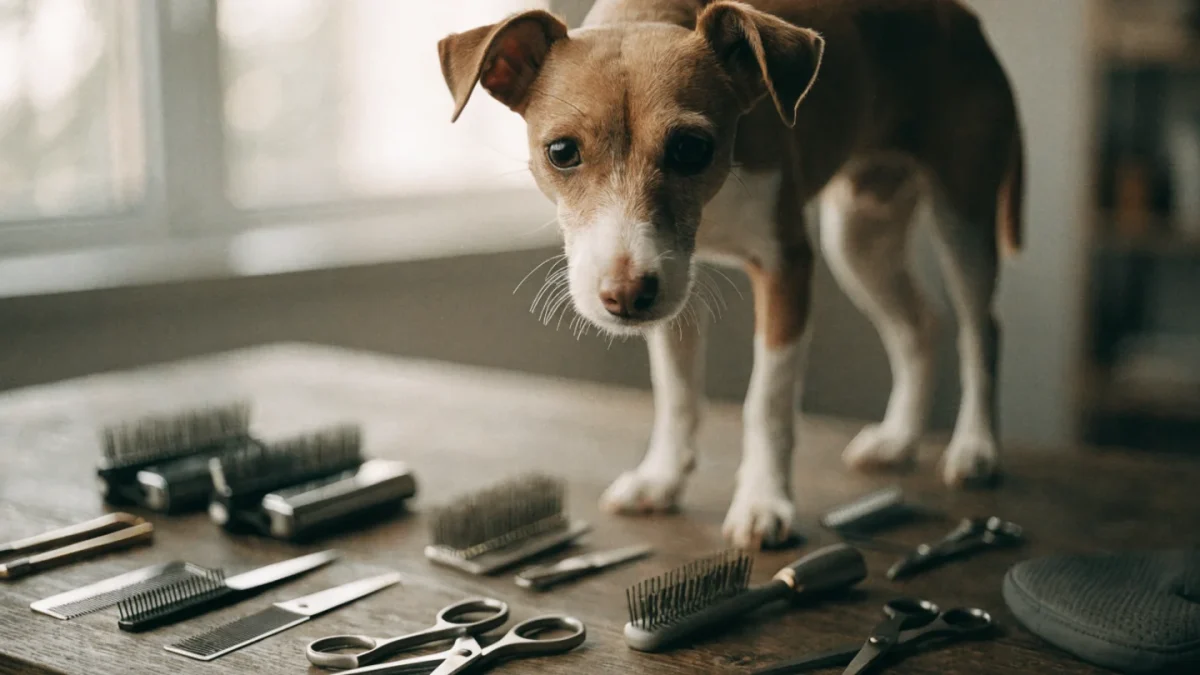
The pet grooming tool market is enormous, bewildering, and full of items that have specific uses being sold as universal solutions. Walk into any pet supply store with the intention of "getting what I need to groom my dog" and you'll leave either overwhelmed or with the wrong tools.
This guide covers every category of grooming equipment — what each tool actually does, which coat types it's appropriate for, what to look for when buying, and what you can skip. I've handled most of the tools I'm describing on actual dogs over the past decade. Some of the things marketed enthusiastically to pet owners are genuinely useful. Others are solutions to problems you don't have.
Brushes: The Foundation
Brushes are the most important category and the most complicated. Different coat types require different brush types — using a slicker brush on a smooth-coated dog is cosmetic at best; using a bristle brush on a double-coated breed is near-useless at reaching the undercoat.
Slicker Brushes
Rectangular or oval head with dense, fine wire tines set at an angle. The standard workhorse for most grooming tasks. Slicker brushes work well on:
- Medium-to-long coats
- Wavy and curly coats
- Double coats (outer layer maintenance)
- Removing loose fur during shed season
The tines are close-set and angled, which grabs loose hair and tangles efficiently. The firmness of the tines varies — soft-flex tines for sensitive areas, firmer tines for heavy coats.
How to use it right: Apply gentle pressure and use smooth strokes, working with the direction of hair growth. On longer coats, use the "line brushing" technique — part the coat, hold back the upper layer, and brush from the skin upward in sections. Never drag a slicker through a mat. Work from the mat's edges inward after applying detangling spray.
What to look for: A comfortable grip, firm enough tines for your dog's coat type, and a head size appropriate to the dog. A 4-inch head on a Labrador Retriever saves time; a 4-inch head on a Chihuahua is unwieldy.
Pin Brushes
Oval or rectangular head with metal pins (often ball-tipped to protect skin) set in a flexible rubber or cushioned base, spaced farther apart than slicker tines. Pin brushes are gentler than slickers and excellent for:
- Long, flowing coats (Rough Collies, Setters, Afghan Hounds)
- Finishing after slicker brushing
- Fluffing and smoothing
- Coats that are prone to breakage from aggressive brushing
Pin brushes don't remove as much loose hair as slickers but are less likely to break the coat. Many long-coat breed specialists use a pin brush first (to work through the coat without damage) and a slicker only in dense or tangled areas.
What to look for: Ball-tipped pins (essential — bare metal pins scratch skin), a cushioned base that flexes with the dog's body contours, and appropriate pin length for the coat depth you're working.
Bristle Brushes
Natural or synthetic bristles on a traditional brush head. These are finishing brushes — good for:
- Short, smooth coats (Boxers, Vizslas, Beagles)
- Final pass after slicker/pin brushing on any coat
- Stimulating skin oil production
- Removing surface dust and fine debris
Bristle brushes don't penetrate into medium or long coats effectively. On a Labrador or a German Shepherd, a bristle brush is fine for quick maintenance between thorough grooming sessions. On a Rough Collie, it's cosmetic.
What to look for: Firm natural bristles for short coats; softer bristles for sensitive skin. Natural boar bristle is excellent for finish work on any coat.
Rubber Curry Combs and Grooming Mitts
Rubber tools with nubs or tines — available as handheld ovals or as mitts that slip over the hand. Excellent for:
- Short to medium smooth coats
- Removing loose fur from single-layer coats
- Bathing (work shampoo into the coat and stimulate skin simultaneously)
- Dogs who resist traditional brushes (the massage quality tends to be accepted more readily)
Not effective on long or double coats — the rubber doesn't penetrate deep enough.
Combs: The Checkpoint
Steel combs are used after brushing to verify that the brush reached the skin. If a comb passes from skin to tip without resistance anywhere in the coat, the brushing is thorough. If it catches, there's mat or undercoat remaining that the brush missed.
Types of Steel Combs
Wide/medium/fine tooth: Most groomers use a combination comb with wider spacing at one end and finer at the other. Wide end for initial work through medium or thick coats; fine end for the face, ears, and thin-coated areas. A medium-tooth comb handles most jobs.
Flea combs: Very fine-tooth combs designed to drag flea debris and parasite matter from the coat. Useful for monitoring flea presence, particularly in puppies and cats. Not a replacement for flea prevention.
Dematting combs: Feature curved, separated tines or blade edges designed to break apart mats without cutting through them entirely. The curved blades work through the mat structure progressively. These are more aggressive tools — they do some cutting — and should be used carefully near sensitive areas.
Deshedding Tools
The category that's been most heavily marketed over the past decade. Deshedding tools have a blade-like edge (usually stainless steel) set in a handle, designed to reach through the outer coat and pull out loose undercoat in quantity. They work well for:
- Double-coated breeds during shed season
- High-volume undercoat removal
Used correctly — with moderate pressure, in the direction of hair growth, on a brushed coat — a deshedding tool is genuinely useful on heavy double-coated breeds like German Shepherds, Huskies, and Golden Retrievers during blow season. Used incorrectly or too aggressively, it removes coat that should stay.
Deshedding rakes: Long-tined tools, often with a double row of pins, designed to reach deep into a thick double coat and pull out loose undercoat. Good for breeds with dense undercoats (Chow Chows, Siberians, Newfoundlands).
Deshedding blades: Toothed or serrated blades on handles — used in a scraping motion to strip loose coat from the surface. More aggressive than rakes.
Grooming gloves: Discussed in detail in the brushes section. Useful supplementary tools, not primary deshedding instruments.
Clippers
Home-use clippers for dog grooming come in two main categories: single-speed rotary motor clippers and variable-speed clippers. For most pet owners who want to trim between professional grooms or maintain a short clip on a lower-coat-demand dog, single-speed clippers are sufficient. Variable-speed clippers handle a wider range of coat types — especially heavier, coarser coats — and are quieter at lower speeds, which matters for anxious dogs.
Blade selection: Clipper blades are sized by number — the higher the number, the shorter the cut. A #10 blade (1.5mm) is standard for feet and sanitary areas. A #7 or #5 is common for body clips on cocker types. A #30 is for very close work. Blade selection is one of the most common areas of confusion for new home groomers. (Detailed guide: see the clipper blade sizes article in this cluster.)
Corded vs cordless: Corded clippers provide consistent power without battery concerns. Cordless clippers offer maneuverability but need charging management. For occasional home use on small or medium dogs, cordless is convenient. For regular use on large, thick-coated breeds, corded clippers don't lose power mid-groom.
Noise: Motor sound varies significantly between models. For noise-sensitive dogs, quieter operation is a real consideration, not marketing. Lower-speed modes reduce both noise and vibration.
Scissors and Shears
Three types relevant to home grooming:
Straight scissors: General trimming. Feet, facial shaping, outline work. A 6–7 inch straight scissor is the versatile choice for most home use.
Curved scissors: The curve follows body contours, making it easier to trim around ears, eyes, and limbs without awkward hand positioning. Particularly useful for face work.
Thinning shears: One blade has teeth, one is straight. Cutting removes only a percentage of hair at each snip, blending and thinning rather than cutting a clean line. Essential for blending and softening transitions — between body and legs, around ears, any area where a clean scissor line would look harsh.
Safety: Scissors near a moving animal are always a risk. Blunt-tip scissors for work near eyes, ears, and sensitive areas. Never cut toward the skin on a tented mat.
Nail Care
Guillotine clippers: A blade slides across the nail, cutting it. Good for small nails; requires proper blade alignment. Blades dull and should be replaced regularly.
Scissor-type clippers: Work like scissors around the nail. Better for larger breeds and clearer visibility of where you're cutting. Most professional groomers prefer scissor-type for medium to large dogs.
Grinders/dremels: Rotary grinding tools that file the nail rather than cut it. Produces a smooth, rounded edge (no sharp corners). Preferred by many owners who are nervous about cutting the quick. The noise and vibration require desensitization in some dogs.
Styptic powder: Not a cutting tool but essential to have on hand. Applied to a cut quick to stop bleeding. Every home groomer should own it.
Ear Care Tools
Ear cleaner: Veterinary-formulated ear cleaning solutions for routine maintenance. Standard practice is to apply a small amount, massage the base of the ear for 30 seconds, then allow the dog to shake, then wipe the outer canal with a cotton ball. Never use cotton swabs deep in the ear canal.
Ear powder: Used by groomers to grip and remove hair from inside the ear canal before plucking. Applied inside the ear, gripped with fingers or hemostats. Contested somewhat — some veterinary dermatologists prefer trimming canal hair rather than plucking.
Hemostats: Locking forceps used to grip and pluck ear canal hair in breeds that grow significant hair in the canal (Poodles, Bichons, some terriers). A skilled groomer procedure; not something to attempt without guidance the first time.
Bathing Tools
High-velocity dryers: Blow hot or warm air at high velocity to physically blow the coat apart and dramatically speed drying. Essential for thick double-coated breeds. The airflow blows loose undercoat out during blow season. Transformative if you groom a German Shepherd, Samoyed, or Newfoundland at home — what takes two hours of stand-dryer work takes 20 minutes. Expensive but the single most useful upgrade for heavy-coat breeds.
Stand dryers: Direct warm air at moderate velocity, hands-free. Used in professional grooming salons mounted on adjustable stands. Good for working through a coat with a brush while drying.
Grooming noose and arm: Attached to a grooming table or bath, loops around the dog's neck to prevent them stepping off the table. Safety device — a dog who steps off a grooming table can injure itself. Not restraint, just positioning.
Grooming Tables
A fold-out table at standing height eliminates the back strain of grooming on the floor and puts the dog at a height where handling is easier. Not essential for small or cooperative dogs. Increasingly useful as dog size and grooming complexity increase.
Fold-flat tables are the practical choice for home groomers — stored when not in use. Look for a non-slip surface and a sturdy frame. A grooming arm (for the noose) typically attaches to one end.
Height-adjustable tables are the professional standard. A hydraulic or electric lift table eliminates the problem of adjusting to dog size. Significant investment; primarily worth it for regular, multi-dog grooming.
Building Your Kit
The minimum effective kit varies by coat type:
Short single-coated breeds (Vizsla, Boxer, Greyhound): rubber curry brush or grooming mitt, soft bristle brush, metal comb, nail clippers, ear cleaner.
Double-coated shedding breeds (Labrador, German Shepherd, Husky): slicker brush, undercoat rake, wide-tooth metal comb, nail clippers, ear cleaner. High-velocity dryer if you can budget for it.
Long-coated or continuously-growing breeds (Poodle, Shih Tzu, Maltese): slicker brush, pin brush, fine-tooth steel comb, straight and curved scissors or clippers, nail clippers, ear cleaner.
Cats: slicker brush or pin brush (depending on coat length), fine-tooth comb for face and ears, flea comb for monitoring, nail clippers.
The equipment should match the dog in front of you, not the most complete professional kit available. Start with the fundamentals, add specialized tools as the need becomes apparent. For bathing tools and technique, the bathing guide for dogs and cats covers everything from shampoo selection to drying methods.
For brush types compared in detail, see our guide to dog grooming brushes. For clippers, see our guide to home-use dog grooming clippers.