

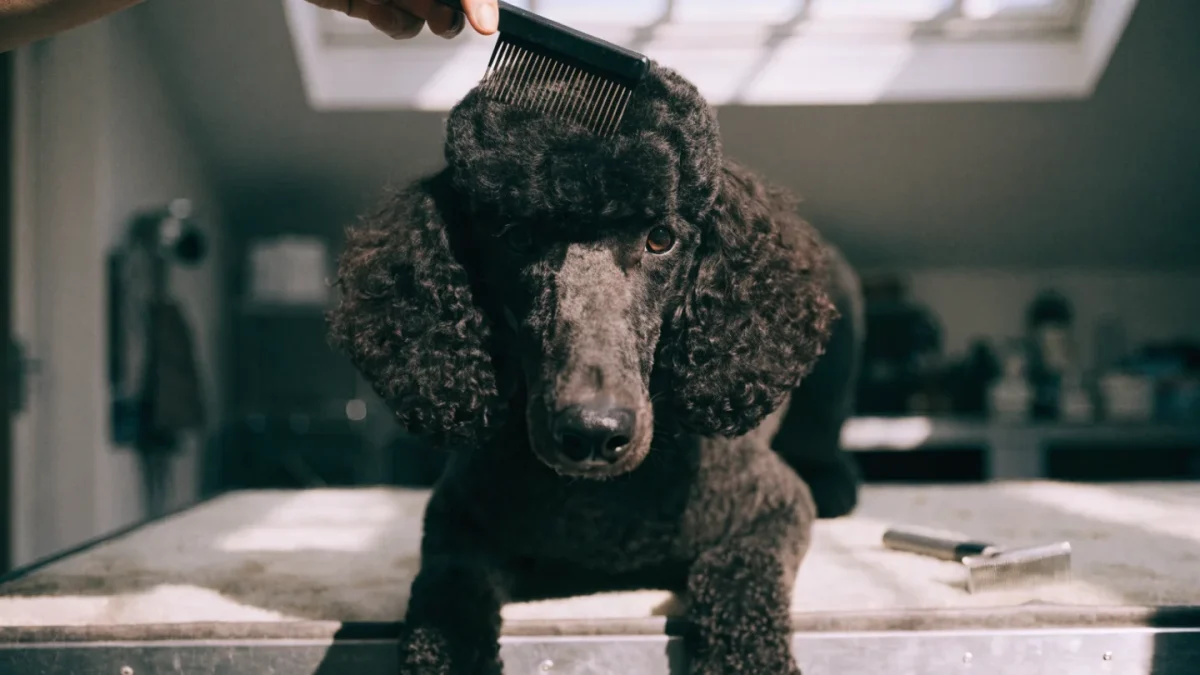
People often compare curly-coated dogs to double-coated breeds when they talk about grooming difficulty. The comparison isn't wrong exactly — both require real commitment — but they're difficult in completely different ways.
A double-coated dog sheds. The challenge is managing what comes out. A curly or wool-coated dog doesn't shed in the conventional sense — the coat grows continuously, and if you don't manage it proactively, it mats into felt. The challenge is staying ahead of a coat that never stops growing and tangles at a rate that would shock you if you're coming from short or smooth-coated breeds.
I've spent years around Poodles at shows and Doodles in training groups and Bichons in pet homes, and the consistent pattern I see is this: owners who understand what continuous-growth coats actually require thrive with these breeds. Owners who don't understand it — who brush occasionally and hope for the best — end up at groomers asking for a shave-down on a dog that arrived matted to the skin.
What Makes Curly/Wool Coats Different
The coat grows from individual follicles continuously, the way human hair grows. It doesn't shed in the seasonal blowout pattern of double-coated breeds. Loose hairs that would fall out on a double-coated dog instead get trapped in the curls — which is why these breeds are often called low-shedding — but trapped hair becomes matted hair if it's not removed through regular brushing.
The curl pattern matters enormously:
- Tight curls (Poodle, Bichon Frise) mat quickly and require more frequent brushing
- Loose curls or waves (some Doodles, Portuguese Water Dog) have slightly more forgiveness but mat just as badly when neglected
- Wool coats (Bedlington Terrier, Lagotto Romagnolo) have a distinct texture that requires different tools than a tight Poodle curl
All of them need to be clipped or trimmed regularly because the coat doesn't stop growing.
Brushing: The Non-Negotiable
Three to five times per week is the minimum for curly-coated breeds, depending on coat texture. Poodles and tightly curled coats need the higher end of that range. Every-other-day brushing, at minimum.
The technique that works is line brushing — the same systematic section-by-section approach used for double coats. With curly coats it's even more critical, because the mat in a curly coat forms from the inside out. The surface can look fine while the coat is felting underneath.
Work in sections: hold a portion of coat back with one hand, brush from the skin outward in short strokes, move through the section systematically. A slicker brush works for most curly coats. A comb through after brushing confirms you've reached the skin.
The slicker brush plus comb combination is the standard kit for curly-coated breeds. The comb is the quality check — if it doesn't move freely from skin to coat tip, there's more work to do.
The Clip Schedule
Curly and wool-coated dogs need a haircut every 6-8 weeks. Some dogs with fast-growing coats need it every 4-6 weeks. Waiting longer means more work for the groomer and a higher chance that underlying mats have developed.
Between professional clips, home brushing maintenance is what keeps the coat in condition to be clipped efficiently. A groomer receiving a dog that hasn't been brushed in 4 weeks since its last clip is often looking at a shave-down rather than a style cut — the coat has matted too close to the skin to work with.
Breed-Specific Notes
Poodle: The standard-bearer for this coat type. Clip schedule 6-8 weeks; daily to every-other-day brushing between clips. Poodle haircuts and clip styles covers the range from puppy cut to continental.
Doodles (Goldendoodle, Labradoodle, Cockapoo, Schnoodle): Variable coat texture depending on which parent traits dominate. Curly Doodle coats are as demanding as Poodle coats; wavy Doodle coats are slightly more forgiving. The challenge specific to Doodles is unpredictability — littermates can have significantly different coat types. Doodle grooming for mixed curly coats addresses the specific challenges.
Bichon Frise: Dense, springy coat that requires daily brushing and 4-6 week clip schedule. The white powder-puff silhouette that defines the breed requires consistent maintenance to achieve.
Portuguese Water Dog: Two coat varieties — wavy and curly. Both require regular brushing and clipping. The working clip and lion clip are the two traditional styles for this breed.
Lagotto Romagnolo: Dense, ring-formed curls that can cord naturally if left. Most pet owners prefer to keep the coat trimmed to a manageable length; traditional corded Lagottos require a different approach entirely.
Bedlington Terrier: Wool-textured coat with a distinct linty feel. Requires regular trimming and shaping to maintain the characteristic silhouette.
Irish Water Spaniel: Dense, tight curls on the body with a smooth face and "rat tail." Regular clipping and consistent brushing.
Bathing Curly Coats
Every 4-6 weeks, more frequently than double-coated breeds. Curly coats trap debris and lose their curl pattern when dirty.
For curly coats: brush before the bath, use a curl-enhancing or moisturizing shampoo formulated for wavy/curly coats, and dry thoroughly. Unlike double-coated breeds, some owners of tightly curled dogs use a light leave-in conditioner to help maintain curl formation — this is appropriate for this coat type where it wouldn't be for double coats.
Drying approach varies by curl tightness. Poodle coats are traditionally blown dry while being brushed to give volume and a consistent finish. This takes practice but produces the best result for show or styled cuts. For pet clips, a high-velocity dryer plus final fluff with a slicker brush works well.
What Happens If You Skip Brushing
The mat forms from the inside out. The coat surface looks reasonable while the interior is felting against the skin. When a curly-coated dog arrives at the groomer significantly under-brushed, the only option is often a full shave-down — removing all the coat and starting fresh. This is a reset, not a failure, but it takes 6+ months to grow back to working length.
The irony is that curly coats that are properly maintained are genuinely low-shedding and manageable. The same coat, neglected, becomes a welfare issue. The coat type doesn't change — what changes is whether the owner is keeping up.
FAQ
Are curly dogs really low-shedding?
Yes and no. They don't leave hair on your furniture the way double-coated breeds do — shed hairs stay in the coat. But those hairs still need to come out via brushing, or they mat. "Low-shedding" means low environmental shedding, not low-maintenance.
Can I groom my curly dog at home without professional help?
Many owners do, with the right clippers, scissors, and technique. The learning curve is real — getting even lines and a balanced silhouette takes practice. Most people find a hybrid approach works best: professional clips every 6-8 weeks, consistent home brushing in between.
My dog's curls keep going flat between groomings — why?
Usually a combination of oil and debris buildup, and possibly coat overgrowth. More frequent bathing and brushing with a slicker to separate curls can help. If the coat naturally falls flat, the dog may have a wavier coat type than tight curls — see the Doodle curl type comparison articles.
At what age do curly puppies get their adult coat?
Most curly-coated breeds transition from puppy coat to adult coat between 9 and 14 months. The puppy coat is often softer and less tightly curled. This transition period requires extra vigilance for matting because the two coat textures can interlock and felt quickly.
How do I find a groomer experienced with Poodles or Doodles?
Ask for a portfolio of previous work, specifically on the breed or coat type you have. A groomer experienced with double-coated breeds only is not the same as one with curly coat expertise — the cutting and finishing techniques are fundamentally different.