

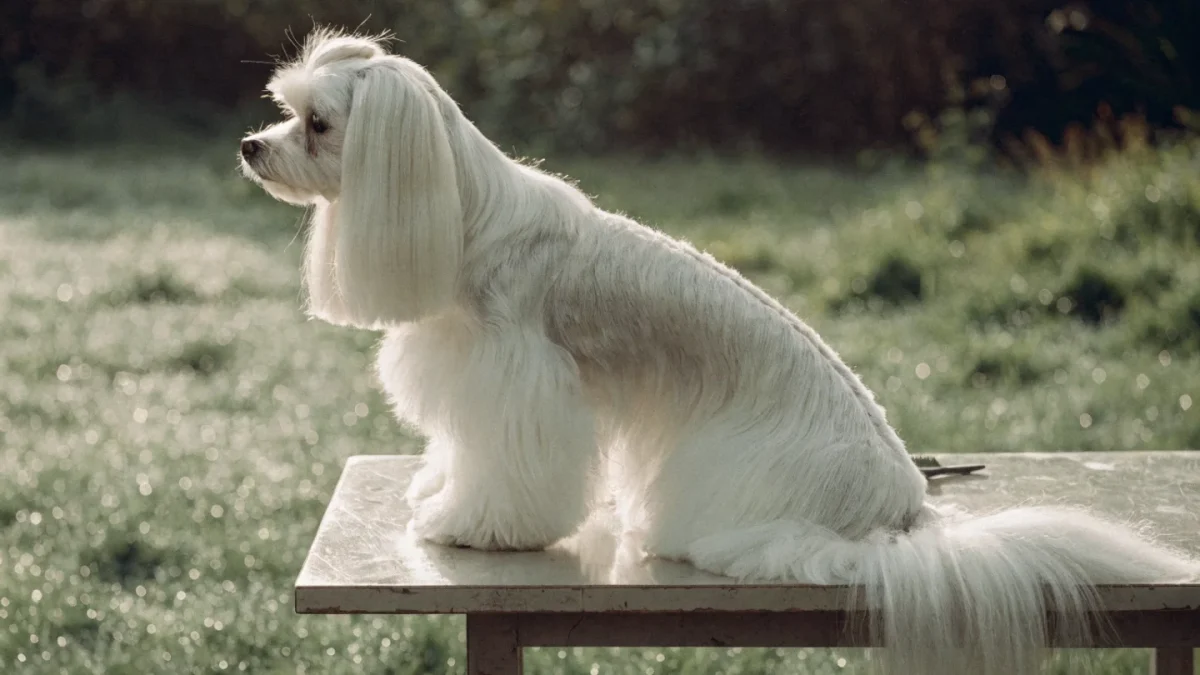
Long and silky coats are among the most beautiful in dogdom. They're also, without question, the most demanding to maintain. A Maltese in full coat, parted down the spine with a silk topknot, is a grooming achievement on the level of a concert performance — it takes that level of daily practice, consistent technique, and genuine attention to detail.
That's the reality. It's also why many owners of these breeds opt for a shorter clip rather than the full show coat. Which is completely fine — but the grooming requirements don't disappear with a clip. They just change character.
What Makes Silky Coats Different
Silky coat — the characteristic of Maltese, Yorkshire Terriers, Shih Tzus, Afghan Hounds, Cavalier King Charles Spaniels, Cocker Spaniels, and similar breeds — has a specific structure that distinguishes it from both double coats and wire coats.
The hairs are fine, smooth, and lie flat. They have very little natural crimp or texture to hold them apart from each other. When two silky hairs brush against each other in the same direction, they stay separate. When they're compressed together at an angle — as happens at armpit friction points, behind the ears, anywhere the dog lies or rubs — they twist, entangle, and mat.
The mat process is progressive. A tiny tangle becomes a small mat becomes a dense, skin-tight clump that causes discomfort, prevents air circulation to the skin beneath, and can harbor moisture and bacteria. Going from "just needs a thorough brush" to "needs professional dematting or shaving" can happen in less than two weeks of missed brushing sessions.
The Daily and Weekly Reality
Dogs in full coat need brushing every day, or at minimum every other day.
I know that sounds like a lot. For some people it genuinely is — and that's a legitimate reason to choose a shorter maintenance clip. But if you're maintaining a long coat, this is not optional. The math is straightforward: silky hairs tangle faster than the coat grows. You can only stay ahead of mats by brushing more often than tangles form.
Dogs in a shorter clip (typically 1–3 inch trim) can be maintained with brushing every 2–3 days. This is a reasonable middle ground for many pet owners.
Brushing: Correct Technique
The line brushing method is the gold standard for long coats. The premise: you can only effectively brush one layer at a time, so you work in sections from the skin outward.
How to line brush:
- Section off a portion of the coat with your non-brushing hand, holding back the upper layers
- Lay the coat down so you can see the skin
- Brush the lowest layer (immediately above the skin) from root to tip
- Release a small amount of the upper coat and brush that layer
- Continue upward until the entire section is brushed through
- Move to the next section
The critical check: after line brushing a section, run a fine-toothed comb through it from skin to tip. If the comb passes smoothly, the section is clear. If it snags, you have a mat or tangle at that depth that the brush passed over. The comb is your verification tool.
Tools for long silky coats:
- Pin brush (cushioned): The primary brushing tool. Flexible pins on a cushioned pad that move through silky coat without breaking or ripping hair
- Greyhound comb (fine/medium): The verification and finishing tool. The fine end for checking close to the skin; the medium end for the coat body
- Dematting comb: Fine-toothed detangling comb for working through mats that are still pliable (before they become dense)
- Leave-in conditioner spray: Makes brushing easier on dry coat, reduces static that causes tangling
What not to use: slicker brushes (damage silky coat) and rubber curry brushes (wrong tool type for this coat).
Mat Zones: Where Problems Concentrate
Certain areas of long-coated dogs mat faster than anywhere else:
Behind the ears: The ear leather moves constantly; the coat behind it folds and rubs. This is the first place you'll find mats and the last place you'll check. Check here first, every session.
Armpits: Constant friction from leg movement. On full-coat dogs, the armpits deserve their own focused brushing pass at every session.
Around the collar: The collar itself creates friction and compression. Consider removing the collar before grooming and during periods of extended wear. A harness used daily creates armpit mat issues faster than a collar.
Back legs and groin: Friction, moisture, and the dog's own movement create tangles here.
Underbelly: Often neglected because it requires the dog to stand still with you working underneath. But the belly coat, particularly near the inner legs and chest, mats readily.
Dealing With Mats
Minor tangles — caught early, still loose and pliable — can be worked through with fingers, a detangling spray, and patient comb work. Start at the outer tip of the mat, work inward. Never pull through a mat from root to tip; you'll either break the hair or hurt the dog.
Moderate mats require more patience. A dematting comb used carefully through the mat, separating hairs gradually, sometimes with specific dematting spray applied to soften the mat.
Severe mats — dense, tight to the skin, covering significant area — should be handled by a professional groomer. Attempting aggressive dematting on a large, tight mat causes pain and potentially damages the skin. The professional may assess that shaving is the better option.
And here's the honest thing I tell every owner: there's no shame in a fresh start shave-down after severe matting. It happens. The coat grows back, and with better maintenance habits going forward, it rarely happens twice.
Bathing Long Coats
Every three to four weeks for most long-coated breeds in pet clips; sometimes more frequently for floor-length show coats that contact the ground.
Brush before bathing. Thoroughly. A mat that goes into the bath wet becomes dramatically harder to remove than a dry mat. Water causes tangled hair to bind tightly. Pre-bath brushing to clear tangles is non-negotiable.
Conditioning is not optional. Silky coats are damaged by dryness — the individual fine hairs become brittle and more prone to breaking. A quality conditioner (cream rinse or leave-in) applied after every bath is part of standard maintenance. For floor-length show coats, oil-based conditioners or wrapping products are used to protect the coat between baths.
Dry properly. Never let a long-coated dog air dry while free to roll, rub, or lie down — the coat will tangle. Towel pat (never rub) first, then blow dry on low heat with a slicker brush to straighten and separate while drying. This combination produces the characteristic smooth, flat lie of a well-maintained silky coat.
Trimming: Maintenance vs. Full Clip
Even pet owners who keep their long-coated dog in a short clip need some strategic trimming between professional grooming appointments:
Paw trim: The hair between the paw pads and around the paw edges accumulates debris and causes slipping on hard floors. Regular trimming with blunt-tipped scissors.
Sanitary trim: Hair in the anal and genital area that causes hygiene issues. This is more important on female dogs but relevant for all long-coated breeds.
Eye trim: Any hair falling into the eyes. This causes irritation and eventual corneal damage if left. Fine-tipped curved scissors, working carefully with the dog held still.
Ear trim: Some breeds develop hair inside the ear canal (Cockers, Poodle crosses, some spaniels). This hair needs plucking or trimming to allow air circulation; left unchecked it contributes to ear infections.
For anything more involved — shaping the body, trimming the head, maintaining breed-specific profiles — see the breed-specific grooming guide or schedule a professional groomer every 6–8 weeks for most pet owners.
The Show Coat vs. Pet Clip Decision
This deserves a direct conversation. Maintaining a Maltese, Shih Tzu, Afghan Hound, or similar breed in full show coat is a substantial daily commitment. Not just in time — maybe 20–30 minutes per day — but in willingness to be consistent. The consequence of inconsistency isn't just a messy coat; it's a dog in discomfort from mats pulling at its skin.
For owners who are genuinely committed, the full coat is magnificent and achievable. For everyone else, a shorter pet clip maintained by a professional groomer every 6–8 weeks with owner brushing 2–3 times weekly is a completely valid and humane choice. Your dog doesn't have an aesthetic preference for the floor-length coat.
FAQ
How do I tell if my long-coated dog has mats I'm missing?
Use a comb, not a brush, for your final check. Run the comb from skin to tip through every part of the coat, including behind the ears, armpits, and between the back legs. Anywhere the comb snags is either a mat or a starting tangle. The visual appearance of the coat is not reliable — a mat can be completely invisible beneath the overlying coat layers.
My long-coated dog hates being brushed. What can I do?
Start with short sessions ending before the dog's tolerance runs out — even 5 minutes of positive brushing is better than a 20-minute fight. Use high-value treats throughout. Identify whether the resistance is to the tool (try a softer pin brush or lighter pressure), to specific areas (usually mat zones — work those last after positive associations are established), or to standing still generally.
Can I use a detangling spray designed for human hair?
Some human detangling products are appropriate for dogs; many aren't. Avoid products with fragrances, alcohol, or dimethicone as primary ingredients. Purpose-made dog detangling sprays are the safer choice. If in doubt, your groomer can recommend a specific product.
How often does a long-coated dog need professional grooming?
For a pet in a short clip: every 6–8 weeks for trimming. For a dog in a longer coat that the owner is managing at home: professional grooming every 8–12 weeks for a thorough bath, professional dematting check, and any trimming needed. For show dogs: on a custom schedule driven by show calendar.
Is it painful to remove a mat from a dog?
It can be. A small, loose tangle worked through gradually with proper technique causes minimal discomfort. A dense, skin-tight mat that's pulling the skin when the dog moves is already causing constant low-level pain — removing it is the relief, though the removal process itself can be uncomfortable. Using dematting spray, working in small sections, and staying patient makes the process as gentle as possible.