

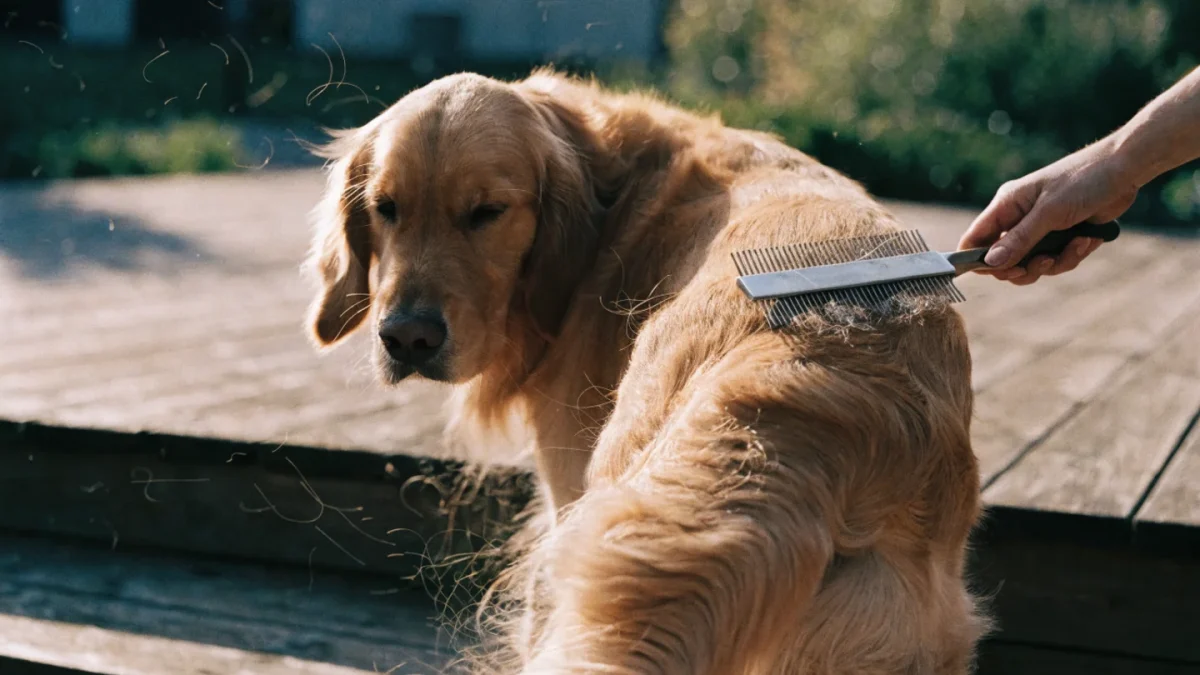
I've spent years watching people make the same mistake with double-coated breeds. They see a fluffy dog, reach for whatever brush is closest, drag it across the top of the coat a few times, and call it groomed. Six weeks later they're at the groomer with a dog that's basically a matted felt sculpture from the chest down.
Double-coated grooming is a system. Not complicated — but it has to be done in order, with the right tools, and with some understanding of what you're actually working with. This guide covers everything: the coat structure, the tools, the technique, the bathing process, and the one thing you absolutely cannot do no matter how hot it gets in July.
What "Double-Coated" Actually Means
The term gets used loosely, so let's be precise. A double coat means two structurally distinct layers doing two completely different jobs.
The outer coat — called the guard coat — consists of coarser, longer hairs that repel water, block UV, and protect the skin from abrasion. These hairs have a specific diameter and surface texture that allows them to shed debris and resist matting under normal conditions. They also insulate against heat, which is why shaving them off in summer backfires spectacularly.
The undercoat is soft, dense, and wool-like. It traps air close to the skin — which keeps the dog warm in winter, yes, but also provides a thermal buffer against heat. Think of it as the insulation in your walls. It doesn't let heat in; it stabilizes temperature in both directions.
When the undercoat sheds (which it does twice a year in a process called "coat blow," plus continuously in some breeds), it disconnects from the skin but stays tangled in the guard hairs. That's where grooming comes in. If you don't remove it, dead undercoat compresses against live undercoat, traps moisture and heat, and creates the conditions for hot spots, fungal growth, and severe matting.
The breeds most people ask about — Huskies, German Shepherds, Golden Retrievers, Samoyeds, Border Collies, Bernese Mountain Dogs, Akitas, Chow Chows, Great Pyrenees — all have double coats. They vary in density, texture, and shed volume, but the grooming principles are the same.
The Tool Kit You Actually Need
People buy too many tools. Here's what you actually need and why.
A quality slicker brush with fine, angled pins is your everyday maintenance brush. It moves through the outer coat and catches loose guard hairs and surface debris. The key word is "quality" — cheap slicker brushes have blunt pins that scratch skin. If it looks like a baby's teething toy, it's not doing anything useful.
An undercoat rake is the workhorse. Long-toothed rakes — typically 2 to 3 inches of tine length — penetrate through the guard coat and pull out disconnected undercoat. This is the tool most people skip, and skipping it is why the dog looks fine from the outside while hiding a dense mat situation underneath.
A metal comb (sometimes called a Greyhound comb) is your quality check. After brushing, run it through. If it stalls, you're not done. The comb finds the stuff the brush missed.
A deshedding tool — the Furminator being the most recognizable brand name, though I won't recommend specific brands — works differently than a rake. It has a fine-edged blade that strips loose undercoat more aggressively. Useful during coat blows. Easy to overuse — more on that below.
A high-velocity dryer is not optional if you have a serious double-coated breed. It blows water out of the coat rather than evaporating through it, cuts drying time from hours to minutes, and physically blasts loose undercoat out before you even start brushing. If you have a Husky, a Samoyed, or a Malamute, this is the single best investment you'll make. The noise takes some desensitization, but the results are transformative.
You do not need: coat sprays (optional, mildly useful for detangling), deshedding shampoos (marketing more than science), thinning shears (for professionals only), or most of the specialized gadgets that populate grooming aisles.
The Grooming Sequence
Order matters. Work through these steps, and the whole process becomes faster and more effective each time.
Before the Bath: The Dry Brush-Out
Always brush before bathing. Always.
Water causes dry, tangled undercoat to felt and compress. If you bathe a matted dog, you've just set those mats in place. So before a bath — and ideally every week or two as regular maintenance — run through the full dry brush sequence.
Start with the slicker brush. Work in sections, lifting the outer coat to brush from skin level outward. Don't just brush the surface. Cover the whole dog: body, legs, chest, tail, behind the ears, and the collar area where mats develop fastest from friction.
Then follow with the undercoat rake. Same sectional approach. Long, gentle strokes. Don't rake the same area repeatedly — you'll irritate the skin. Move through the entire coat. The amount of undercoat that comes out on the first pass will either vindicate the process or make you vow to never let it go this long again.
Finish with the metal comb to check your work.
Bathing
Use a dog shampoo formulated for double coats or a moisturizing shampoo — nothing too stripping. Double-coated breeds generally have healthy skin oils that you don't want to eliminate entirely.
The main challenge in bathing a double coat is saturation. Water resists penetrating through a dense guard coat. You need to work shampoo all the way to the skin, not just lather the surface. Use your fingers to part and work down through the layers. Take your time. If the shampoo doesn't reach skin, neither does the rinse.
Rinse longer than you think necessary. Shampoo residue left in a dense undercoat causes itching and contributes to skin issues. When you're sure you've rinsed enough, rinse again.
Conditioner is optional for most double-coated breeds. Some do benefit from it — particularly during coat blows when the skin is more exposed — but it's not a requirement.
Drying: The Most Important Step
This is where double-coated grooming separates from everything else.
If you're using a high-velocity dryer: start while the dog is still dripping. Direct the air in the direction of coat growth — not against it — to move water out without tangling the guard coat. Work section by section. As you blow, you'll see undercoat physically exit the coat. It's deeply satisfying. Continue until the dog is bone dry.
If you're not using a high-velocity dryer: towel blot (don't rub — rubbing tangles guard hairs), then let air dry in a warm area while periodically brushing with the slicker to prevent the coat from setting in clumps. This takes significantly longer and produces less thorough results, but it works if you're patient.
Do not skip drying. A damp double coat takes hours to dry on its own, and a dense, wet undercoat against skin is a recipe for hot spots.
Post-Bath Brush-Out
Once fully dry, run through the full brush sequence again: slicker, rake, comb. The drying process loosens additional undercoat, and the post-bath brush-out is where you get to a truly clean, well-groomed result.
This is also when the coat looks its best — guard hairs separated, undercoat reduced, the coat showing the actual structure the breed was bred to have. A properly groomed double-coated dog is honestly one of the more beautiful things in the world of dogs.
Seasonal Grooming: Coat Blows
Twice a year, most double-coated breeds "blow" their coat. In spring, the dense winter undercoat sheds to make way for lighter summer undercoat. In fall, the reverse happens as they grow in for winter. These events last two to six weeks and produce an almost alarming volume of loose fur.
During a coat blow, your regular maintenance routine needs to intensify. Daily brushing isn't excessive. This is when the deshedding tool earns its place — used carefully, on clean dry coat, for no more than a few minutes per session, it strips out loose undercoat efficiently. Don't overdo it. The deshedding blade can damage the guard coat if you rake the same spot repeatedly.
Some dogs (I'm thinking of the Alaskan Malamute I spent two hours brushing out at a show in Portland a few years back — the pile of fur that came off this dog was larger than my forearm) produce so much shedding coat that daily brushing and weekly baths for the duration of coat blow is the only sustainable approach.
Keeping up during coat blow prevents the matting that can happen when disconnected undercoat isn't removed. It also reduces the amount of fur coating every surface in your home, though it won't eliminate it.
Maintenance Frequency by Coat Type
High-density double coats (Samoyed, Great Pyrenees, Chow Chow, Alaskan Malamute): Weekly brushing minimum. Every 4-6 weeks full groom. Daily during coat blow.
Medium-density double coats (Husky, Akita, German Shepherd, Border Collie): Brushing every 5-7 days. Full groom every 6-8 weeks. Daily or near-daily during coat blow.
Lighter double coats (Golden Retriever, Labrador Retriever): Brushing every 7-10 days for most of the year. Labs especially can go longer between full grooms when they're not blowing coat.
These are baselines. An active dog that spends time outdoors needs more frequent grooming than a more sedentary house dog — debris, vegetation, and moisture all accelerate tangling.
What You Cannot Do: The Shaving Myth
I want to spend a moment on this because it genuinely harms dogs and the advice is everywhere.
People shave double-coated breeds for summer. The logic sounds reasonable — they look hot, the coat looks thick, removing it should help. But it doesn't work that way, and here's why.
The guard coat isn't just insulation. It's a UV barrier, a moisture shield, and a thermal management system. When you shave it off, you expose skin to direct sun (which double-coated breeds weren't built to handle), eliminate the air-gap insulation that keeps the dog cool, and create conditions for sunburn on dogs that have never needed sun protection in their evolutionary history.
Then there's the regrowth problem. Guard hairs and undercoat don't grow back at the same rate. Undercoat typically grows back faster, producing a coat that's denser and softer at the base — the opposite of what you want. The guard coat texture can take a year or more to return, and in some dogs, especially older ones, it never fully does. The coat ends up with altered texture, reduced water-repellency, and chronic matting issues. It's called "post-clipping alopecia" in the worst cases.
The only exception is a medical necessity — a wound requiring shaving, a severe mat situation where shaving is the only humane option, or specific veterinary direction. Otherwise: do not shave a double-coated dog.
For hot weather, the actual solution is to keep the undercoat blown out through good grooming so air can circulate to the skin. A well-groomed double coat in summer actually works better than you'd think.
The Matting Problem
Mats deserve their own section because they're where grooming failures compound.
A mat is a dense tangle of shed undercoat, guard hairs, and sometimes external debris compressed together. They form fastest in high-friction areas: behind the ears, under the collar, in the armpits (axilla), between the hind legs, and around the base of the tail.
Small mats can be worked out with a mat splitter or detangling spray and patience. Work from the outside of the mat inward. Never pull from the base — that hurts the dog and tears out healthy coat. Cut the mat into sections with small scissors before trying to brush through each section.
Large mats, or mats that have been allowed to compress against the skin, often need to be cut out. This is where a professional groomer earns their fee. Don't attempt to scissor out large mats without experience — you can cut skin.
Prevention is straightforward: brush regularly, remove dead undercoat before it compresses, and pay extra attention to the high-friction areas. The time investment in regular maintenance is a fraction of the time required to deal with mats once they form.
Finding a Groomer Who Knows Double Coats
Not all groomers are equal. A groomer who primarily works with Poodles and Bichons may not have experience with high-volume double coats, and more importantly, may not know why shaving isn't appropriate.
Ask specifically: do they have experience with double-coated breeds? Do they use a high-velocity dryer? What's their approach to coat blows? If the answer to the last question is "we just shave them shorter," find a different groomer.
Breed-specialty groomers, show groomers, and groomers who list Nordic breeds or herding breeds in their specialty are generally safer bets. At-home grooming between professional visits — even just regular brushing — also reduces the workload at each appointment and keeps the coat in better condition overall.
FAQ
How often should I brush a double-coated dog?
At minimum, every week for most double-coated breeds. During a coat blow, daily brushing keeps the shed undercoat from compressing into mats. The specific breed matters — a Samoyed needs brushing more frequently than a Labrador. But "once a month" isn't grooming, it's damage control.
Does double-coated dog grooming require professional help?
Not necessarily. Most of the regular maintenance — brushing, raking, combing — you can do yourself with the right tools. The learning curve is technique, not complexity. Where professionals add genuine value is in the full bath and blow-dry process (a high-velocity dryer is a significant investment), handling severe mats, and breed-specific finishing. If you have a Samoyed and a high-velocity dryer, you can do most of it at home. If you have a Great Pyrenees and a towel, a professional visit every 6-8 weeks makes sense.
Can I use a Furminator on my dog every week?
Using a deshedding tool weekly throughout the year is overuse. These tools have a blade that strips out undercoat efficiently — but used too aggressively or too frequently, they can damage the guard coat. Save deshedding tools for coat blow season, use them on clean, dry coat only, and limit to a few minutes per session, not a full groom. For regular maintenance, a slicker brush and undercoat rake do the job without the damage risk.
My double-coated dog smells even after bathing. What's happening?
The most common cause is incomplete drying. A dense undercoat that isn't blown or dried thoroughly retains moisture against the skin for hours, which produces that persistent musty smell. Make sure you're getting the dog completely dry, all the way through the coat. The second cause is incomplete rinsing — shampoo residue in the coat breaks down and smells bad. Rinse longer, especially through dense sections.
What's the difference between an undercoat rake and a shedding blade?
An undercoat rake has long tines that penetrate through the guard coat to pull out loose undercoat from below. A shedding blade (or deshedding tool) has a finer edge that strips loose hair from the surface and upper layers. For routine grooming, the rake is more versatile and gentler. Shedding blades are more aggressive and are better suited to active coat blow phases on dogs that handle the sensation.
How do I know when the coat blow is over?
The volume of shed fur during brushing drops back to normal, the undercoat feels dense and even again rather than patchy, and the dog stops leaving fur drifts on every surface. Most coat blows run 3-6 weeks. If excessive shedding continues beyond 8 weeks without resolution, a vet check is worth doing — thyroid issues and certain skin conditions can cause extended shedding.
For dogs with different coat structures, the same grooming principles don't always apply. If you're working with curly and wool coat types like Poodles or Portuguese Water Dogs, or long silky coats like Yorkies or Maltese, the approach changes significantly — those coats present their own challenges that double-coat technique can't solve.