

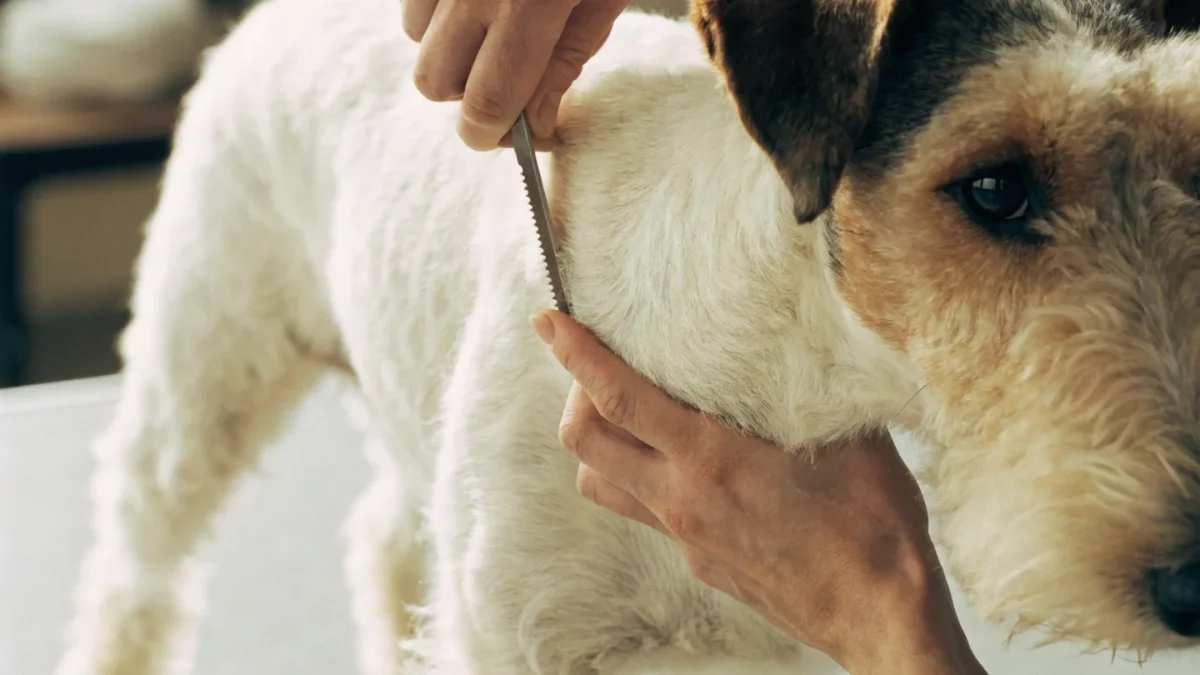
Hand stripping is one of those skills that looks straightforward from the outside and turns out to have significant nuance once you're actually doing it.
The principle is simple: dead outer coat hairs are removed by gripping and pulling in the direction of hair growth. The reality is that doing this efficiently, on the correct coat at the right stage of its growth cycle, with a technique the dog tolerates comfortably, takes genuine practice to develop. The groomers who hand strip well have built muscle memory and coat-reading ability over years. You can learn — but you should start with realistic expectations about the learning curve.
Why Timing Is Everything
The single biggest mistake beginners make is attempting to strip coat that isn't ready. The guard hairs in a wire coat have a distinct growth cycle: active growth, maximum length, dead phase (the hair stops growing but remains in the follicle), and finally loosening and shedding. Hand stripping is most effective — and most comfortable for the dog — when the coat is in the dead phase.
How to tell if the coat is ready:
Grip a small pinch of the outer coat between thumb and forefinger. Pull in the direction of hair growth with firm, even pressure. If the hairs come out cleanly with minimal resistance, and the dog shows no discomfort, the coat is ready. If you're fighting significant resistance, the coat needs more time.
A properly ready coat will strip almost willingly. You should feel the hair coming loose from the follicle without the dog flinching. If you're working hard and the dog is showing discomfort, stop and reassess.
Tools
Fingers: For fine, short coat areas — the face, ears, and detailed shaping work. Gripping the hair between thumb and index finger, rolling it slightly to grip, and pulling with controlled pressure.
Stripping knife: A grooming tool with a serrated or notched blade designed to grip the hair as you pull. Not a cutting tool — the blade grips, not cuts. Work in the same direction as hair growth. The serrations catch the hair and give you leverage for larger body sections.
Stripping stone: A pumice-like block used for fine texturing work, particularly on the face and head. It roughens the hair slightly as you pull, making the grip easier. Better for detail work than the stripping knife.
Rubber finger covers: Many experienced hand strippers wear a rubber finger cot on the thumb and index finger to improve grip on fine or short hairs without cutting the skin.
The Basic Technique
1. Assess the coat first. Check readiness in multiple areas — the back and sides may be ready while the neck or hindquarters are behind. Don't force areas that aren't ready.
2. Work with the direction of hair growth. Always pull in the direction the hair grows, never against it. Pulling against the grain is uncomfortable and ineffective.
3. Grip a small amount. You're pulling perhaps 10-20 hairs at a time, not a fistful. Small amounts strip more cleanly and are less uncomfortable for the dog. Gripping too much at once is a beginner's error.
4. Support the skin. Use your non-working hand to hold the skin taut near where you're pulling. This is essential — the pulling action should remove hair from the follicle, not pull the skin with it.
5. Short, controlled pull. Don't jerk. A smooth pull in the direction of hair growth with your elbow, not a quick yank with your fingers, produces clean results.
6. Work in sections. Methodically cover the dog area by area. The back and sides first, then the neck, chest, and finally the legs and head. Mark your progress visually.
Breed and Area Differences
The back and body coat strips most easily — it's the largest surface with the most accessible coat. The head, face, and ears require more precision and more finger work than stripping knife work.
Terriers with specific pattern work — Airedales with their black saddle, Wire Fox Terriers with their precise outline — require shaping attention during stripping. You're not just removing coat; you're maintaining or building toward a specific silhouette. This is where breed-specific experience matters.
Schnauzers are often "pattern clipped" rather than fully stripped — the body coat is stripped but the characteristic eyebrows and leg furnishings are clipped or scissored to shape. This is a hybrid approach common for pet Schnauzers.
Rolling the Coat
Professional terrier groomers often use a technique called "rolling the coat" — stripping different areas of the coat on a staggered schedule so no two areas are at the same growth stage at the same time. This keeps the dog in coat year-round rather than having a fully stripped-down period. Rolling requires more ongoing attention but produces more consistently good-looking coat.
For owners learning the skill, a single full strip on a predictable schedule is easier to manage than rolling.
After Stripping
The dog will look thinner and shorter-coated immediately after a full strip. The new coat grows in over 6-8 weeks. During this period, the coat is softer than it will be at full growth — the harsh texture fully develops as the coat matures. In some breeds, the color deepens as the new coat reaches full length.
For the context on when to strip versus clip and what the trade-offs are, hand stripping versus clipping wire coats covers the comparison. For the full wire coat picture, complete guide to wire-coated dog grooming is the foundation.
FAQ
How long does a full hand strip take?
Depends heavily on breed and size. A Border Terrier can be fully stripped in 2-3 hours by an experienced hand. An Airedale Terrier in full coat can take 4-6 hours. A Wire Fox Terrier in show condition by a specialist: 8+ hours. For beginners working on their own dog, add 50-100% to those estimates.
Is there a way to practice hand stripping before working on my own dog?
Yes — some groomers will allow observation sessions. You can also practice on a colleague's dog that's ready to strip, or take a breed-specific handling class where stripping technique is taught. Video demonstrations specific to your breed are the next best thing.
My dog won't sit still for hand stripping — what do I do?
Start very young if possible, introducing the feeling of pulling fur in short, positive sessions before the dog needs a full strip. For older dogs already resistant, work in extremely short sessions with breaks. Some dogs never fully cooperate with hand stripping — for those animals, clipping is the practical solution.
Can a dog be switched from clipping back to hand stripping?
Yes, but it takes time. A coat that's been clipped for years has lost its correct texture. When you switch to hand stripping, the first few strips will remove what's been growing in — the new coat that grows after the switch will gradually return to a more correct harsh texture, but it typically takes 1-2 years of consistent hand stripping to fully restore.