

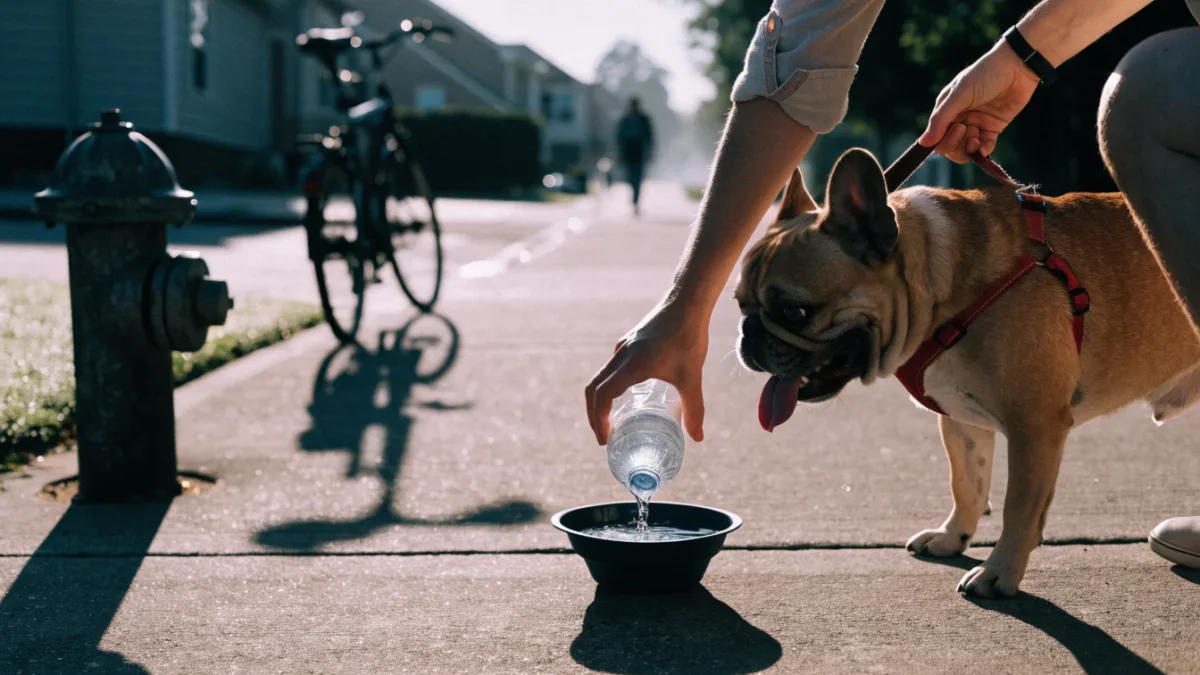
One of the cases that stays with me was Biscuit, a four-year-old French Bulldog whose owner carried him into the clinic one Saturday afternoon in July. They’d been out for a twenty-minute walk — not a marathon, just a normal loop around the neighborhood — when Biscuit flopped down on the sidewalk and refused to move. His panting was loud even by Frenchie standards, his tongue was a dark brick red, and he was drooling thick ropes of saliva. “He always breathes like this,” his owner told me. “I didn’t think anything of it.” Biscuit spent two days with us on fluids and went home fine, but his owner’s confusion is one I hear every single summer. We assume panting means a dog is coping. The truth is that panting is a coping mechanism with hard limits — and when those limits are crossed, heatstroke in dogs develops fast, while in cats it often goes unseen until it’s already dangerous.
Why Panting Has Hard Limits
Dogs and cats don’t cool off the way we do. They sweat only a little, through their paw pads, which is nowhere near enough to regulate body temperature.:[1] rapid, shallow breathing evaporates moisture from the tongue and upper airways, and that evaporation carries heat away. It’s an elegant system — until it isn’t.
Two things break it down. First, if the heat coming in (from air temperature, exertion, or both) exceeds what evaporation can shed, body temperature just keeps climbing. Second, humidity sabotages evaporation itself — when the air is already saturated with moisture, there’s nowhere for the sweat on a tongue to go. That’s why a humid 85°F day can genuinely be harder on a dog than a dry one at 95°F.
For reference: a normal body temperature for dogs and cats runs about 101 to 102.5°F (38.3–39.2°C). Heatstroke is generally defined at 104°F (40°C) and above, and once you pass roughly 106°F (41.1°C), you’re in life-threatening territory where organs start taking damage. The window between “he’s fine, just hot” and “this is an emergency” is shorter than most owners realize.
The Dogs Who Overheat First
Flat-faced breeds
Brachycephalic — literally “short-headed” — breeds like French Bulldogs, English Bulldogs, Pugs, Boxers, and Shih Tzus have compressed upper airways. Many have nostrils narrowed to slits and extra soft palate tissue flopping across the airway, which is where that characteristic snorting comes from. Here’s the cruel math: they have to pant harder to move the same amount of air, and that extra respiratory effort generates heat while cooling less. A noisy breather who suddenly gets more noisy in warm weather is telling you something important.
One large UK study of veterinary records.[2] found breed-level risk differences that were striking — Chow Chows faced roughly sixteen times the average risk of heat-related illness, with French Bulldogs, English Bulldogs, and Greyhounds also significantly elevated. Meanwhile, Frenchies remain among the most popular breeds in many countries, which means the population of dogs most vulnerable to heat keeps growing.
Thick coats and northern breeds
Huskies, Malamutes, Newfoundlands, and other double-coated or heavy-coated breeds carry insulation year-round. That coat is magnificent in January; in July, during exertion, it slows how quickly they can shed body heat. These dogs can do fine in warm climates, but they need owners who respect the physics.
The fit dog myth
The other group I see is the weekend athletes. Research attention has shifted in recent years from hot-car tragedies to exertional heatstroke — running, hiking, and fetch in warm weather — as the leading cause of canine heat illness. Last spring I saw Koda, a five-year-old Husky mix, after a trail run his owner had done with him “all winter.” The dog started lagging behind, then got wobbly at the knees. Fitness isn’t protection if the season changed three weeks ago — dogs acclimatize to heat over weeks, not days.
Cats Hide Heat Distress Until It’s Dangerous
Cats are the stealth patients of summer. Their instinct to mask illness and discomfort runs deep — in the wild, an animal that looks weak doesn’t last long — so instead of dramatic signs, an overheating cat often just quietly retreats. Which is exactly what a cat is supposed to do in heat, which is why owners miss it.
Miso, a nine-year-old domestic longhair, came to see me during a heat wave in an apartment without air conditioning. Her owner found her limp in the back of a closet, breathing with her mouth open.
“She’s been sleeping in there all week — I thought she was just staying cool.”
She was trying to. But by the time a cat is open-mouth breathing, the situation is already serious. The cat overheating signs that matter most are:
- Open-mouth breathing or panting — unlike in dogs, this is never routine in a cat, and even one episode warrants a same-day call to your vet
- Sweaty, clammy paw pads — you may actually notice damp footprints
- Drooling, often thick
- Bright red tongue or gums — though pale or gray gums are also a danger sign, often indicating shock
- Stumbling or weakness when walking
- Vomiting
- Vocalizing while hiding, or hiding and not responding normally
- Rapid heartbeat you can feel through the chest wall
Cooling a Pet Safely: What I Recommend Now
Here’s where I’ll admit I’ve changed my mind. Early in my career, the advice was ice baths — pack them in ice, drop their temperature fast. Current veterinary consensus has moved away from that, and I’ve moved with it. Extreme cold causes surface blood vessels to constrict, which can actually trap hot blood in the core, and shivering generates heat. Emergency-medicine specialists still debate iced-water immersion for the most dire cases, but at home, cool or tepid water plus air movement is the right call — you’re harnessing the same evaporative physics as panting, just more of it.
One popular home remedy I’d skip: rubbing alcohol on the paw pads. The evaporation logic is real, and I understand the appeal, but alcohol is toxic if licked off and the evidence behind it is thin. Tepid water does the job without the risk.
If your pet is overheating, here’s the sequence I teach clients:
- Get them out of the heat immediately — shade or air conditioning.
- Offer cool (not ice-cold) water to drink, but never force it.
- Wet them down with tepid water, focusing on the belly, armpits, groin, and paws, and put a fan on them or run the car’s AC during the drive.
- Stop active cooling around 103°F (39.4°C) — yes, you can overshoot and send them hypothermic.
- Go to a veterinarian even if they seem to recover. Call ahead so the team is ready. Heatstroke can cause delayed damage to the kidneys, the gut lining, and blood clotting over the following 24 to 72 hours — and the [2]
Prevention Beats Heroics Every Time
Keeping [3] is mostly about habits, not gear:
- Exercise early or late — before the pavement heats up and after it starts releasing the day’s stored heat.
- Do the seven-second test: press the back of your hand against the pavement. If you can’t hold it for seven seconds, it will burn paws.
- Never leave a pet in a parked car, even briefly, even with windows cracked — the interior of a car can climb about 20°F in just ten minutes on a mild 70°F (21°C) day, and cracking the windows barely changes that.
- Fresh water and shade, always — plus airflow and access to cool floors. Cooling mats can help; look for ones that are puncture-resistant and non-toxic if chewed.
- Avoid anything that restricts panting, including tight muzzles or heavy gear during warm-weather outings.
- Check the hiding spots — during a heat wave, know where your cat retreats and how she normally looks there, so you can tell the difference between napping and struggling.
The through-line in all of this: panting is a first response, not a safety guarantee. Learn your own animal’s baseline — what your Frenchie’s breathing normally sounds like, where your cat normally hides, how your Husky normally trots — because it’s the change from normal that tells you the cooling system is failing. With summers getting longer and hotter nearly everywhere, heat safety has quietly become a seasonal skill every pet owner needs, and I’d argue it’s part of the same attentiveness we owe animals everywhere, from the dog on the end of our leash to wildlife coping with a warming world. The animals in our care can’t check the forecast, notice their own gum color, or pour themselves another bowl of water. We’re their thermostat, and they’re counting on us to be a good one.
Sources
- Panting is their main heat-release mechanism — facebook.com
- led by researchers at the Royal Veterinary College — rvc.ac.uk
- pets in hot weather safe — humanerescuealliance.org