

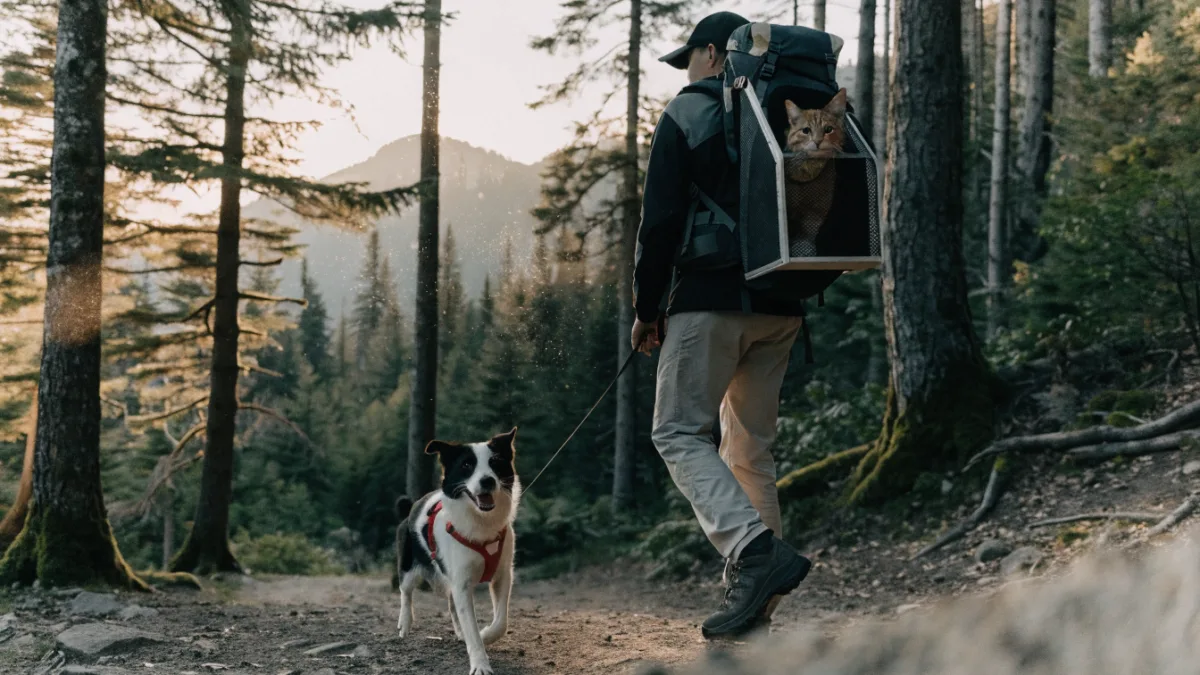
Let me tell you about the time I thought it would be a great idea to take my cat Mochi on a “short nature walk.” Ten minutes in, she had wedged herself inside my hoodie pocket like a furry little kangaroo, an off-leash Labrador came bounding around a bend with zero recall skills, and I was doing what I can only describe as a panicked sideways shuffle while trying to look casual. We survived. But I learned more in those ten minutes than in any article I’d read beforehand. Hiking with pets — whether dog or cat — is one of the most rewarding things you can do together. It’s also an exercise in humility, preparation, and accepting that nature doesn’t care about your weekend plans.
Before You Even Pack the Car: Training Fundamentals
Here’s the thing nobody wants to hear: the trail is not the place to start training. I know, I know — you want to skip ahead to the scenic Instagram photos. But a trail is a high-stakes environment full of wildlife, strange dogs, mountain bikers appearing out of nowhere, and smells that will short-circuit even a well-trained dog’s brain. If your dog doesn’t have rock-solid recall and decent leash manners in your neighborhood, they definitely don’t have them when a deer bolts across the path.
For dogs, foundational obedience isn’t optional — it’s safety equipment. A reliable “leave it” command might be the difference between your dog sniffing a interesting bush and snouting a rattlesnake. I’ll defer to actual dog trainers on the specifics (my partner Jake is the dog person in this household — I just admire the results), but the baseline is non-negotiable: your dog should come when called, even when distracted.
Cats are a different story, and honestly, a different sport entirely. Mochi isn’t going to learn recall — she barely acknowledges her name when I say it at home. Cat hiking works because you’re the one in control of the environment, not because the cat is in control of herself. Your cat needs to be comfortable in a harness long before you hit any trail. And I mean genuinely comfortable — not “tolerating it for thirty seconds before doing that dramatic flat-cat collapse on the floor.”
Gear That Actually Earns Its Space
The Canine Kit
Dogs are relatively straightforward hiking companions, gear-wise. You want a well-fitting harness — something that won’t chafe under a pack or restrict shoulder movement on inclines. A regular collar with ID tags is your backup, not your primary control point. Bring more water than you think you need; dogs don’t sweat like we do, and they’ll happily dehydrate themselves chasing a stick. A collapsible bowl, waste bags (non-negotiable — pack them out), and a basic pet first-aid kit round out the essentials.
If you’re doing anything beyond a casual loop, consider a dog pack — but only if your dog is physically mature and conditioned for it. Talk to your vet about whether your dog is ready for weighted pack work. And please, for the love of everything, check their paws afterward. Trail grit gets between pads like it’s being paid to cause problems.
The Feline Loadout
Cats require a more specialized approach. You need an escape-proof harness — and I mean truly escape-proof, not “probably fine.” Cats are liquid when they want to be, and a spooked cat on a trail will absolutely Houdini out of anything that fits loosely. Look for a harness designed specifically for cats, with secure buckles rather than just velcro, and get your cat used to it over weeks, not the morning of your hike.
The secret weapon for cat hiking? A secure backpack or carrier they can retreat into. This isn’t laziness — it’s strategy. When Mochi gets overwhelmed, her backpack is her safe space. She pops her head out when she’s curious and ducks inside when she’s had enough. It gives her agency in a situation where she’d otherwise have none.
The Off-Leash Elephant on the Trail
We need to talk about this directly. Off-leash dogs are the single biggest source of trail conflict, and if you’re hiking with a cat or a small dog, they’re a genuine safety threat. I’m not being dramatic — that “friendly” off-leash Lab I mentioned earlier? It wasn’t aggressive. It was just excited. But a large, excited dog barreling toward a cat in a harness is a life-or-death situation for the cat, regardless of intentions.
The reality is that many trails have strict leash laws that a subset of dog owners treat as suggestions. This creates a frustrating dynamic. You can be doing everything right — your dog leashed, your cat secured, your situational awareness dialed up — and still end up in a bad situation because someone else decided the rules didn’t apply to their golden retriever.
My approach is pragmatic: I assume every trail has off-leash dogs until proven otherwise. I scope out routes during off-peak hours. I yield generously. And I’m not shy about stepping between an approaching dog and my cat while clearly saying, “She’s not friendly with dogs” — even when she’s asleep in her pack. The trail is shared space, and that means managing what you can control while staying alert to what you can’t.
Cat-Specific Trail Strategy
Cats do not belong on every trail. There, I said it. And I say that as someone who genuinely loves bringing Mochi along on adventures. The truth is, popular hiking trails — especially those with heavy dog traffic, mountain bikes, or large groups — are stressful environments for most cats. Your job as a cat owner is to find the quiet corners where your cat can actually enjoy being outside.
Look for less-traveled paths, nature areas that don’t allow dogs, or trails you can hit at sunrise before the crowds arrive. Urban-adjacent green spaces with predictable foot traffic can be better starter trails than wilderness paths, ironically, because they’re more predictable. A cat who feels secure is a cat who will actually explore. A cat who’s constantly bracing for the next threat is just enduring the experience — and that’s not the point of any of this.
Also: accept that your cat may hike for twenty minutes and then decide she’s done. That’s fine. This isn’t about mileage.
Wildlife, Snakes, and Knowing When Things Get Real
Regional wildlife varies wildly, but the principle is universal: know what’s out there before you go. In the Southwest, rattlesnakes are a serious trail hazard for dogs — and rattlesnake aversion training has become increasingly popular for good reason. In bear country, you’re thinking about different protocols entirely. Coyotes are a real threat to small dogs and cats in many regions. Birds of prey will absolutely scoop up a small pet given the opportunity.
Keep pets on marked trails. This isn’t just about your safety — it’s about protecting local wildlife from your pet. Ground-nesting birds, small mammals, sensitive native plants: all of them are better off if your dog or cat stays where they’re supposed to. Off-trail pets harass wildlife, damage fragile ecosystems, and create problems that lead to trail closures for everyone.
Know where the nearest emergency vet is before you start hiking, not after something goes wrong. Program the number into your phone. Bring a basic first-aid kit and know how to use it. If you’re in venomous snake territory, ask your vet about the rattlesnake vaccine and whether aversion training makes sense for your dog.
None of this is about fear. It’s about being prepared enough that you can actually relax and enjoy the hike. The best trail experiences happen when you’ve done the unglamorous homework beforehand.
Hiking with pets — whether it’s a trail-ready dog or a cat in a backpack — is a privilege, not a right. Trails are shared with wildlife, with other users, with ecosystems that were there long before we showed up with our harnesses and collapsible bowls. The goal isn’t to conquer nature with your pet in tow. It’s to move through these spaces with enough awareness and respect that they remain open, healthy, and welcoming — for the birds nesting in the underbrush, for the hikers coming up behind you, and for every person who wants to watch their cat’s ears perk up at the sound of wind through the trees. Pack out what you pack in, leash your dog, choose your trails wisely, and the outdoors will keep being there for all of us.