

I’ll never forget the afternoon a frantic client rushed her four-year-old tuxedo cat, Barnaby, into the clinic. Elena was shaking. She had left a lit vanilla candle on the dining room table while she ran to the grocery store. Barnaby, being a typically curious cat, hopped up on the table and nudged the candle straight into a vase of dried flowers. Fortunately, a neighbor saw the smoke and called the fire department. Barnaby survived with singed whiskers and mild smoke inhalation, but Elena’s dining room was destroyed. “I always thought he was smart enough to avoid fire,” she told me, crying as I examined Barnaby’s corneas with a fluorescein stain to check for burns.
That day changed how I talk to my clients about fire safety. We often think of our companion animals purely as victims of house fires, but the truth is far more complicated. Pets are frequently the accidental cause. According to fire safety organizations, our animals inadvertently start hundreds of house fires every year. Whether you share your home with a playful puppy, a free-roaming parrot, or a curious cat, fire safety requires a proactive approach built on three pillars: prevention, detection, and evacuation.
Prevention: Pet-Proofing the Home
When we bring a new pet into our homes, we are usually great about hiding electrical cords or locking away cleaning supplies. But we often completely overlook fire hazards. I’ve actually changed my mind on a few things over the years. Early in my career, I used to tell clients that a low-wattage space heater in the corner of a room was perfectly fine. After seeing a few too many patients with severe thermal burns, I absolutely changed my tune.
There is a persistent, and frankly dangerous, myth that animals have an instinctual ability to avoid hot surfaces or open flames. Fire department statistics repeatedly prove this false. A sleeping dog might back up against a hot coil, or a cat trying to catch a moth might sweep its tail through an open flame.
Eliminate Open Flames and Hot Surfaces
The easiest way to prevent a disaster is to remove the temptation entirely. If you aren’t in the room to actively supervise, open flames must be extinguished. This means completely blowing out candles and ensuring oil warmers or incense are out of reach.
When it comes to heating the home, avoid using space heaters in rooms where pets have unsupervised access. If you must use them, look for heaters that have tip-over auto-shutoff switches and overheat protection sensors. Even better, utilize centralized heating or radiant baseboard heating that doesn’t expose glowing, hot elements to the air.
The Fireplace Factor
There is nothing quite like a roaring fire on a chilly evening, and many dogs love to snooze right in front of the hearth. However, flying embers can easily singe fur or spark a fire on a nearby rug. Always use a sturdy metal or heat-tempered glass screen in front of your fireplace. A screen acts as an impenetrable physical barrier, keeping your pet safely away from the intense heat and popping wood.
Detection: The Critical Role of Smoke Alarms
Working smoke detectors are non-negotiable in any home, but they provide the earliest possible warning, granting you the precious minutes needed to safely evacuate your animals. However, a standard smoke alarm is only helpful if someone is actually home to hear it. If you are at work and your dog is in his crate, a blaring siren isn’t going to save him.
Upgrading to Monitored Systems
This is where I strongly recommend upgrading to monitored smoke detectors. Monitored systems are the ultimate safety net for pets left home alone. When these alarms detect smoke or a sudden spike in heat, they don’t just sound a siren—they send an immediate electronic signal to a central monitoring station. That station then dispatches emergency services to your home, even if you are miles away and completely unaware.
With the rapid rise of smart home technology, pet owners have more options than ever. You can now install smart smoke detectors that connect directly to your home’s Wi-Fi network. If smoke is detected, the system sends an instant push notification straight to your smartphone. Some systems even integrate with home security cameras, allowing you to pull up a live feed, assess the situation, and direct first responders exactly where to go.
Evacuation: The Pet Fire Escape Plan
When a fire breaks out, chaos follows. Smoke fills the room, alarms scream at deafening decibels, and visibility drops to zero. In these terrifying moments, pets do not act like themselves. The loud, scary commotion of a fire alarm can cause extreme disorientation.
The Great Debate: Can You Train a Pet to Evacuate?
There is an ongoing debate in the animal behavior community regarding how much a pet—particularly a cat or a small mammal—can actually be trained to follow an escape route during a fire. Some experts argue that practicing exits works well for dogs, who can be leash-trained to follow you out of a specific door. However, this approach is largely ineffective for cats and exotic pets. Cats do not typically run toward you when they are frightened; their instinct is to bolt for the nearest hiding spot, like under a bed or deep inside a closet.
Because of this behavioral reality, I advise owners to focus on their own speed and preparedness in securing hiding pets, rather than expecting the animal to navigate an exit independently.
Mapping and Practicing Your Route
You need to treat your pets like human family members in your escape planning. Start by mapping out and identifying all viable exits in your home. Once you know your routes, you have to practice them under simulated stress.
During my consultations, I ask owners: “If your smoke alarm went off right now, in the dark, where is your cat’s carrier? Where is the dog’s leash?” If it takes you five minutes to dig a leash out of a chaotic hall closet, that is five minutes you don’t have.
- Staging Supplies: Keep leashes, harnesses, and pet carriers near the primary exit doors. If your pet requires a muzzle (perhaps they are fear-aggressive at the vet), keep it next to the leash. High-stress situations can cause even the gentlest pets to bite out of panic.
- Know the Hiding Spots: Make a mental map of where your pets go when they are scared. If you know your cat bolts for the space behind the water heater, you won’t waste precious time searching the living room.
- The Pillowcase Trick: If you cannot locate your small pet’s carrier in an emergency, a heavy-duty pillowcase makes an excellent improvised transport bag. You can scoop up a cat or small mammal, tie the top securely, and carry them out safely.
Helping First Responders Help Your Pets
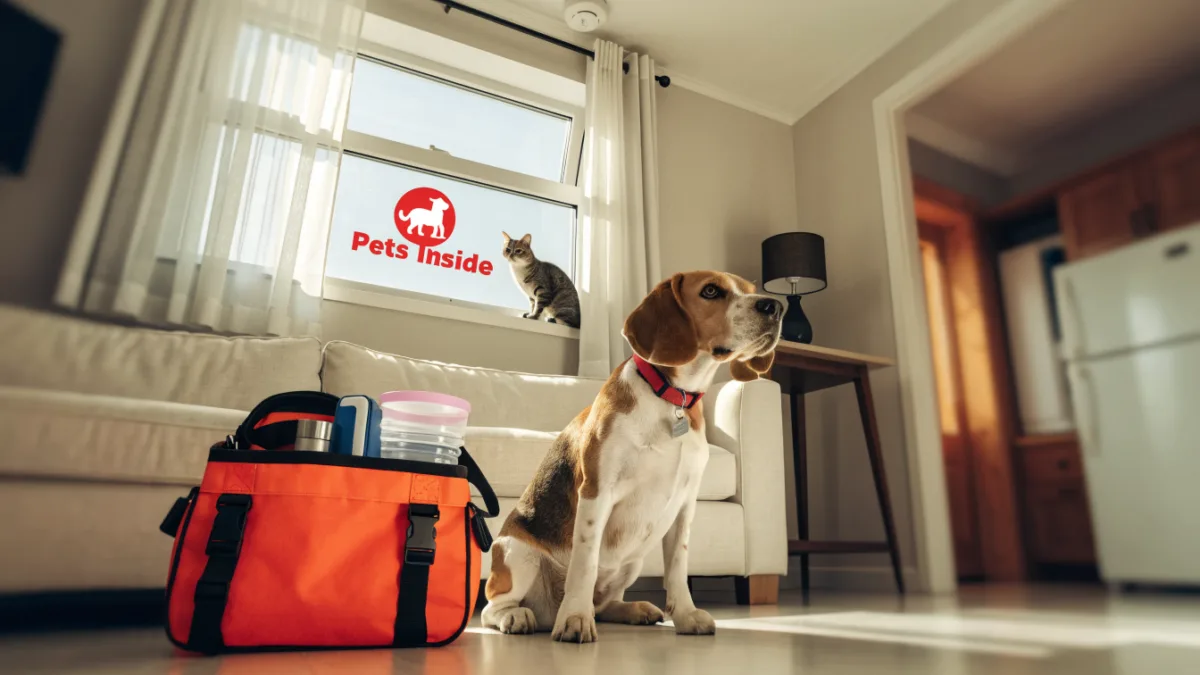
If you are not home when a fire breaks out, first responders are going in blind. They don’t know how many animals are inside, what kind of animals they are, or where they like to hide. You can bridge this communication gap with a simple, low-tech tool: a static-cling window decal.
Organizations like the [1] have heavily promoted the use of these pet-rescue window clings. You place them on your front and back doors, or on ground-floor windows. They allow you to write down the exact number and species of pets inside (e.g., “2 Dogs and 1 Cat”). When firefighters arrive, this simple sticker tells them exactly who they are looking for, saving them critical minutes during search and rescue.
“Having a sticker on the window doesn’t just alert the fire department; it serves as a daily reminder to us, the owners, to keep our evacuation plans up to date and fresh in our minds.”
Final Thoughts on Preparedness
Fires move terrifyingly fast, and smoke inhalation can overwhelm a small animal in mere minutes. [2] and veterinary professionals agree: preparation is the absolute best defense. By eliminating open flames, upgrading to monitored or smart detection systems, and planning out exactly how you will secure and transport your pets, you are drastically increasing their chances of survival.
Take ten minutes tonight to look at your living room through your pet’s eyes. Move that scented candle, secure the fireplace screen, and hang those rescue decals. A little bit of proactive pet-proofing is the greatest act of love you can show the animals who depend on you completely.
Sources
- ASPCA — aspca.org
- Fire safety experts — redhawkfp.net