

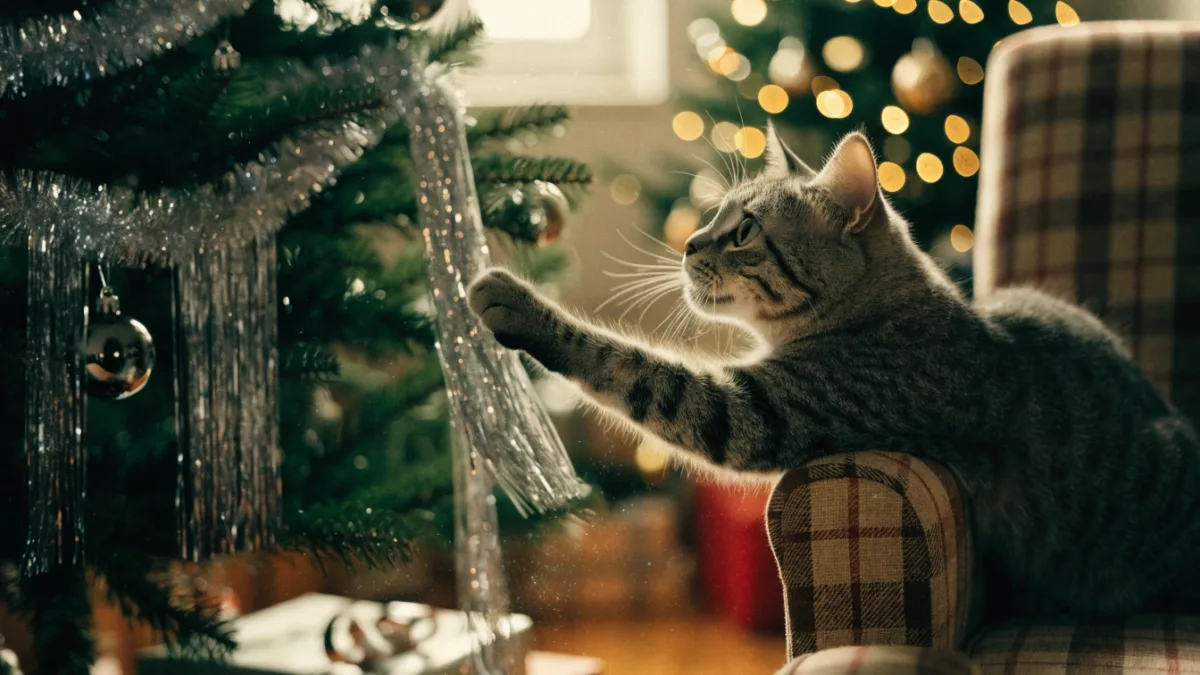
The call came at 11 p.m. on December 26th. A client — I’ll call her Margaret — was standing in her bathroom with her phone in one hand, hovering over her two-year-old calico, Clementine, with the other. Four inches of gold curling ribbon was hanging from Clementine’s back end. “I was about to pull it out,” Margaret told me, and my stomach dropped. That instinct is so natural, and so dangerous. She called first, thankfully. We found the ribbon anchored under Clementine’s tongue, and she was in surgery by morning. She’s now a smug senior cat who steals zipper pulls, none the worse for wear — but every December, emergency clinics see versions of this story play out over and over, and the patients are almost always cats.
Why December’s Emergency Room Belongs to Cats
Poison-control hotlines and pet insurers consistently report a spike in ingestion cases during the holidays, and the foreign-body side of that ledger — pets who’ve swallowed something solid or stringy — skews heavily feline. There are good biological reasons for this, and understanding them will do more for your holiday pet safety than any product you can buy.
First, cats are ambush predators wired to attack anything that dangles, drapes, or flutters. Tinsel and curling ribbon are essentially prey mimics. Second, a cat’s tongue is covered in papillae — backward-facing barbed hooks made of keratin, the same material as claws. They work like Velcro in one direction only. Once a cat starts licking a strand of ribbon, the physics of her own tongue ratchets it toward her throat, and she physically cannot spit it back out. Third, cats groom. A dog who sticks his nose in the wrapping paper mess makes a mess; a cat cleans debris off her fur and swallows it. Kittens and young adults are dramatically overrepresented, and breeds like Siamese and Orientals have a known tendency toward pica — compulsive chewing and swallowing of fabric and string.
Dogs aren’t off the hook in December; their risk profile is just different. I spent one Christmas Eve inducing vomiting in Henry, a four-year-old Labrador who ate an entire gift box of dark chocolate truffles, foil wrappers included, while his family was at church. Food toxicities are overwhelmingly a dog problem. String and sparkles are a cat problem. Your audit should reflect whichever animal is eyeing your decorations.
The Living Room: Your Christmas Tree Through a Cat’s Eyes
Tree water is not a water bowl
To a cat, the tree stand is a conveniently located puddle, and whatever’s in it gets drunk. Use plain tap water only —,[1] commercial tree preservatives, aspirin (an old-school additive some families still swear by, and one cats metabolize very poorly), and sugar-or-baking-soda home remedies. Even pristine tree water goes stagnant within days, and the bacteria and mold that grow in it can cause genuine gastrointestinal upset. A covered or enclosed stand, or a skirt pinned firmly around the base, solves most of this.
While you’re at it, anchor the tree to the wall or ceiling. I’ve treated two cats for limping after tree-tipping incidents, and both trees fell because nobody imagined the cat would actually climb it. (Cats will absolutely climb it.) Neither real nor artificial trees are automatically safer — real fir and pine oils are mild GI irritants and shed needles that can puncture a mouth, while artificial trees offer chewable plastic needles and older models can contain materials you don’t want in any pet’s stomach.
Ornaments: sharp, salty, and swallowable
Go through your ornament box with a skeptic’s eye. Glass ornaments shatter into shards that slice paws and mouths. Those little metal hooks can lodge in or perforate the GI tract — swap them for string loops, which is a five-minute fix. Homemade salt-dough ornaments are a hidden danger people rarely consider: their concentrated salt load can cause tremors and seizures if eaten. Popcorn and cranberry garlands, gingerbread decorations, and anything scented like food is an invitation. And button batteries, common in musical ornaments, cause caustic chemical burns if punctured.
The placement strategy that works: heirloom and glass ornaments go on the top third of the tree; fabric, wood, and shatterproof plastic go on the reachable lower branches. One caution — beaded garlands, often marketed as the tinsel alternative, are still a linear foreign body risk. More on why that matters so much below.
The Tinsel Trap: The One Emergency You Can’t Wait On
Here’s why tinsel is dangerous for cats in a way that goes beyond “don’t eat that.” String-like objects cause what we call a linear foreign body. One end of the strand lodges — usually under the tongue or at the exit of the stomach — while peristalsis, the wave-like muscle contractions that move food through the gut, pulls the rest of it deeper into the intestine. The bowel then plicates, essentially bunching up along the strand like fabric gathering on a thread. The string can slowly saw through the intestinal wall or cut off its blood supply, and a perforation means leakage into the abdomen and peritonitis — a life-threatening infection. The [2] describes tinsel anchored under the tongue as acting like a piano wire inside the digestive tract, and that image is not an exaggeration.
Which brings me to the single most important sentence in this article: if you ever see string, ribbon, or tinsel hanging from your cat’s mouth or anus, do not pull it. You cannot see how much is anchored inside, and pulling can slice through tissue that surgery might otherwise have saved. Go to a veterinarian immediately — that’s exactly what Margaret did. These cases frequently require surgery, sometimes removing damaged sections of intestine, and the bill routinely runs well into the thousands. Surgery is survivable; well-meaning traction and a wait-and-see approach often aren’t.
Watch for repeated or unproductive vomiting, hiding, lethargy, a hunched posture, crying when picked up, or refusing food — and know that symptoms can appear hours to days after the swallowing event, which is frequently unwitnessed. Cats also mask illness masterfully; by the time a cat looks sick, she’s been sick. Last winter I treated a six-month-old Siamese kitten whose owners never saw her eat anything — she simply stopped playing on December 29th.
Some owners tell me they’ll just supervise around tinsel. I’ve changed my position on this over the years: I used to nod along. But ingestion takes seconds, tinsel is engineered to shimmer and flutter, and cats are most active when we’re asleep. My honest advice now is no tinsel, no curling ribbon, and no angel-hair garland in any cat household. Traditional tinsel has quietly vanished from many stores, but ribbon and beaded garlands have simply taken its place. The danger didn’t disappear; it changed shape.
Kitchen, Dining Room, and the Guest Bathroom Everyone Forgets
The kitchen is dog territory. The classic December offenders:
- Chocolate — darker means more dangerous; the toxic compound is theobromine, which dogs clear from their bodies very slowly
- Xylitol — a sweetener in sugar-free gum and candy that can crash a dog’s blood sugar and damage the liver
- Grapes and raisins — linked to kidney failure even in small amounts, by a mechanism we still don’t fully understand
- Onions and garlic — damage red blood cells over time
- Raw yeast dough — rises in the warm stomach, producing painful bloating and alcohol
- Fatty scraps and cooked bones — table food is a leading trigger of pancreatitis, a painful inflammation of the pancreas, and cooked bones splinter
On plants: the poinsettia’s deadly reputation is largely a myth — I spent the early years of my career telling people to banish it, and I’ve relaxed since. It causes mild drooling and stomach upset at worst. The plant that genuinely deserves your fear is the lily. Even a grain of pollen groomed off a cat’s fur is enough to cause acute kidney failure. No lilies in a cat’s home, ever; amaryllis, mistletoe, and holly sit somewhere in the middle and are best kept out of reach. If you want festive blooms, orchids, roses, and gerbera daisies are safe choices.
Two final rooms. Liquid potpourri, usually simmering in the guest bathroom, is caustic — it can cause serious chemical burns to a cat’s mouth and esophagus when licked off paws. And candles mean singed whiskers and knocked-over flames; flameless versions have quietly become one of the best holiday upgrades you can make. Add cord protectors for kittens (chewed electrical cords cause oral burns and worse), and designate a quiet, escape-proof room for parties — December door-darting and stress-related illness are real, and a stressed guest with a plate of hors d’oeuvres feeds pets things they shouldn’t have.
Your Five-Minute Holiday Pet Safety Audit
- Anchor the tree; fill the stand with plain tap water only and cover the base
- Swap metal ornament hooks for string loops; glass and heirlooms go high, soft and shatterproof go low
- Skip tinsel, curling ribbon, and beaded garlands entirely in cat households
- Unwrap gifts with supervision, then bin the ribbon and bows immediately
- Add cord protectors and switch to flameless candles
- Remove lilies; double-check bouquets from guests
- Keep chocolate, xylitol candy, dough, and fatty scraps unreachable — and brief your guests
- Set up a quiet room for party nights, and save your veterinarian’s and nearest emergency clinic’s numbers in your phone tonight
And repeat it with me, because it’s worth saying twice: never pull a visible string from either end of your cat — go straight to the vet. None of this means a tense, tinsel-free, joyless holiday. Most pets sail through December without incident, and small changes do almost all the protective work. Remember, too, that the season hands your cat something genuinely wonderful: [3] and an empty cardboard box with a folded blanket is the safest holiday gift you’ll ever give. The takeaway I’d leave you with is simple: your cat isn’t plotting against your decorations — she’s doing exactly what evolution built her to do. Decorate around her instincts instead of against them, and you’ll both enjoy the tree until January.
Sources
- safety experts consistently warn against — countynewscenter.com
- Cornell Feline Health Center — vet.cornell.edu
- cats famously adore December boxes — facebook.com