

Picture a family sending a photo before they even bring in the kitten. Two weeks after adopting Mochi, a nine-week-old tabby from a local rescue, both of their kids had developed round, scaly, itchy patches — one on a forearm, one behind an ear. “I thought it was eczema,” their mom said, “but then I saw the same flaky spot on the kitten’s face.” It wasn’t eczema. It was ringworm, and their new kitten was the connecting thread. This scenario plays out constantly, especially in families with young children, so let me walk you through what ringworm in cats actually is, whether it’s contagious to humans (spoiler: yes, very), and how to end a household outbreak without losing your mind.
It’s Not a Worm — It’s a Fungus That Loves Kittens
First, the naming crime we all have to live with: ringworm involves no worms whatsoever. It’s a fungal skin infection caused by dermatophytes — fungi that digest keratin, the protein in dead skin, hair, and nails. The name comes from the ring-shaped rash it tends to create on human skin, not from anything wiggling around in there.
In cats, roughly 90% of cases are caused by one species, Microsporum canis, and cats are the most common animal source of human infections with it. Kittens are uniquely vulnerable because their immune systems are still developing, and an infected mother cat can spread spores to her whole litter just by grooming them. Cats under a year old — and long-haired breeds like Persians and Himalayans in particular — are dramatically overrepresented in my caseload.
Here’s the detail that catches most families off guard: cats don’t always show the classic signs. The textbook presentation is circular patches of hair loss with broken, stubbly hairs, scaling, or crusting, usually on the face, ears, paws, or tail. But plenty of kittens look essentially normal. Some estimates suggest that around 20% of healthy-appearing cats may be carrying infectious spores. I once treated a Persian kitten named Clementine whose only symptom was a patch of mild dandruff behind one ear — easy to miss, easy to dismiss, and more than enough to infect two kids and the family dog.
Is Ringworm Contagious to Humans? Yes — Here’s What It Looks Like
Ringworm is zoonotic, meaning it moves between animals and people. You can catch it through direct contact with an infected pet or indirectly through contaminated bedding, brushes, furniture, or clothing. Those fungal spores are remarkably hardy — they can survive in your home for 12 to 24 months, which is why environmental cleaning matters as much as treating the animal.
In people, symptoms typically show up 4 to 14 days after exposure: a red, scaly, often itchy ring that expands outward with a clearer center. Children, elderly family members, and anyone with a weakened immune system are at highest risk. One important note for parents: if a lesion appears on your child’s scalp, skip the drugstore and call your pediatrician. Scalp infections can cause hair loss and usually need prescription treatment, not over-the-counter cream.
For most healthy people, though, ringworm on the body is a nuisance, not an emergency. Over-the-counter topical antifungals containing clotrimazole or miconazole — generic ingredients, available in most pharmacies — typically clear it up in two to four weeks. I say this deliberately: ringworm is gross and itchy and inconvenient, but it is not a reason to panic, and it is absolutely not a reason to return the kitten.
Why Diagnosis Takes Longer Than You’d Expect
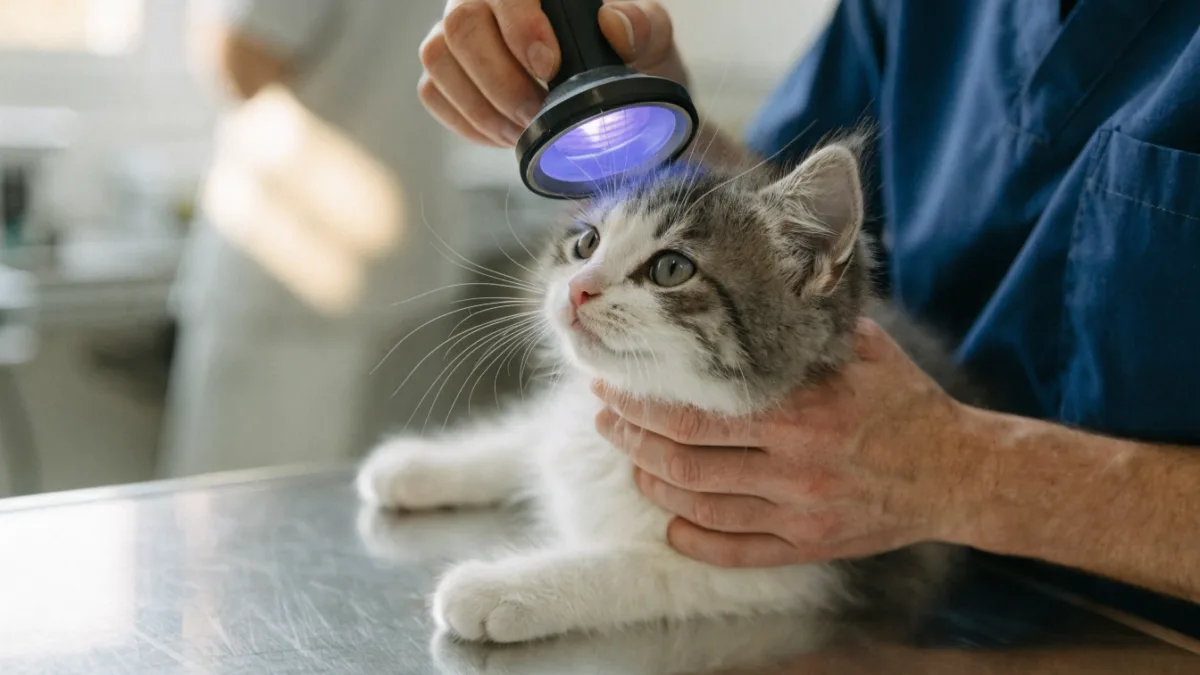
When Mochi’s family came in, I did what most vets do first: a Wood’s lamp exam, where an ultraviolet light makes some ringworm strains glow apple-green under the fur. It’s fast, but it only picks up about half of M. canis strains, so a negative result doesn’t rule anything out. The traditional gold standard is a fungal culture, which is reliable but takes 10 to 21 days to grow results. Increasingly, we’re turning to PCR testing, which can confirm infection in days rather than weeks.
My practical advice: if one pet in your house is diagnosed, screen all of them. Cats and dogs pass this fungus back and forth readily, and treating one animal while another silently carries spores is how households get stuck in outbreak limbo for months. The [1] has an excellent breakdown of the diagnostic process if you want to go deeper.
Treatment: Plan on Weeks, Not Days
For your kitten or cat
The most effective approach combines topical and systemic treatment. Topically, lime sulfur dips remain a gold standard — they’re safe for young kittens and highly effective, though I warn families upfront that they smell like rotten eggs and will temporarily tint light fur yellowish. Medicated shampoos and creams round out the options. Systemically, oral antifungals like itraconazole are the preferred choice, and there’s now an oral solution approved specifically for cats — a genuine improvement over the off-label options we relied on for years. Your vet will determine the right medication and dosing for your cat’s age, weight, and health status; please don’t improvise with antifungals on your own, especially in kittens or pregnant animals, where some drugs are off-limits.
If your dog catches it too
Ringworm treatment for dogs follows the same playbook: lime sulfur dips or medicated antifungal shampoos, often paired with oral medication, confirmed with follow-up cultures. Dogs frequently pick it up from a new kitten before anyone knows the kitten is infected — I saw a seven-year-old Golden Retriever named Waffles last spring who developed a crusted patch on his muzzle two weeks after a kitten joined the household. His owner assumed it was a hot spot. Same fungus, same protocol, same eventual cure.
Now, the timeline reality check: treatment takes a minimum of six to eight weeks, and three to four months is common. The biggest mistake owners make is stopping when the skin looks healed. Fungal lesions can visually resolve while spores linger, so the standard is to continue treatment until there are two consecutive negative cultures. I’ll also admit something here: I’ve changed my mind about clipping long-haired infected cats. Early on, I’d have endorsed a full body clip almost automatically. Now I’d be much more selective, because careless clipping can aerosolize spores and actually spread the infection around your home. If clipping is needed, it should be done carefully, by professionals, in a contained space.
Quarantine and Cleaning: The Part Everyone Underestimates
Setting up a quarantine
While your infected pet is being treated, confine them to one easily cleaned room — a bathroom works beautifully because it has few soft surfaces. No shared bedding, toys, brushes, or furniture between pets. Have an adult, not a child, do the hands-on care, wearing gloves, with thorough handwashing afterward. And keep the infected pet away from anyone who’s immunocompromised until they’re cleared.
Attacking the environment
Because those spores can survive over a year, contamination is what causes most household reinfections:
- Clean hard, non-porous surfaces with diluted household bleach — ask your vet for the exact dilution they recommend; common protocols fall in the range of 1 part bleach to 10–30 parts water. Never apply bleach to the animal itself.
- Wash all pet bedding in hot water, and wash your own if the pet has had access to it.
- Discard anything you can’t disinfect — carpeted cat trees and plush toys are usually beyond saving. Yes, this stings, but so does month four of an outbreak.
- Vacuum frequently and dispose of the bag or canister contents immediately outdoors.
- Clean or replace grooming tools, and consider swapping out furnace or AC filters once treatment wraps up.
Mochi’s family did all of this — bathroom quarantine, weekly dips, daily laundry, bleach on every doorknob — and called it “the world’s most annoying group project.” But the kids’ rashes faded, the cultures eventually came back negative twice, and Mochi, now a lanky year-old cat, sleeps in the kids’ beds again. The [2] is a solid reference to keep handy if you’re mid-outbreak.
My final takeaway is really a reframe. Ringworm has a worse reputation than it deserves, and that reputation has real consequences: historically, some shelters euthanized infected animals as a cost-cutting measure. The encouraging shift is that most modern welfare organizations now treat ringworm-positive kittens and adopt them out with full disclosure — because it’s a curable, temporary condition, not a death sentence. If you’re considering adopting a kitten who’s currently being treated, resources like the [3] will reassure you that it’s genuinely manageable. So if your new kitten turns out to be the culprit in a family outbreak, you haven’t made a mistake — you’ve just been handed a six-to-twelve-week project with a purring reward at the end. Wash your hands, break out the bleach, call your vet, and hold steady. This one has a finish line.
Sources
- VCA Hospitals guide on ringworm in cats — vcahospitals.com
- PetMD overview of ringworm in cats — petmd.com
- Humane Society of Charlotte's guide — humanesocietyofcharlotte.org