

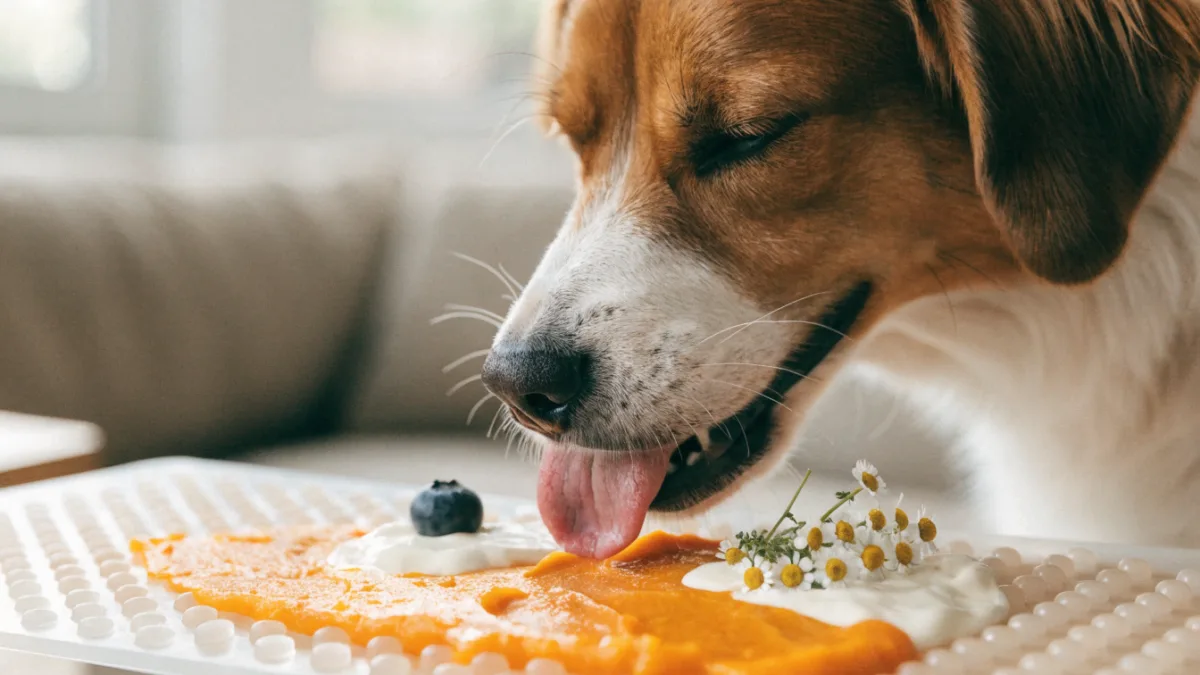
You’ve probably seen them — those colorful silicone squares with weird textures, covered in peanut butter, stuck to the side of a bathtub while a dog goes to town. Lick mats exploded in popularity a few years back, and for a lot of owners, they’ve become just another way to stuff food into a dog’s face. But here’s the thing: if you’re only using a lick mat as a messy treat dispenser, you’re missing about 90% of what it can actually do. These things aren’t just snack trays. They’re a tool you can use to genuinely shift your dog’s nervous system out of panic mode — if you use them strategically.
Why Licking Actually Changes Your Dog’s Brain
Let’s start with the mechanics, because this matters. When a dog licks repetitively, their brain releases endorphins — the same [1] that flood a human’s system after a long run. These endorphins do two things: they lower heart rate, and they create a mild calming effect that’s essentially built into canine biology. Puppies do it when they nurse. Adult dogs do it when they groom themselves. It’s instinctual, and it’s self-soothing.
What a lick mat does is hijack that natural mechanism and put it to work on your schedule. The textured surface forces your dog to really work at getting the food out — it’s not a quick inhale like a bowl. That prolonged licking keeps the endorphin release steady instead of a quick spike and crash. And while they’re focused on that task, their brain literally has less processing power available to freak out about the thunder rolling outside or the clippers coming toward their nails.
There’s also a digestion angle here that people overlook. Anxiety messes with a dog’s gut — same as it does with humans. When a dog is stressed, they often gulp food, which leads to bloating, gas, and poor nutrient absorption. A lick mat slows everything down. The food sits flat against a textured surface, and your dog has to work through it methodically. That slow feeding pattern is easier on the digestive tract and helps prevent the vomiting or diarrhea that anxious dogs often deal with after a stress event.
The Gut-Brain Connection: Why What You Put On the Mat Matters
Here’s where I had to change my own thinking. I used to throw whatever I had on a lick mat — usually peanut butter, sometimes cream cheese — and call it good. The licking itself was doing the heavy lifting, right? Well, sort of. But recent veterinary behavioral research keeps pointing back to the gut-brain axis, and it turns out the ingredients you choose can either support or undermine the calming effect.
The gut microbiome directly influences serotonin production — and serotonin plays a huge role in mood regulation for dogs, just like it does for us. So when you load up a lick mat with ingredients that support gut health, you’re not just distracting your dog in the moment. You’re reinforcing a biological foundation that helps them handle stress better over time.
Plain, nonfat Greek yogurt is one of the best bases you can use. It’s packed with probiotics, it’s low in calories compared to peanut butter, and its tangy flavor keeps most dogs interested without overloading them on fat. Kefir works too if your dog tolerates dairy. From there, you can layer in ingredients that serve a specific purpose — and no, peanut butter shouldn’t be the default every single time.
Strategic Deployment: When to Break Out the Mat
This is where most owners get it wrong. They hand the dog a loaded lick mat and hope for the best. But timing is everything if you want the nervous system benefits. Here’s how to think about it:
Before the Storm Hits
If your dog loses their mind during thunderstorms, fireworks, or construction noise, the worst time to introduce a lick mat is when they’re already at full panic. At that point, they’re too flooded to eat — and if they do manage to lick, they’re not really engaging with it. You need to deploy the mat before the anxiety peaks.
Here’s what that looks like in practice: you check the weather, you see storms rolling in around 3 PM, so at 2:30 you pull a frozen lick mat out of the freezer and set it up in the spot where your dog usually retreats during bad weather. They start licking. The endorphins start flowing. By the time the first thunderclap hits, their nervous system is already in a calmer baseline, and the repetitive licking gives their brain a job to focus on instead of spiraling.
During Grooming and Handling
This is probably my favorite use case. A lick mat stuck to the shower wall or the side of a grooming table can completely change how a dog tolerates baths, nail trims, and brushing. The key is that the mat gives them something to do with their mouth — and for a lot of dogs, oral fixation is how they self-soothe when they’re being handled in ways they don’t love.
I worked with an owner whose terrier mix would scream — literally scream — during nail trims. Not because it hurt, but because the restraint and the handling sent her into a panic. We started sticking a frozen yogurt-and-pumpkin mat on the wall at nose height during trims, and within two sessions, the screaming stopped. She was still nervous, but she had a coping mechanism. That’s the difference between distraction and genuine nervous system regulation.
Post-Exercise Cool-Down
People don’t think about using lick mats after physical activity, but this is a genuinely underrated application. When a dog comes back from a high-intensity walk, a fetch session, or agility training, their heart rate is elevated and their arousal level is through the roof. Some dogs struggle to transition from “go mode” to “rest mode” — they pace, they whine, they can’t settle.
A frozen lick mat forces them to stop moving, lie down, and engage in a slow, rhythmic behavior. The licking brings their heart rate down. The frozen element extends the session. And by the time they finish, their body has actually had a chance to cool down and shift into parasympathetic mode — that’s the “rest and digest” state where recovery actually happens.
Calming Recipes That Go Beyond the Jar
Alright, let’s get specific. These are recipes I’ve tested with dogs who deal with genuine anxiety — not just picky eaters. Each one combines the mechanical benefit of licking with ingredients that support calm on a biological level. And yes, you should freeze all of them. A room-temperature lick mat lasts about 90 seconds. A frozen one gives you 15 to 25 minutes of genuine engagement, depending on your dog’s skill level.
The Pumpkin-Gut Soother
Start with a base of plain, nonfat Greek yogurt — about two tablespoons for a medium-sized mat. Add one tablespoon of pureed pumpkin (not pumpkin pie filling — check the label, because the spiced stuff can contain nutmeg, which is toxic to dogs). Drizzle a small amount of local honey on top. Spread it evenly across the mat, making sure to push the mixture deep into the crevices, then freeze for at least four hours.
The pumpkin provides soluble fiber, which supports digestive health. The yogurt delivers probiotics. And local honey contains trace amounts of local pollen, which some holistic vets believe can help with seasonal allergy symptoms — though the research on that is still limited. Either way, it’s a low-fat, nutrient-dense option that won’t pack on pounds if you use it regularly.
The Chamomile Banana
Mash half a ripe banana with about two tablespoons of cooled, dog-safe chamomile tea. Chamomile has mild sedative properties — it’s been used for centuries as a calming agent, and while the canine-specific research is thin, many holistic veterinarians recommend it for situational anxiety. The banana provides potassium and natural sweetness without being calorie-dense. Spread it thin, freeze it solid, and deploy it about 30 minutes before a known stress event.
The Bone Broth Reset
For post-workout recovery, try mixing plain yogurt with a tablespoon of low-sodium bone broth. Bone broth contains amino acids like glycine, which supports joint health and may have calming properties. Freeze it, and let your dog wind down with it after intense exercise. This one’s especially good for older dogs or dogs with arthritis who need the joint support anyway.
Safety and Common Mistakes
Lick mats aren’t perfect, and pretending otherwise does nobody any favors. Let’s talk about the real risks.
Xylitol — Check Every Label
This one’s non-negotiable. Xylitol — sometimes labeled as “birch sugar” — is an artificial sweetener that’s extremely toxic to dogs. It causes a rapid, potentially fatal drop in blood sugar, and it can trigger liver failure. It shows up in peanut butter, yogurt, and other “sugar-free” products. Read every single label before you put anything on a lick mat. If you see xylitol or birch sugar on the ingredients list, it doesn’t go near your dog. Period.
The Cleaning Problem
Lick mats are a pain to clean, and that’s not a minor issue — it’s a genuine health concern. The deep crevices that make them effective also make them perfect breeding grounds for bacteria like Salmonella and E. coli. If you’re not scrubbing the mat thoroughly after every single use and running it through a dishwasher on a hot cycle, you’re rolling the dice on your dog’s health. I recommend buying at least two so you always have a clean one ready while the other is being sanitized.
Chewing vs. Licking
Some dogs don’t lick — they chew. And a chewer will tear a silicone lick mat apart once the food is gone, which can lead to gastrointestinal blockages. If your dog is an aggressive chewer or a dog who gets so anxious that they destroy things, don’t leave them unsupervised with a mat. Use it as a supervised activity, and take it away the moment they shift from licking to gnawing on the silicone itself. There’s no shame in recognizing that a tool isn’t right for your specific dog.
Caloric Awareness
It’s easy to forget that everything on a lick mat counts toward your dog’s daily calories. If you’re loading up a mat with peanut butter twice a day on top of regular meals, you’re going to end up with a overweight dog — and excess weight makes anxiety worse, not better, because it limits exercise and increases inflammation. Stick to low-fat bases like yogurt and pumpkin for daily use, and save the high-value stuff like peanut butter for true emergency-level stress events.
The Bigger Picture
Look, a lick mat isn’t a cure for anxiety. If your dog has severe separation anxiety, noise phobia, or generalized anxiety disorder, they need a comprehensive behavior modification plan — and probably a conversation with a vet or a qualified behavior professional about whether medication is appropriate. A lick mat is one tool in the toolkit, not the whole kit.
But used strategically, with intention and the right ingredients, it’s a genuinely powerful tool. It leverages your dog’s own biology — their instinct to self-soothe through licking — and channels it into something productive. It gives their nervous system a break. And in a world where we ask dogs to live in environments that are often overstimulating and confusing for them, that matters more than we usually acknowledge.
The best thing you can do for your dog isn’t to eliminate every stressor — that’s impossible. It’s to give them the tools to cope with the stress they’ll inevitably face. A well-used lick mat, loaded with ingredients that support their body and deployed at the right moment, does exactly that. It’s not about treats. It’s about meeting your dog where they are and helping their nervous system find its way back to calm.
Sources
- feel-good chemicals — akc.org