

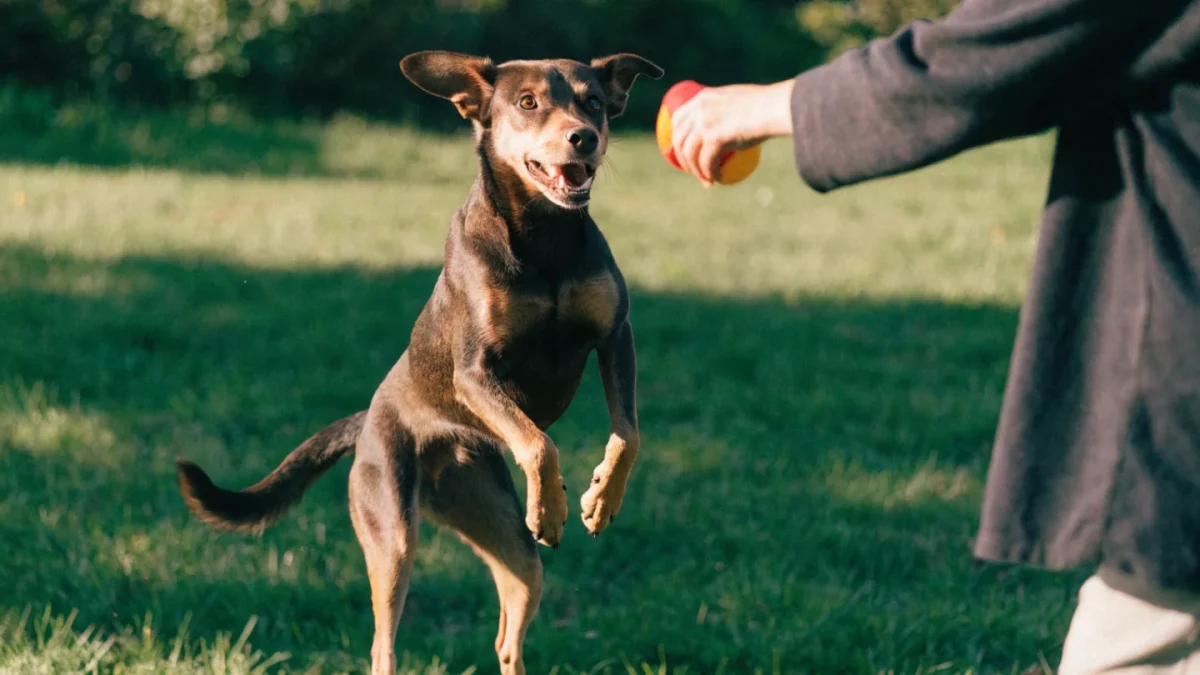
I know, I know — another trainer telling you to "be more positive." But this isn't about ideology. It's about what actually works with excited dogs.
Excited dogs have a high arousal level. At high arousal, punishment-based feedback is less effective because the dog's learning system isn't well-suited to taking in nuanced information. Saying "no" to a dog that's spinning in excitement isn't really reaching the learning part of their brain.
What does reach them: management of the environment, redirection to appropriate outlets, and building default behaviors that have been trained at low arousal and can fire at high arousal.
The Three-Part Approach
Part 1: Reduce the overall arousal level.
An under-exercised, under-stimulated dog is a harder dog to manage. Full stop. For high-energy dogs specifically: the morning exercise sets the tone for the day's behavior. A dog that's had a real workout (not just a walk around the block) has lower baseline arousal for several hours afterward.
Sniff walks are also highly effective at reducing arousal — the focused sniffing activity is cognitively engaging and produces a genuinely calm state. A 20-minute sniff walk in new territory reduces arousal more than a 40-minute regular walk.
Part 2: Build default behaviors that can work at arousal.
The behaviors that are most useful are the ones that become reflexive — the dog does them almost automatically in triggering contexts. Sit when a person appears. Mat when food is present. Toy in mouth at greetings.
Train these at low arousal. Practice them frequently. Reinforce heavily. Over many repetitions, they start to fire automatically in the triggering contexts.
Part 3: Redirect before the peak.
The critical timing skill is intervening before the dog hits full arousal. A dog at 4/10 excitement can take a treat and hear your cue. A dog at 9/10 cannot.
Learn to read your dog's escalation signals. Redirect — offer the toy, ask for the sit, move to a different location — at 4-5/10, not after they're already bouncing off walls.
Practical Tools for Excited Moments
The toy redirect. Have a toy available during high-excitement moments (guest arrivals, before walks, playtime). The dog's energy goes into the toy, not into jumping or mouthing.
The sit-stay in exciting contexts. If the dog can sit and hold it around exciting things, they're managing their own arousal. This is trained systematically: sit in calm contexts → sit around moderate distractions → sit around exciting things.
The "find it" game. Scatter treats on the ground and say "find it." The dog's head goes down, they start sniffing, the physical posture lowers arousal. Useful in moments when the dog is getting too excited indoors.
See incompatible behaviors in training for the broader framework of building alternatives, and positive reinforcement dog training for the science behind why these approaches work.