

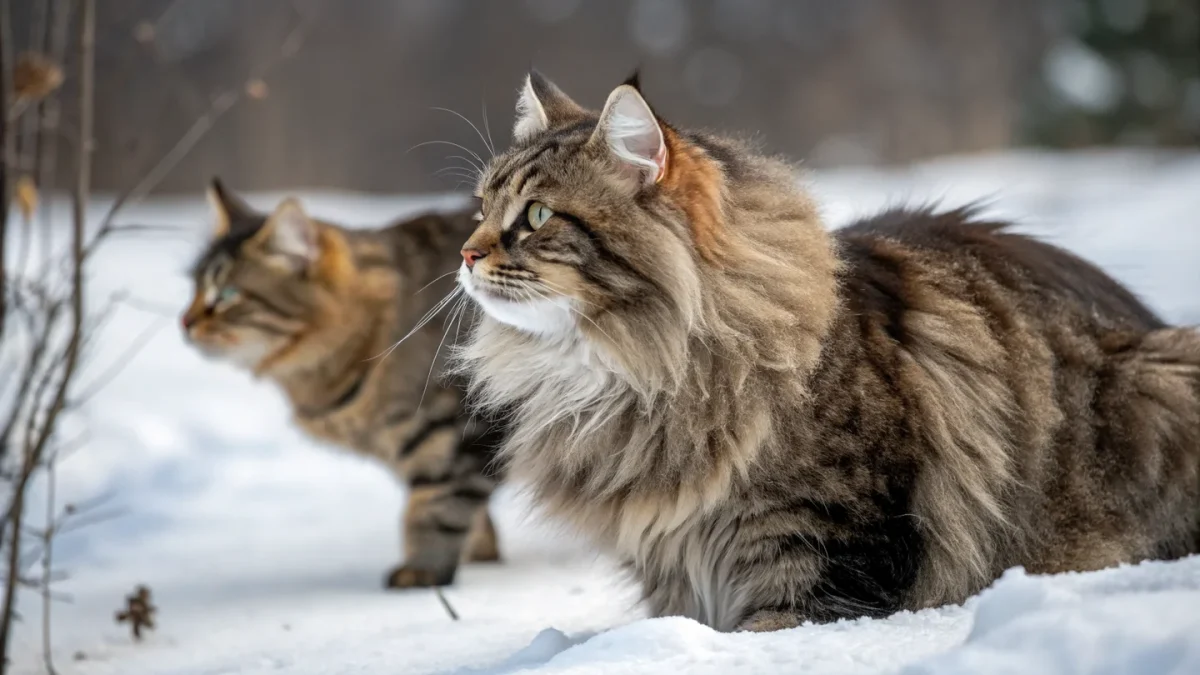
Two massive, heavily furred northern cats — one from the Scandinavian forests, one from the Russian taiga. At a glance, the Norwegian Forest Cat and the Siberian can seem nearly interchangeable. Both are large, both have triple-layered coats, both move with the purposeful efficiency of animals built for genuine winter conditions. The personality difference is where the comparison opens up.
The cat breed comparison guide covers the systematic approach to evaluating similar breeds.
Quick Comparison
| Trait | Norwegian Forest Cat | Siberian |
|---|---|---|
| Build | Large, long-legged, athletic | Large, stocky, barrel-chested |
| Coat | Triple layer; dense, water-resistant | Triple layer; thick, dense |
| Grooming | Weekly; more in shedding season | Weekly; significant shedding season |
| Energy | Medium | Medium-high |
| Vocalization | Quiet | Moderate |
| Independence | High | Moderate |
| People-orientation | Self-sufficient | Warmer, more people-seeking |
| History | Natural breed from Norway | Natural breed from Russia |
The Norwegian Forest Cat: The Skogkatt
The "Wegie" — as affectionate owners have nicknamed the Norwegian Forest Cat — appears in Norse mythology and Viking-era literature as far back as the second millennium. The Norwegian Forest Cat breed profile covers the full historical record, coat structure, and health considerations. Norwegian farmers valued them as working cats, and the breed developed naturally over centuries in Scandinavia's harsh climate. The wedge-shaped head, triangular ears set at an angle, and long leg structure are distinctive once you know what to look for.
The personality reflects the history: self-sufficient, observant, and not especially demanding of human interaction. Norwegian Forest Cats are warm companions who prefer proximity to physical closeness. They'll be in the room with you, watching what's happening, but probably not in your lap. They handle solitude better than most breeds. They make excellent choices for people who value a companion that doesn't require constant management.
The coat is genuinely remarkable. The outer layer is water-resistant; the dense woolly undercoat provides insulation. It sheds dramatically in spring — a shedding season that leaves impressive amounts of fur on any surface in range.
The Siberian: Russia's National Cat
The Siberian is equally ancient — Russia's native forest cat, naturally developed over centuries in the harsh Siberian environment. Broader and more barrel-chested than the Norwegian Forest Cat, the Siberian has a rounder head and slightly different facial structure.
Temperamentally, the Siberian is warmer and more people-oriented than the Norwegian Forest Cat. They're curious, playful, and more likely to seek out their people actively. They make good family cats and generally integrate well in multi-pet households.
One frequently noted characteristic of the Siberian: lower levels of Fel d 1 (the primary cat allergen protein) in some individuals — though I'll be direct about the state of the evidence here. The one peer-reviewed genetic study on this, out of Italy in 2017, tested just four cats and came back genuinely inconclusive, with one low reading and two well above typical levels. The bigger claims you'll see repeated — "50% lower," that kind of thing — trace back to breeder-funded research, not independently replicated science. This has made the breed attractive to allergy-sensitive households, but no breed is reliably hypoallergenic, and individual variation within the breed is significant.
The Verdict
Choose the Norwegian Forest Cat if you want a magnificent, self-sufficient northern cat who provides calm companionship without social demands — good for independent owners, people who work from home but don't want constant attention-seeking, and those who find the understated bond satisfying.
Choose the Siberian if you want a large, rugged cat with more warmth and interactive personality — better for families, people who want a cat that's noticeably engaged with the household, and potentially those with mild cat allergies willing to test individual tolerance before committing.
Both are excellent breeds. The Norwegian Forest Cat is more independent; the Siberian is warmer. Both are cold-climate adapted, gloriously furred, and magnificent animals.