

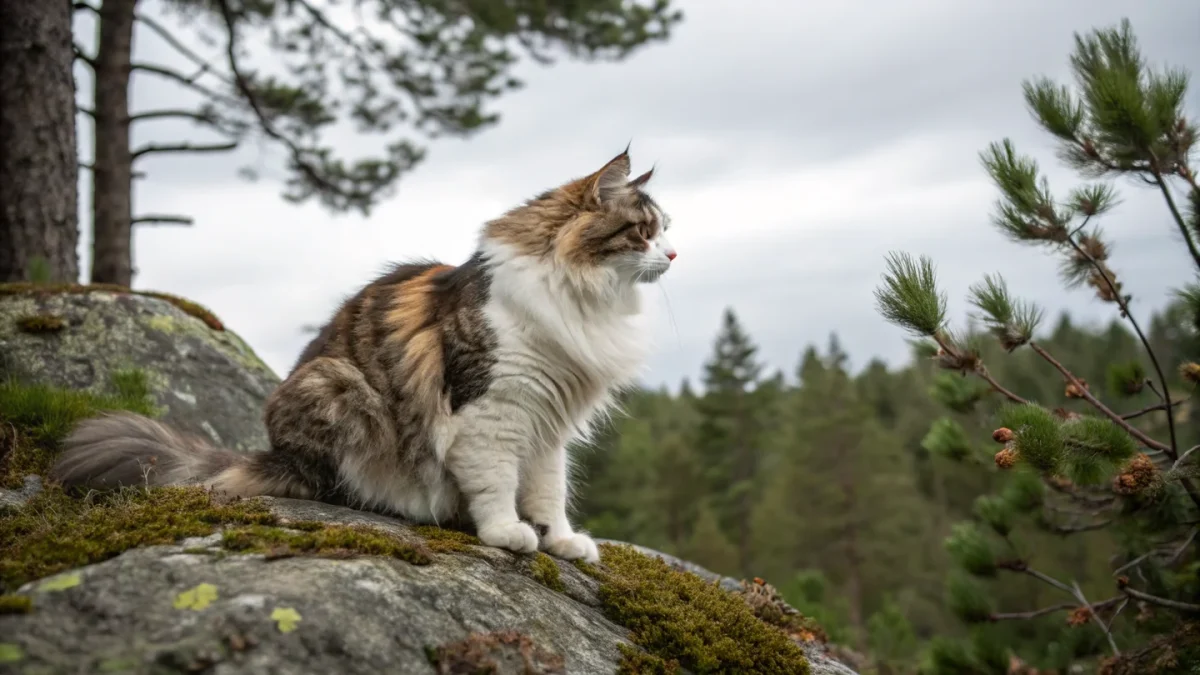
Norse mythology describes the goddess Freya riding a chariot pulled by large, long-haired cats. Whether those mythological animals were recognizable ancestors of the Norwegian Forest Cat — the Wegie, as enthusiasts call them — or simply the cats of Scandinavian forest folklore is a question no one can answer with certainty. What is documented is that large, thick-coated cats have been part of Norwegian rural life for centuries, appearing in farm records, folk stories, and eventually in the serious breeding programs that began in the 1930s.
The Norwegian Forest Cat is the breed that makes people re-examine their assumptions about what a cat can look like. Substantial, weatherproofed, utterly confident in its own nature, and possessed of an independence that is absolutely authentic.
Origins: From Farm Cat to Championship Breed
The Norwegian Forest Cat's documented modern history begins in the 1930s, when Norwegian cat enthusiasts began working to establish the breed formally. A show cat named Pans Truls was exhibited in Oslo in 1938 — considered the first formal showing of a Norwegian Forest Cat. World War II interrupted these efforts, and the breed almost disappeared as a distinct type.
Norwegian breeders resumed standardization work in the 1970s through the Norsk Skogkattring (Norwegian Forest Cat Club). The foundation stock was drawn from working farm cats of the Norwegian countryside — cats that had been living semi-wild and developing the physical characteristics suited to a Nordic climate for generations. The heavy, water-resistant double coat, tufted paws, and robust body are not breeders' selections for aesthetics; they are functional adaptations that actually worked for cats surviving Norwegian winters.
Formal international recognition came in the late 1970s and early 1980s, with Fédération Internationale Féline (FIFe) accepting the breed in 1977. North American registries followed through the 1980s.
The mythology connection — Freya's cats, skogkatt (forest cat) legends — is cultural context, not breed history. The Norse connection is real in the sense that cats very like the Norwegian Forest Cat have been part of Norwegian culture for a very long time. But documented breed development begins in the 20th century, not in the Viking Age.
Physical Characteristics
The Norwegian Forest Cat is built for conditions most cats would find inhospitable. It is a large breed — adult males often reach 5.5 to 7.5 kilograms, females somewhat less — but the size is carried in a way that looks purposeful rather than simply large. The body is long and substantial, with solid bone structure and muscular haunches that give these cats their characteristic ability to descend trees headfirst by rotating their hind legs — a capability uncommon in domestic cats.
The coat is the defining feature. The double coat consists of a dense, woolly undercoat and long, water-resistant guard hairs that form a dramatic mane around the neck and chest, long ear tufts, heavily furred paws, and a flowing, plumed tail. In winter, the full coat is dramatically thick. In summer, the Norwegian Forest Cat sheds the bulk of its undercoat and can look surprisingly moderate — less majestic than its winter self.
The head is an equilateral triangle from the front, with a straight profile, strong chin, and the characteristic large, obliquely-set eyes. Eye color can be any shade. The ears are medium-large with lynx-like tufts at the tips.
Colors and patterns span an enormous range — virtually every combination found in domestic cats except colorpoint (pointed). Traditional tabbies — brown tabby, silver tabby — with white are among the most recognizable, but solid, smoke, and bicolor versions are common.
Temperament: Independent but Present
The Norwegian Forest Cat is not a lap cat in the way a Burmese or Sphynx is, and this is probably the most important thing a prospective owner needs to understand before acquiring one.
The Wegie is affectionate — genuinely, consistently affectionate — but on its own schedule. It will choose to come to you, settle nearby, invite petting when it wants it, and leave when it's had enough. It does not feel the compulsive need for proximity that drives more people-dependent breeds. This is not aloofness; it is independence, and there is a real difference.
In practice, a Norwegian Forest Cat in the right household is a deeply satisfying companion. It is present, engaged with its environment, and will participate in household life without needing to be at the center of it. Many owners describe their Wegies as "dog-like" in terms of following them around — but unlike a dog, the Wegie does this on its own terms.
The breed is calm and confident with strangers. Not immediately social the way a Burmese or Sphynx would be, but not the profound shyness of a Russian Blue either. Most Wegies will investigate newcomers at their own pace and settle into appropriate social interaction.
Vocal level is low to moderate. The breed communicates in trills, chirps, and quiet chirring sounds rather than conventional meows. They will comment on events but are not continuously chatty.
Play drive is high throughout life, particularly around anything that engages hunting instincts — moving prey-type toys, puzzle feeders, anything requiring skill and athleticism. The Norwegian Forest Cat is an impressive jumper and climber. It will use the highest accessible point in any room.
What Most People Get Wrong About the Norwegian Forest Cat
They're the same as Maine Coons. This confusion is extraordinarily common and understandable — both are large, longhaired, tufted, triangular-eared cats with similar coloring possibilities. But they are distinct breeds with different physical structures. The Norwegian Forest Cat has a straight profile; the Maine Coon has a concave, slightly scooped profile. The Wegie's body is longer and more angular; the Maine Coon is often broader and more rectangular. The tail-base-to-shoulder ratio differs. Up close and knowing what to look for, they are clearly different animals.
The thick coat requires professional grooming. The coat is designed to take care of itself to a substantial degree — the water-resistant guard hairs shed dirt, and the undercoat is designed to separate naturally. Domestic-kept Wegies do not need professional grooming unless individual circumstances require it. Weekly brushing is sufficient for most of the year. The real demand comes during spring shedding season.
They need outdoor access. The breed's working farm cat origins create an assumption that Norwegian Forest Cats need the outdoors. Many do well as strictly indoor cats, provided they have sufficient vertical space and active environmental enrichment. The high athletic drive needs an outlet — a tall, sturdy cat tree is not optional. But that outlet doesn't have to be a back garden.
They're low-maintenance because they're independent. The coat requires real attention during shedding season. The mental and physical enrichment needs are genuine. The independence is emotional, not care-related.
Health Considerations
The Norwegian Forest Cat is generally a healthy, robust breed, benefiting from the diverse genetic background of its working cat origins.
Glycogen storage disease type IV (GSD IV): A serious, eventually fatal metabolic disorder caused by a recessive mutation in the GBE1 gene has been identified in Norwegian Forest Cats — researchers pinned down the exact mutation in 2007, in a paper published in Molecular Genetics and Metabolism. That discovery is what made a DNA-based screening test possible, and it's the reason GSD IV is fading into the breed's history rather than remaining an ongoing crisis. Cats test as clear, carrier, or affected; two carriers bred together are the only way to produce an affected kitten. Reputable breeders test and plan matings around the results — it's standard practice now, not an optional extra.
Hypertrophic Cardiomyopathy (HCM): As in many cat breeds, HCM is a risk. The Norwegian Forest Cat is not among the highest-risk breeds for HCM, but cardiac screening of breeding cats is still considered good practice.
Hip dysplasia: Documented at higher than average rates among large-bodied pedigree cats, and the Norwegian Forest Cat is one of the breeds carrying that risk. A 2021 study out of the University of Veterinary and Pharmaceutical Sciences Brno, published in the journal Animals, X-rayed over a hundred pedigree cats — Norwegian Forest Cats included — and found hip dysplasia in close to half of them, most of it mild to moderate. Breed-specific numbers for the Wegie alone are still thin (the study's own authors flagged this as a gap in the literature), but the broader pattern holds: bigger cats carry more of the risk. In most individuals this does not cause clinical problems, but awareness and monitoring in older cats is appropriate.
The robust health of a breed derived from working outdoor cats means the Norwegian Forest Cat generally has good longevity: 12 to 16 years is typical.
Grooming the Double Coat
The Norwegian Forest Cat coat looks more demanding than it is during most of the year. The natural separation of the guard hairs from the undercoat means the fur does not mat under normal circumstances the way a Persian's will. Weekly brushing with a wide-toothed comb or a slicker brush keeps the coat in good condition, removes loose hair, and prevents any seasonal tangles from developing.
Spring shedding is the intense period. The undercoat releases in quantity — Norwegian Forest Cats shed impressively in spring — and daily brushing for three to six weeks prevents the loose undercoat from matting at the base of the guard hairs and from distributing itself across every horizontal surface in your home.
The mane, chest, and tail benefit from particular attention during shedding. A stainless steel comb pulled carefully through these areas works out any developing tangles before they become true mats.
Bathing is not a regular requirement. The coat's water resistance means it can actually be difficult to wet thoroughly — some Wegies find this genuinely alarming when they realize their coat is repelling the water. An occasional bath when the coat is genuinely dirty is manageable; unnecessary bathing is counterproductive.
Paw fur care: some Norwegian Forest Cats develop long fur between their toe pads that can mat and trap debris. Trimming the inter-digital fur (the fur between the pads) periodically is a practical step many owners overlook.
Living With a Norwegian Forest Cat
The Norwegian Forest Cat is a versatile household companion, but there are specific requirements it cannot do without.
Vertical space. This is not negotiable for a Wegie. A tall, sturdy cat tree — ideally one that reaches close to ceiling height — and other climbing opportunities are necessary for the breed's physical and mental wellbeing. A cat with this level of athletic capability and this much energy will find alternative climbing routes if appropriate options aren't provided.
Environmental enrichment. The high intelligence and prey drive mean a Norwegian Forest Cat in an unstimulating environment will find its own stimulation. Puzzle feeders, rotating toy selection, and regular interactive play sessions make the difference between a content Wegie and a cat that has redesigned your living room.
The breed handles family life well. It is not easily startled or provoked, tolerates reasonable household noise, and integrates with other pets — dogs included — without the anxiety some more delicate breeds demonstrate. It will establish its own hierarchy with other cats on its own terms.
The Right Owner for a Norwegian Forest Cat
The Wegie is ideal for someone who wants a genuine, large, impressive animal — physically and in terms of presence — without the constant social demands of the most people-dependent breeds.
It suits: people who appreciate independence in a companion, homes with adequate vertical space and enrichment, owners who enjoy active, athletic cats, multi-pet households where the cat won't be overwhelmed, and families with older children who understand appropriate interaction.
It is less well-suited to: people who want an always-available lap cat, those who can provide only minimal environmental enrichment (no tall cat trees or climbing options), or anyone who will be upset by a cat that maintains its own schedule for affection.
The Norwegian Forest Cat gives its loyalty steadily, without performance. For the right owner, there is something deeply satisfying about being chosen by an animal that chooses for itself.
Frequently Asked Questions
How do you tell a Norwegian Forest Cat apart from a Maine Coon?
Profile is the most reliable distinguishing feature: the Norwegian Forest Cat has a straight nose-to-brow profile, while the Maine Coon has a slight concave dip. The Wegie is typically longer and more angular; the Maine Coon is often wider through the chest. The tail base is usually proportionally larger on a Maine Coon. Side by side with experience, they are clearly different — in isolation, the distinction takes practice.
Are Norwegian Forest Cats good climbers?
Exceptional. The Norwegian Forest Cat is one of the few domestic cat breeds that can descend trees headfirst by rotating its hind ankles — a physical adaptation from its working outdoor cat origins. Indoors, this ability means they will access the highest available surfaces. Appropriate tall climbing structures are essential.
How much do Norwegian Forest Cats shed?
Significantly during spring shedding season, moderately during the rest of the year. The long guard hairs are less problematic than the dense undercoat when it releases in spring. Daily brushing during the spring season is the practical solution. The shed fur is coarse and long enough that it's relatively easy to vacuum and lint-roll compared to fine, short shed fur.
Do Norwegian Forest Cats need outdoor access?
No — they can thrive as indoor cats with appropriate enrichment. The breed's history as an outdoor working cat creates this assumption, but indoor-only Wegies living in stimulating environments do very well. Adequate vertical space, puzzle feeders, and interactive play are more important than a garden.
What is the typical weight of a Norwegian Forest Cat?
Adult males typically range from 5.5 to 7.5 kilograms; females from 3.5 to 5 kilograms. There is significant variation within the breed, and the full winter coat can make a cat appear larger than it is. The structure should feel substantial and muscular, not simply overweight — a distinction worth understanding when assessing body condition.