

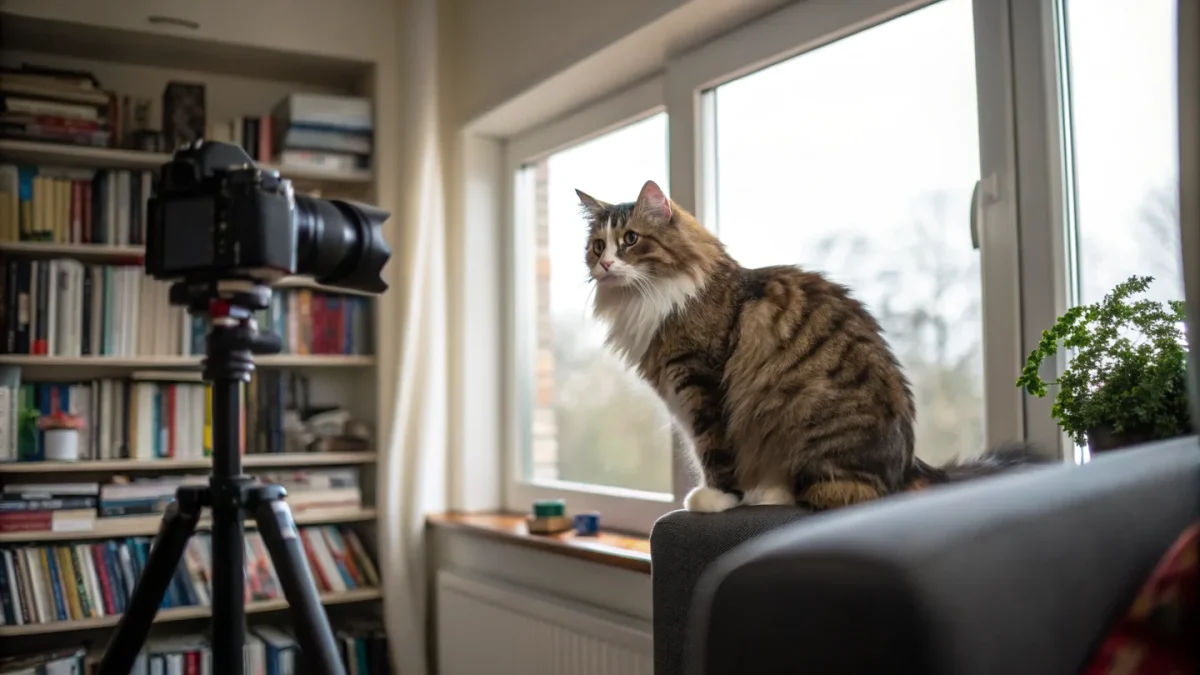
Ask a Norwegian Forest Cat what it would like to do right now, and it will tell you, on its own schedule, when it's ready. This isn't a failing. This is the whole personality, expressed in miniature.
The Wegie — as enthusiasts have called the Norwegian Forest Cat for decades — is one of the most temperamentally self-sufficient cats in the pedigree world. It is affectionate without being dependent. Present without being intrusive. Warm without being theatrical about it.
Independence as Temperament, Not Coldness
The confusion about Norwegian Forest Cat temperament tends to happen when people confuse independence with aloofness. These are different qualities.
An aloof cat is distant, uninterested in connection, and treats its household as an ambient environment rather than a social space. The Norwegian Forest Cat is not this.
An independent cat wants connection on its own terms: when it chooses, in the manner it chooses, for the duration it chooses. The Norwegian Forest Cat is very much this.
In practice, the difference looks like this: a Wegie will often follow its person through the house, appearing in whatever room they occupy. It will seek proximity. It will sometimes ask to be petted. When it's finished, it will leave — without drama, without explanation — and settle somewhere nearby on its own terms. This is the complete social transaction, as far as the Norwegian Forest Cat is concerned, and it considers it satisfactory.
People accustomed to very people-dependent breeds sometimes find this underwhelming. People accustomed to very independent cats often find it surprisingly warm. The Wegie exists in a genuine middle ground.
Confidence as a Core Trait
The Norwegian Forest Cat was shaped by generations of working outdoor life in a demanding climate, and its temperament reflects this. It is a confident, composed cat. Strangers entering the household are assessed, not fled from. Novel situations are investigated, not avoided. Loud noises provoke alertness, not panic.
This confidence is consistent and genuine. It's one of the reasons Wegies tend to adapt to multi-pet households more readily than more anxious breeds — they don't immediately cede territory or retreat. They observe, establish their position, and proceed.
The same confidence means the Norwegian Forest Cat doesn't require constant reassurance. A change in routine, a visitor, a new piece of furniture — these are events to be examined and incorporated, not disruptions to be anxious about.
Physical Affection: How It Happens
The Wegie's physical affection is real, but it has a particular character. It tends toward proximity and contact initiated on the cat's terms rather than unlimited tolerance of being held or arranged.
Many Norwegian Forest Cats will settle beside rather than on their person. They will accept and lean into petting when they've invited it, and will remove themselves when they've had enough. Extended lap sitting happens — but not as a constant state, as it might be with a Burmese or Sphynx. In this respect, the Wegie is often compared to the Maine Coon, another large, self-directed breed that chooses proximity without requiring constant physical contact.
The moments when a Norwegian Forest Cat chooses to come to you, settles heavily against you, and purrs for an extended period carry a particular quality. It's clearly a choice. That specificity is, for the right owner, more satisfying than the constant availability of a more indiscriminate breed.
Vocal Behavior
The Norwegian Forest Cat communicates in trills, chirps, and quiet chirring sounds — the soft, variable vocalization common in Nordic breeds — rather than conventional loud meows. They are quiet cats by most standards.
They will comment on events — the appearance of an interesting bird outside the window, the sound of a food container — but they don't maintain continuous commentary. This makes them good apartment cats from a noise perspective, and well-suited to households where loud vocalization would be a problem.
Play Drive and Activity
The Norwegian Forest Cat is an athletic, intelligent cat with a genuine prey drive that persists through its life. Play behavior involves stalking, sprinting, jumping, and the full sequence of feline hunting behavior — not the casual batting at a toy that satisfied cats exhibit.
The breed needs appropriate outlets for this drive. A tall cat tree is essential, not optional. Interactive wand toy sessions several times a week engage the prey drive in a way that solo toys can't fully replicate. Puzzle feeders channel the food-motivation that underlies much feline behavior effectively.
Without adequate enrichment, the Norwegian Forest Cat's resourcefulness means it will find its own entertainment — typically involving your furniture, your plants, or whatever is highest in the room.
With Children and Other Pets
The Wegie's confidence and robust physical nature make it a good family cat in practical terms. It doesn't startle easily, doesn't escalate conflicts readily, and can handle the noise level of an active household.
Children who understand appropriate handling — approaching the cat rather than chasing it, not forcing contact — typically find the Norwegian Forest Cat an interesting, athletic companion. The breed won't perform lap cat behavior on demand, but it will engage enthusiastically in active games.
With other cats, the Norwegian Forest Cat typically establishes a comfortable arrangement through unhurried, confident negotiation. It doesn't need to dominate, but it doesn't yield easily either. With dogs, the same pattern applies: calm, patient establishment of boundaries and expectations.
The Temperament in Practice
The complete Norwegian Forest Cat breed guide covers the full picture of the breed — history, health, the remarkable double coat. But temperament is the character of the daily experience, and the Wegie's character is this: solid, present, warm in its own considered way, and never demanding in the way that breeds with higher social dependency can be.
For the owner who wants a cat that genuinely participates in household life without requiring them to manage its emotional state, the Norwegian Forest Cat is a particularly satisfying choice. The independence is not an obstacle to connection. It's the condition that makes the connection, when it comes, feel genuinely earned.