

Picture a family arriving at a clinic last spring with their Newfoundland mix, a hundred-and-twenty-pound bundle of love named Bruno. They’d been in a fender bender on the highway — nothing catastrophic by human standards, just a sudden stop when traffic stacked up. Bruno had been riding loose in the back of their SUV. When the car stopped short, Bruno became what physicists call a projectile. He slammed into the front console, fractured his radius and ulna (the two bones in his front leg), and gave his owner a concussion when his skull connected with hers from behind. “He’s always just ridden in the back,” the owner said, visibly shaken. “I never thought about what would happen if we actually crashed.” That conversation happens more often than anyone would like. And it’s exactly why I’ve spent the last several years deep in the research on pet car safety — because the science of what happens to our animals in a crash is both terrifying and surprisingly fixable.
The Physics of a Flying Dog
Let’s start with the numbers, because they’re the quickest way to understand why this matters. In a crash at just 50 miles per hour, an unrestrained 10-pound dog generates roughly 500 pounds of projectile force. That’s not a typo. Five. Hundred. Pounds. Now scale that up to Bruno at 120 pounds — we’re talking about thousands of pounds of force launching through the cabin of your vehicle.
The physics here is straightforward Newtonian mechanics — the same principle that keeps your coffee mug flying off the dashboard when you slam the brakes. An object in motion stays in motion unless acted upon by an outside force. When your car stops suddenly, your dog doesn’t. They continue moving at whatever speed the car was traveling until something stops them — the windshield, the front seat, or you.
A common reaction is a shrug and “But he lies down in the back. He’s fine.” Try imagining driving with a bowling ball loose on the back seat — the point usually lands immediately. Your dog, no matter how calm, no matter how well-trained, cannot brace themselves against crash forces. Neither can your cat, who is probably going to be hiding under a seat and will absolutely panic if the vehicle suddenly fills with airbag dust and breaking glass.
The “Crash Tested” Lie
Here’s where things get frustrating. When you go shopping for a pet harness or carrier, you’ll see “crash tested” stamped on packaging left and right. It sounds reassuring. It’s often meaningless.
There is no universally mandated federal standard for pet car safety. None. A manufacturer can drop a harness from waist height onto a concrete floor, watch it survive, and legally print “crash tested” on the box. Another might run a low-speed computer simulation that doesn’t remotely approximate real-world crash dynamics and use the same label. I’ve seen harnesses marketed as crash-tested that I wouldn’t trust to hold a leash on a walk, let alone survive a 30 mph collision.
The distinction that matters isn’t “crash tested.” It’s “crash test certified” — and right now, only one organization is doing that work with scientific rigor for pet products.
The Center for Pet Safety (CPS) is an independent nonprofit that conducts actual crash testing — the kind that uses crash test dogs (specially instrumented dummies), realistic speeds, and real vehicle seats. They’ve tested harnesses, carriers, and crates using methodologies adapted from human child safety standards. When a product earns their Certified seal, it means it survived testing that approximates the forces generated in a real accident. Not a drop test. Not a simulation. An actual, destructive crash test.
Harnesses: Convenient, But Not Without Risks
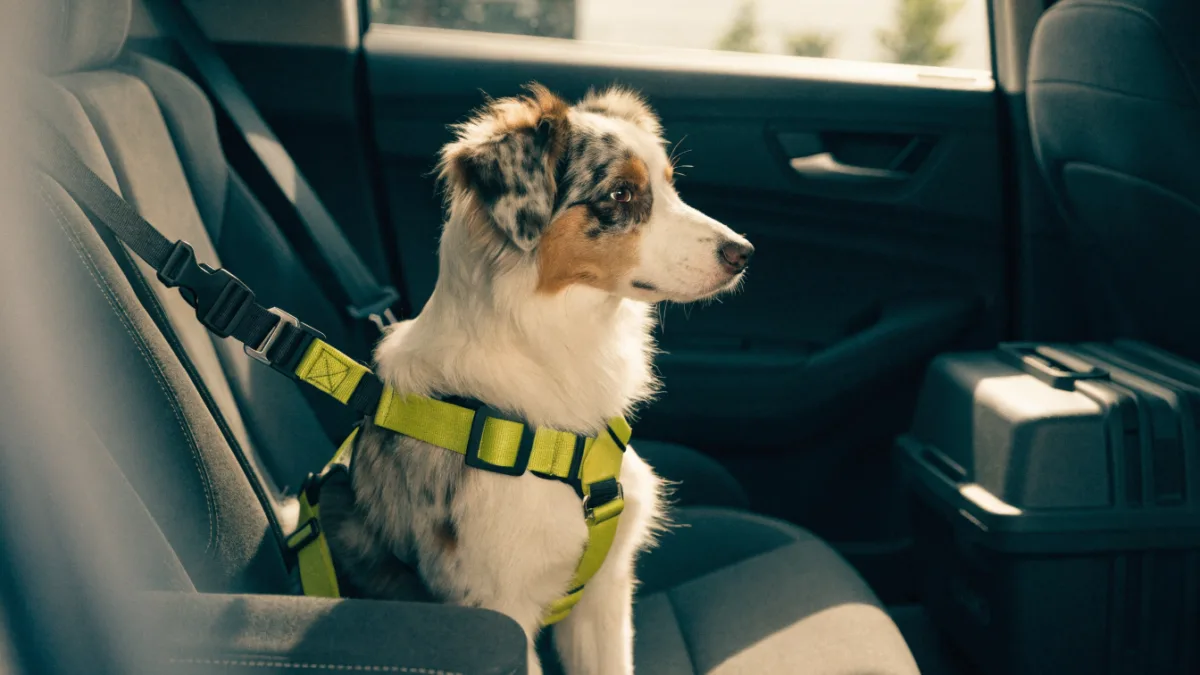
Harnesses are the most popular restraint option, and for good reason. They’re portable, they work across different vehicles, and most dogs tolerate them well once they’re used to putting one on. A well-designed crash-rated harness distributes crash forces across the strongest parts of a dog’s body — the chest and shoulders — rather than concentrating force on the neck the way a collar would.
What Makes a Harness Actually Safe
When I’m evaluating a harness for safety, I look at three things. First, the hardware — I want to see metal, not plastic, at every load-bearing connection point. Some of the newer harnesses on the market are using aerospace-grade aluminum buckles, which is a significant improvement over the plastic clips that shatter on impact. Second, the webbing — high-tensile nylon that won’t shred under the concentrated force of a crash. Third, the design — the best harnesses use a wide back plate that the seatbelt threads through, creating a secure anchor point that keeps the dog in place during frontal, side, and rotational impacts.
But here’s the honest truth about harnesses: even the best one exposes your dog to some risk of blunt force trauma. In a crash, a harness holds your dog against the seat, which is far better than letting them fly — but they’re still absorbing significant deceleration forces through their body. If the harness fails — and many do, usually at the buckles or stitching — the dog can be partially or fully ejected. I’ve seen the results, and they’re not pretty.
I’ve also changed my mind on something over the years. Early in my career, I thought any restraint was fine — the cheap ones, the ones that clipped to a collar, whatever. Then I started seeing the aftermath of failures, and I started reading the CPS data, and I realized I was giving bad advice. Now I tell clients: if you’re going to use a harness, use one that’s been certified, or don’t bother. A harness that fails in a crash can actually be more dangerous than no harness at all, because the failure point introduces unpredictable dynamics.
Hard Carriers and Crates: The Survival Capsule Approach
The alternative — and often the safer option for smaller dogs and cats — is a hard-sided carrier or crate secured to the vehicle. The advantage here is enclosure. A hard carrier, especially one made from high-impact plastic, creates a protective shell around your pet. In a crash, that shell absorbs and distributes impact forces that would otherwise hit your animal directly. It also protects against flying glass and debris, which is something no harness can do.
The Routing Problem
The catch with carriers is that they’re only safe if they’re properly secured to the vehicle, and that’s where things get tricky. A carrier sitting loose on a seat is essentially a projectile with your pet inside it — a hard-shell weapon bouncing around the cabin. The vehicle’s seatbelt must thread through or around the carrier in a specific configuration to hold it in place, and not all carriers are designed with this in mind.
Some newer carriers are being designed with built-in LATCH compatibility — that’s the Lower Anchors and Tethers for Children system that’s standard in most vehicles built after 2002. This allows the carrier to be anchored directly to the vehicle’s chassis rather than relying on routing a seatbelt through a handle or loop, which is a meaningful improvement in both security and ease of use.
The Padding Question
A common question I get is whether to pad the inside of a hard crate. The theory is sound — padding absorbs impact energy and reduces the chance of your pet being battered against the hard walls during a crash. In practice, heavily padded crates can restrict airflow, and some dogs will chew on the padding material (which creates a gastrointestinal obstruction risk — a whole different problem I see in the ER). My recommendation is a thin, securely fastened mat — enough to cushion, not enough to fill the space or become a chew toy.
The Great Debate: Certified Harness vs. Sturdy Crate
This is where pet owners — and experts — genuinely disagree. On one side, you have people who argue that a certified crash-rated harness is the gold standard because it distributes forces across the dog’s body without adding weight or creating a secondary impact scenario. On the other side, you have the crate advocates who point out that a sturdy hard crate — even one that hasn’t earned a certification — creates a survival capsule that contains the animal completely.
I see merit in both arguments, and honestly, the right choice depends on your pet and your vehicle. For a large breed dog, a harness is often more practical — you’re not fitting a Great Dane into a carrier. For cats and small dogs, I lean toward a secured hard carrier. The enclosure provides protection that a harness simply can’t match, especially in side-impact collisions where the primary danger is intrusion into the passenger compartment.
What I tell every client is this: the best restraint is the one you’ll actually use every single time, that fits your pet correctly, and that integrates properly with your specific vehicle. A certified harness sitting in your closet because it’s a hassle to put on does nothing. A sturdy crate that slides around unbuckled is worse than nothing.
What to Look For in 2026 and Beyond
The industry is evolving, and that’s encouraging. Manufacturers are beginning to adopt the Federal Motor Vehicle Safety Standard (FMVSS) 213 — the standard for child car seats — as a baseline for pet safety testing. We’re seeing better materials: energy-absorbing tethers that stretch slightly to decelerate the dog more gradually, high-tensile webbing that resists cutting, and metal hardware replacing plastic at critical stress points. Universal car seat adapters and LATCH integration are making proper installation easier, which matters because the best carrier in the world is useless if it’s not correctly secured.
When you’re shopping, ignore “crash tested” and look for “certified.” Check the Center for Pet Safety’s published test results — they’re publicly available and updated regularly. Look for metal hardware, wide load-distributing designs, and clear instructions for vehicle integration. And whatever you choose, use it every time — even for the two-minute drive to the vet. Most accidents happen close to home.
At the end of the day, this comes down to a simple principle: we buckle ourselves in. We buckle our children in. Our pets deserve the same consideration — not because they’re accessories, but because they’re family members who depend entirely on us to make safe choices for them. The science is clear that restraint saves lives and prevents injuries. The technology exists. The only question is whether we’ll use it.