

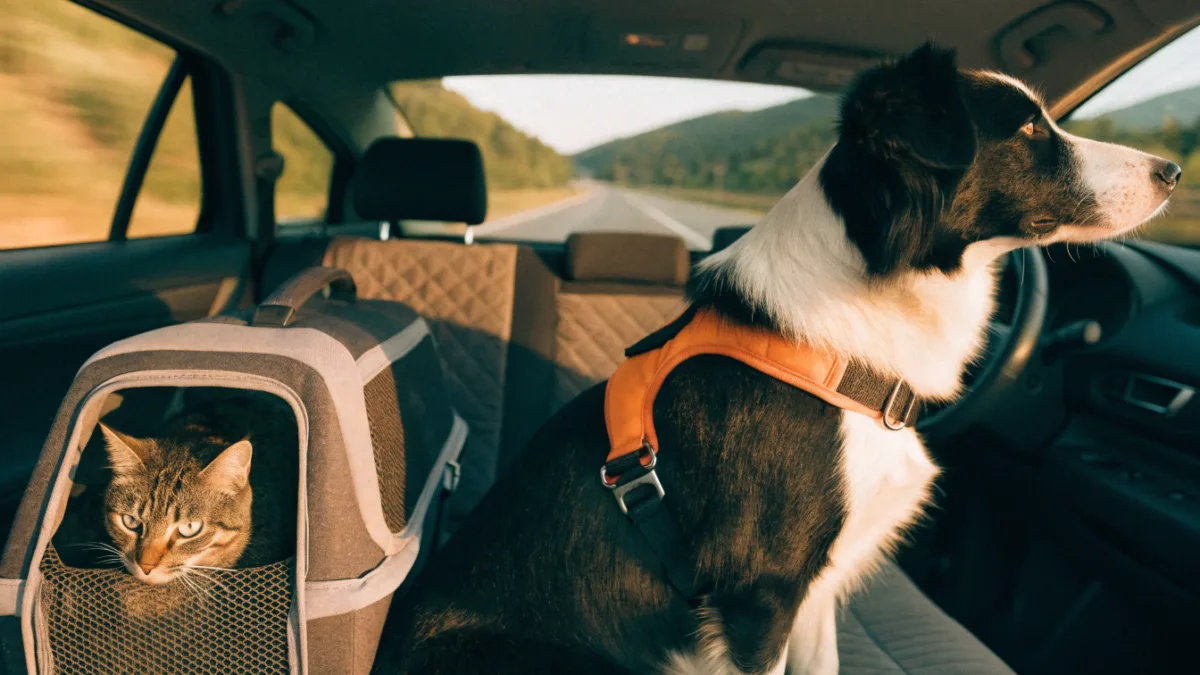
The first time I loaded Mochi (my calico chaos machine) and my sister’s golden retriever, Biscuit, into the same car for a four-hour drive, I genuinely considered pulling over and calling a friend to pick up the cat. Mochi was in her carrier screaming like I was committing a felony. Biscuit was trying to lick the carrier through the bars because he thought it was a fun game. I was white-knuckling the steering wheel wondering how two animals could create that much chaos in a Honda Civic.
That trip taught me something I now tell everyone who’ll listen: multi-species road trips are absolutely doable, but only if you respect that dogs and cats process travel fundamentally differently. Dogs are generally built for adventure. Cats are generally built for predicting exactly when their next meal arrives in a familiar room. When you’re planning a road trip with both, you’re essentially managing two completely different travel philosophies simultaneously.
The Physics Should Scare You (Just a Little)
Before we get into the gear, let’s talk about why this even matters. Because I know someone reading this is thinking, “Oh, my dog just lies down in the backseat, he’s fine.”
Here’s the thing: at just 30 miles per hour, an unrestrained 10-pound dog hits with roughly 300 pounds of crash force. An 80-pound dog? About 2,400 pounds. Your sweet unleashed golden becomes a furry cannonball in even a minor collision. And a cat loose in a car isn’t just dangerous for the cat — a panicked feline under your brake pedal is a situation that ends badly for everyone.
This isn’t fear-mongering. It’s just physics. And it’s why we’re having this conversation at all.
Dogs: Built for the Open Road
Most dogs genuinely enjoy car travel. The world is moving! There are smells! The window is right there! Biscuit would live in a car if I let him — he settles into the backseat like he’s reviewing a moderately priced hotel room and finds it acceptable.
For dogs, a well-fitted travel harness paired with a seatbelt tether is usually the sweet spot. They get to sit up, look around, and feel like they’re participating in the adventure. The harness distributes crash force across their chest and shoulders rather than their neck (which is what would happen if you just clipped a seatbelt to their collar — please don’t do that).
What to Actually Look For
The pet travel gear market has exploded recently, which is great news and also genuinely confusing news. Here’s what matters:
- Certified crash testing. This is the big controversy right now. Lots of products slap “crash-tested” on their packaging, but that can mean whatever the manufacturer wants it to mean. Look for gear certified by independent third parties like the Center for Pet Safety. They test to actual standards, not marketing departments’ fever dreams.
- A harness that doubles as a walking harness. You don’t want to be swapping gear at every rest stop. The best travel harnesses work for both the car and the leash.
- A proper fit. A harness that fits poorly will fail in a crash and will also just annoy your dog the entire trip. Measure your dog’s chest and neck before ordering, and actually try it on them.
Cats: The Great Carrier Debate
Okay, here’s where it gets interesting. Because with cats, there’s an actual ongoing debate in the pet community about what “safe travel” even looks like.
The conventional wisdom — and the stance most veterinarians and safety experts take — is that cats belong in carriers. Period. A hard-sided or soft-sided carrier that’s seatbelted into the backseat gives your cat a den-like enclosed space, protects them in a crash, and prevents them from becoming a driving hazard. For most cats, this is the right answer. The enclosed space helps them feel hidden and secure, and it reduces the motion sickness that many cats are prone to.
But here’s where I push back slightly on the absolutism:,[1] some cats absolutely lose their minds in carriers. We’re not talking mild complaining. We’re talking full-blown panic — screaming, thrashing, injuring themselves trying to escape. For those specific cats, a secured harness and seatbelt leash setup may actually be the safer and more humane option, because a cat having a panic attack in a plastic box isn’t safe either.
I’ll be honest: Mochi falls somewhere in the middle. She’s not thrilled about her carrier, but she settles after about twenty minutes of dramatic commentary. For her, the carrier wins. But I have a friend whose cat, Pepper, literally cracked a plastic carrier from throwing herself against the door. For Pepper? Harness and seatbelt tether, every time.
The Critical Detail Nobody Mentions
Whatever you choose — carrier or harness — your cat needs a martingale collar for travel. These are limited-slip collars that tighten slightly when pulled, preventing your cat from backing out of their collar if they panic. Standard breakaway collars (which are great for everyday wear) can release at the worst possible moment during travel. A panicked cat loose at a highway rest stop is a nightmare scenario.
Acclimation: The Step Everyone Skips
,[2] the single biggest mistake people make is only bringing out the carrier or harness when it’s time to actually go somewhere.
Think about this from your pet’s perspective. If the carrier only appears before vet visits and car rides, your pet has associated that object with stress and nausea. You’ve classically conditioned them to hate it. Thanks, Pavlov.
The fix is boring but effective: introduce the gear weeks before your trip. Leave the carrier open in your living room with a blanket and treats inside. Let your dog wear the harness around the house for short periods, paired with good things. Feed Mochi her dinner in her carrier. Make the equipment boring — just another piece of furniture that sometimes has snacks in it.
I spent two weeks leaving Mochi’s carrier open with a heated blanket inside before our last road trip. By departure day, she was voluntarily napping in it. The actual car ride was still accompanied by some dramatic meowing (she’s a cat, there are standards to maintain), but nothing like the screaming nightmare of that first trip.
When You’ve Got Both Species in the Car
This is where things get logistically spicy. Traveling with a dog and a cat means managing completely different needs at every stop.
The dog needs potty breaks. The cat needs those breaks to not happen, because every time you open a door, you’re creating an escape opportunity and letting in road noise and temperature changes that stress her out.
Here’s what works for me: I make sure Mochi’s carrier is secured in a spot where direct sunlight won’t hit it, and I cover it with a light breathable cloth to create a dark, cave-like environment. When I stop for Biscuit, I make sure the cat carrier is fully secured and all doors are managed — I open the driver’s door, clip Biscuit’s leash, and then we exit together. No cat escapes on my watch.
The Leash Situation
Speaking of leashes: ditch the retractable leash for road trips. I know they’re popular. I know your dog likes the freedom. But retractable leashes are genuinely dangerous during travel. They create burn hazards, entanglement risks, and drop hazards — and the thin cord offers almost no control if your dog decides to bolt at a rest stop near a highway.
Use a standard loop-handle leash, preferably one you can slip over your wrist for hands-free control while wrangling doors, treats, and a cat carrier. It’s not as flashy, but it works.
What to Look For When Shopping
Since I won’t name brands (your pet’s needs are individual, and what works for Biscuit might not work for your greyhound), here’s your shopping checklist:
- For dog harnesses: Look for independent safety certifications, wide padded chest plates, and a design that works as both a travel and walking harness. Check that the tether point is on the back, not the front.
- For cat carriers: Look for something that can be seatbelted securely, has good ventilation from multiple sides, and has a washable liner (because accidents happen). Hard-sided carriers offer more crash protection; soft-sided ones are easier to store and carry.
- For both: Look for products from companies that are transparent about their testing methods. If they say “crash-tested” but won’t tell you by whom or to what standard, that’s a red flag.
The Honest Truth
,[3] there’s no universal winner — just the right choice for your specific animal.
Multi-species road trips require more planning, more gear, and more patience than traveling with a single pet. But they’re completely manageable when you respect the fundamental difference: your dog wants to be part of the adventure, and your cat wants to survive the adventure with their dignity intact. Give the dog a harness and a window. Give the cat a secure, dark den. Acclimate both of them slowly. And for the love of everything, use a standard leash.
And look — I’m not your veterinarian. If your pet has serious anxiety, motion sickness, or health concerns, have that conversation with your vet before a long trip. They know your animal’s history and can offer guidance I can’t.
The bottom line? Safety gear for pets isn’t about wrapping them in bubble wrap. It’s about making it possible to share adventures with the animals we love without turning our vehicles into danger zones. The right harness, the right carrier, and a little patience during acclimation can mean the difference between a stressful ordeal and an actual road trip with your whole weird, multi-species family.
Now if you’ll excuse me, Mochi is judging me from her carrier (which is currently serving as a cat bed in my living room) and Biscuit needs a walk. The road trip isn’t for two more weeks, but the training never really stops.
Sources
- as cat owners have been discussing in communities like r/CatAdvice — reddit.com
- As the team at Wirecutter rightly points out — nytimes.com
- As the Roadtrippers team explored when comparing cats and dogs as travel companions — roadtrippers.com