

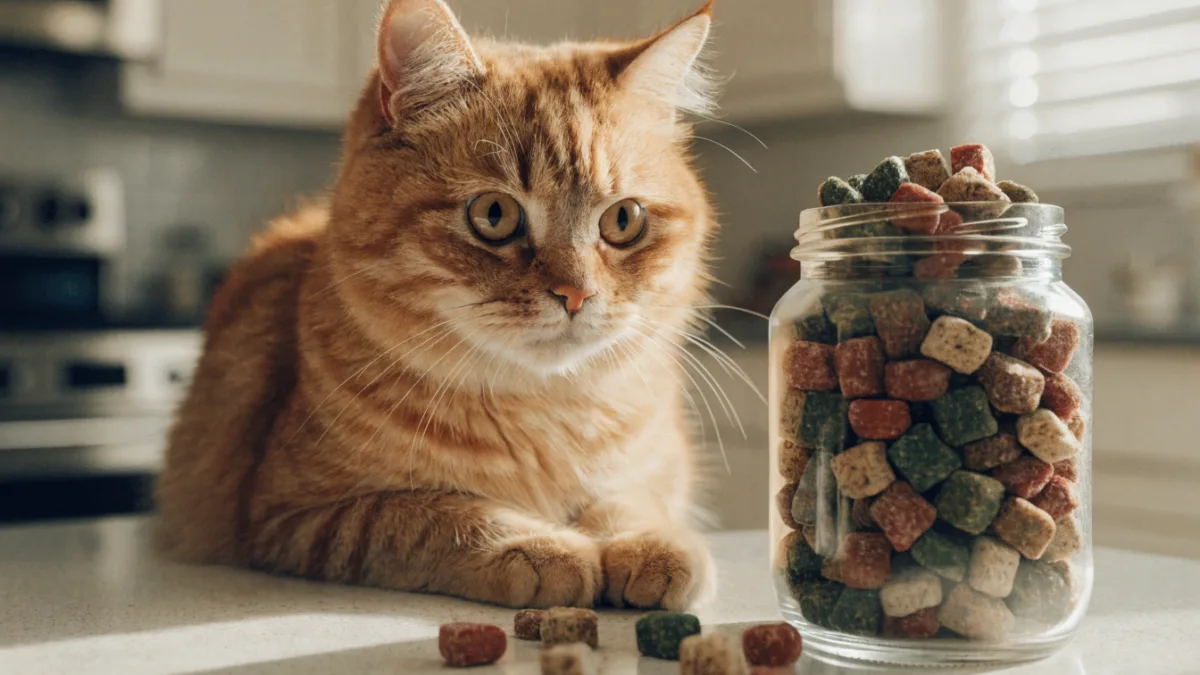
Last week, a concerned owner brought her 9-year-old orange tabby, Marmalade, into my clinic. Marmalade had gained nearly three pounds in six months, and his litter box habits had become erratic — frequent trips, small outputs, obvious discomfort. His owner, Elaine, was bewildered. “But he barely eats his regular food anymore,” she told me, almost apologetically. “I don’t understand where the weight is coming from.” When I asked about treats, she paused, then admitted: “Oh. Well, he gets a little something every time he asks. Maybe… ten or twelve times a day?” That “little something” added up to nearly 300 calories of starchy, carb-heavy snacks — on top of the food he was leaving in his bowl. Marmalade wasn’t overeating. He was being over-treated.
The Treat Trap: When Love Becomes Nutritional Sabotage
Most pet parents I talk to are genuinely thoughtful about what goes into their pet’s food bowl. They read labels, compare protein percentages, maybe even consult their vet about special diets. But then there’s the treat jar — that magical container of goodwill that sits on the counter, ready to dispense affection in crunchy, starchy little pieces.
The problem? Those treats aren’t just empty calories. They’re actively dismantling the careful nutritional balance you’ve built into your pet’s base diet. The [1] has recently issued fresh advisories urging pet owners to pause before reaching for another treat, warning that unregulated extras are destroying the precise nutrient ratios formulated into commercial pet foods. And the culprits aren’t always obvious.
The 10% Rule Nobody Follows
Here’s the guideline every veterinary nutritionist agrees on: treats should never exceed 10% of your pet’s daily caloric intake. For a typical 10-pound cat eating roughly 200 calories a day, that means all treats combined should top out at about 20 calories. That’s roughly four to five small treats. Total. Per day.
In practice? I’d estimate fewer than 20% of my clients stay within that limit. Most don’t realize they’re blowing past it because individual treats seem so small. But add up training rewards, “just because” treats, pill-wrap treats, and the bits of toast offered at breakfast, and you’re looking at a significant caloric and nutritional overlay that competes with — and often replaces — the balanced meal your pet actually needs.
Hidden Carbohydrates: What’s Really in That Treat
Pet treats have a dirty little secret: they’re structurally dependent on carbohydrates. Those crunchy biscuits, dental sticks, and shaped morsels need binding agents to hold their form, and the cheapest, most effective binders are starches — wheat flour, cornmeal, rice flour, potato starch. What looks like a “protein-rich” salmon treat might be 40% carbohydrate by dry matter.
When your pet fills up on these carb-heavy snacks, two things happen simultaneously. First, they consume a surge of simple carbohydrates their body wasn’t designed to process in those quantities. Second, they eat less of their nutritionally complete food, which means they’re missing out on essential amino acids, fatty acids, vitamins, and minerals that were carefully calibrated into that kibble or wet food. It’s a double hit — excess where it’s not needed, deficiency where it matters most.
Cats Are Not Small Dogs: The Obligate Carnivore Problem
If there’s one area where I’ve genuinely changed my clinical approach over the past decade, it’s how I counsel cat owners about carbohydrates. Cats are obligate carnivores — their entire metabolic architecture evolved around consuming animal tissue. They lack the enzymatic pathways to efficiently process starches and plant proteins. Yet many commercial treats and even base diets formulate for cats as if they were “carb-burning omnivores,” loading them with grains and plant-based fillers.
The health consequences are significant. Research indicates that high-carbohydrate diets in cats are linked to a 70% increase in urinary diseases and contribute substantially to chronic kidney disease. When I look at Marmalade’s case — the weight gain, the urinary symptoms — the connection is clear. His body was never designed to process the flood of carbohydrates Elaine was unknowingly providing through “harmless” treats.
What Acceptable Carb Intake Actually Looks Like
For dogs, some carbohydrate in the diet is perfectly appropriate. Their evolutionary history alongside humans included scavenging starch-rich scraps, and most healthy dogs handle moderate carbohydrate intake without issue. But “moderate” is the key word — and treat overload pushes many dogs well past moderate into metabolic strain territory.
For cats, the bar should be dramatically lower. I generally recommend that carbohydrates make up no more than 10-15% of a cat’s total caloric intake, and that includes everything — base food and treats combined. When treats alone contribute 20-30% of daily calories and those treats are 40% carb, you can see how quickly the math breaks down.
The Protein Pendulum: More Isn’t Always Better
In response to growing awareness about carbohydrate overload, many pet owners have swung hard in the opposite direction — embracing extremely high-protein diets for their pets. I understand the impulse, and there’s solid science behind using higher-protein formulations for specific purposes. [2] in both dogs and cats because additional protein helps meet amino acid requirements and prevents muscle loss during caloric restriction. That’s evidence-based medicine, and I recommend it regularly.
But the “more protein is always better” myth has taken on a life of its own. Here’s what concerns me: when protein intake stays excessively high over extended periods, particularly in pets with underlying kidney or liver conditions (which may be undiagnosed), it can contribute to organ dysfunction. I’ve seen dogs on extreme protein diets develop elevated liver enzymes that normalized once we moderated their intake. Balance — not extremity — is what supports long-term health.
The Cancer-Carb Debate: What the 2025 Research Actually Says
One of the most emotionally charged conversations I have with clients involves pets diagnosed with cancer. For years, a popular narrative suggested that since cancer cells exhibit increased glucose uptake, we should “starve” tumors by eliminating carbohydrates from the pet’s diet. It made intuitive sense to worried owners, and I understand why the approach gained traction.
But a [3] has shifted how veterinary oncology nutrition specialists view this question. The research reveals that adequate carbohydrate intake is actually necessary to mitigate paraneoplastic cachexia — the severe, progressive muscle and weight loss that affects many cancer patients. Attempting to starve cancer of glucose by restricting carbs may do more harm than good by accelerating the dangerous wasting that already threatens these patients.
I now counsel my oncology clients differently than I once did. Rather than eliminating carbohydrates entirely, we focus on overall caloric adequacy, high-quality protein to preserve lean body mass, and a balanced macronutrient profile that keeps the pet eating and maintaining weight. Sometimes the most compassionate medicine isn’t the most aggressive intervention — it’s the one that keeps your pet comfortable and nourished.
Commercial Formulation Criticism: A Valid Conversation
I’d be dishonest if I didn’t acknowledge the legitimate criticism leveled at the commercial pet food industry — particularly regarding feline nutrition. Feline-specific and holistic veterinarians have raised valid questions about why obligate carnivores are being fed starch-heavy formulas at all. The answer is largely economic: carbohydrate ingredients are cheaper than animal-derived proteins, and dry kibble manufacturing requires starches for the extrusion process. These aren’t malicious choices — they’re business decisions. But that doesn’t mean they’re biologically optimal.
When selecting food or treats, here’s what I tell clients to look for: animal-based protein sources listed as the first several ingredients, minimal grain content for cats, and transparency about carbohydrate content. If a product won’t tell you the carb percentage, that’s information in itself.
Practical Steps to Restore Nutritional Balance
If you’re reading this and feeling a pang of recognition — maybe you’ve been a little too generous with treats, like Elaine was with Marmalade — here’s the good news: nutritional rebalancing works relatively quickly when you course-correct.
- Measure everything for one week. Track every treat, every table scrap, every “just a tiny piece.” Most people are surprised by the total.
- Implement the 10% rule strictly. Calculate your pet’s daily caloric needs with your veterinarian, then allocate no more than 10% to treats.
- Choose single-ingredient treats. Freeze-dried meat pieces, small bits of plain cooked chicken, or commercially available pure protein treats avoid the carb-binding-agent problem entirely.
- Substitute affection for food. Many pets respond to play, brushing, or verbal praise just as enthusiastically as they do to treats — we’re the ones who’ve trained them to expect food as the primary love language.
- Consult your veterinarian before making major dietary changes. Every pet’s needs differ based on age, health status, activity level, and species-specific requirements.
As for Marmalade, we transitioned him onto a lower-carbohydrate, moisture-rich diet, cut his treats to three small freeze-dried chicken pieces daily, and incorporated more interactive play. At his eight-week recheck, he’d lost a pound, his urinary symptoms had resolved, and Elaine reported he was actually eating his meals again with enthusiasm. “I thought I was being kind,” she told me. “I was just loving him in the wrong language.”
That insight stays with me in every nutrition conversation I have. Our pets depend on us completely for their nutritional wellbeing — and sometimes the most loving thing we can do is put down the treat jar and pick up a toy instead. Whether you share your home with a cat, a dog, or a houseful of both, remembering that balance beats excess every time might be the single most important nutritional decision you make for them. And in a world where domestic animals increasingly suffer from the same lifestyle-related diseases we humans face — obesity, diabetes, metabolic syndrome — that simple recalibration might matter more than any premium food you could buy.
Sources
- ASPCA — aspca.org
- Veterinary nutritionists currently recommend high-protein diets for weight loss — kltv.com
- recently published 2025 paper in PubMed Central — pmc.ncbi.nlm.nih.gov