
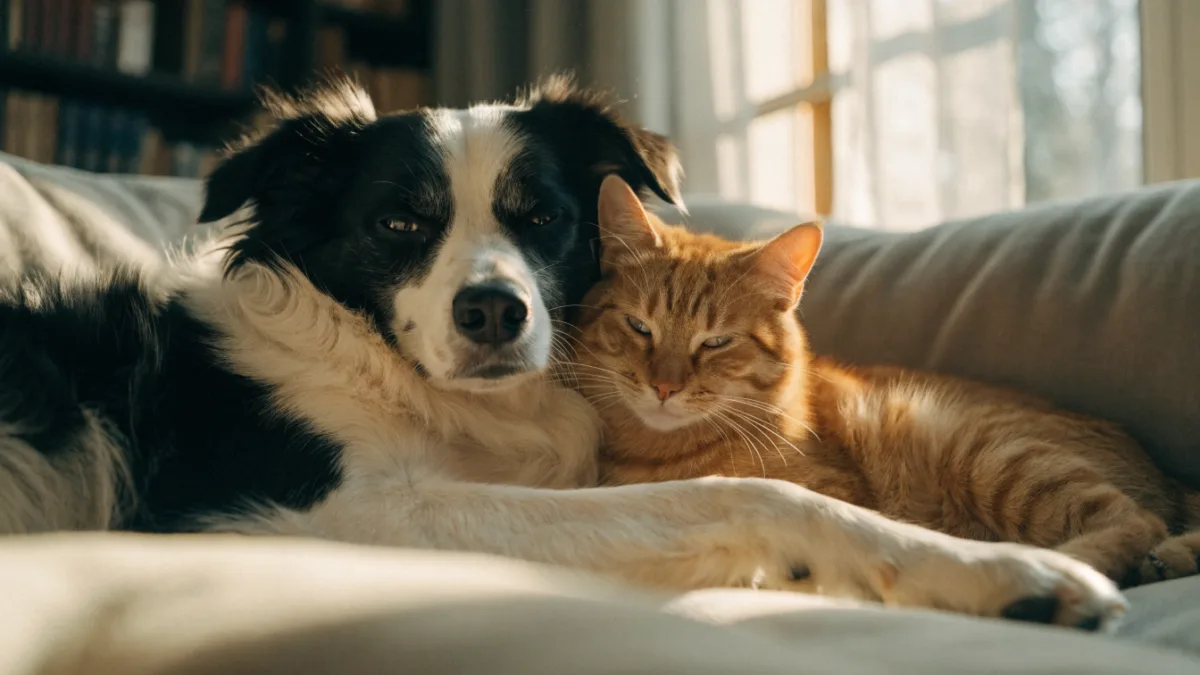
I’ve seen things in living rooms that look straight out of a nature documentary. A 70-pound Shepherd letting a 10-pound tabby cat eat out of his food bowl. A rescue kitten curling up directly on top of a sleeping Beagle, using the dog’s ribs as a mattress. You look at these moments and think they’re just cute flukes. But there’s a massive amount of psychology—and brain chemistry—firing behind the scenes when different species decide to become best friends.
People often rate their relationship with their dog or cat as being as satisfying, or even more satisfying, than their closest human relationships. That’s a huge statement. But what’s even wilder is that this drive to bond across species lines doesn’t just stop with us humans. Animals are doing it with each other, too.
Let’s pull back the curtain on what’s actually happening when a dog and a cat decide to share a bed, or when a prey animal and a predator decide to call a truce. It isn’t magic. It’s biology, early socialization, and a whole lot of brain chemistry.
The Chemistry of a Cross-Species Cuddle
When you sit on the couch and stroke your dog’s ear, or when two of your pets groom each other, something invisible is happening in their brains. Oxytocin is flooding their system.
Oxytocin is often called the “love hormone” or the “cuddle chemical.” It’s the exact same neuropeptide that bonds a human mother to her newborn baby. When a dog and a cat groom each other, or when they simply choose to rest with their bodies touching, their oxytocin levels spike. This chemical drops their heart rates, reduces stress, and actively builds trust.
This is the.[1] Domestication has fundamentally rewired the brains of dogs and cats. We bred them to be social, and in doing so, we gave them an almost boundless capacity for love. Dogs, in particular, have a remarkable genetic glitch that makes them hyper-social. They don’t just tolerate other species; they actively want to bring them into their family unit.
Breaking the Tom and Jerry Myth
We’ve all been sold the idea that cats and dogs are natural enemies. Fighting like cats and dogs, right? It’s mostly a myth.
The truth is that early socialization completely overrides hardwired instincts. If a puppy and a kitten are raised together during their critical socialization windows—usually between 3 and 14 weeks for dogs, and 2 to 7 weeks for cats—they learn each other’s languages fluently.
A puppy raised with a cat learns that a twitching tail isn’t always an invitation to bite. A kitten raised with a dog learns that a wagging tail doesn’t mean the same thing as an angry, swishing feline tail. They don’t just learn to tolerate each other. They actually mimic each other’s behaviors. I’ve seen cats greet their dog siblings by rubbing against their legs and purring, and I’ve seen dogs try to reciprocate by gently nuzzling and licking the cat’s face. They build a shared, hybrid language that only the two of them fully understand.
Real Friendship or Just Sharing Body Heat?
Here is where things get a little controversial in the animal behavior world.
There is a long-standing debate about [2]—which is just a fancy word for projecting human emotions onto animals. The old-school skeptics argue that these “friendships” are strictly transactional. A dog and a cat sleep together because combining body heat keeps them warm. One animal grooms the other to get leftover food scraps off its face.
But modern behavioral scientists have largely moved past this cynical view. When you watch animals in a multi-species household, it becomes obvious that the bond isn’t just about survival or convenience.
When a dog brings his favorite stuffed toy and drops it at the feet of a sleeping cat, he’s initiating play. When a cat chooses to leave a perfectly good, sunny windowsill to go sleep in the middle of a dog’s dog bed, she is seeking proximity for the sake of comfort and safety. These are complex social emotions that look exactly like human friendship. They are choosing to be together because it makes them feel good.
When “Playing” Is Actually Stress
While we shouldn’t underestimate animal emotions, we also have to be careful not to misread them. This is a huge trap for well-meaning pet owners.
I worked with a family a while back who thought their newly adopted terrier mix and their older resident cat were becoming best buddies. They kept sending me videos of the dog obsessively sniffing the cat’s face, following her from room to room, and play-bowing at her while she hid under the bed. They thought it was adorable.
It wasn’t a friendship. It was a dog with high prey drive making the cat’s life a living hell.
True bonding requires mutual consent and relaxed body language from both sides. If the dog is fixated, tense, and panting heavily, he’s not playing—he’s hunting. If the cat’s ears are pinned back, her pupils are dilated, and she’s swatting defensively, she isn’t engaging in a game. She’s fighting for her space. Real interspecies friendships look soft. You’ll see loose body language, slow blinks from the cat, and plenty of resting together.
The Pandemic “Boomerang” Effect
Interspecies bonding has skyrocketed over the last few years, and human behavior is entirely to blame (in a good way).
During the pandemic, people went a little adoption-crazy. Millions of families brought home both puppies and kittens at the exact same time. Suddenly, the house was full of people working from home, constantly supervising these baby animals.
Because these young pets were stuck together 24/7, they had endless opportunities to figure each other out. Forced, continuous proximity under a watchful human eye resulted in a massive spike in successful interspecies bonds. It was the perfect storm for cross-species integration.
Shelters Are Catching On
This shift in how we view animal relationships has completely changed how good shelters operate.
In the past, if a dog and a cat were found together, or if two mismatched species ended up in a kennel, shelters would separate them immediately. Now, rescues are actively identifying and marketing bonded pairs.
Shelter workers quickly realized that breaking an interspecies bond causes severe psychological distress. If you adopt out a dog and leave his goat best friend behind, the dog will often shut down completely. They stop eating. They get depressed. They fail to thrive. We now know that these animals rely on each other for emotional regulation. Recognizing this means shelters are increasingly mandating that odd couples—whether it’s two dogs, a cat and a dog, or even a pig and a dog—must be adopted together.
How to Tell If It’s the Real Deal
If you have a multi-species household, you might be wondering where your pets stand. Are they just roommates silently dividing the kitchen floor, or are they actually friends?
Here is exactly what you want to look for:
- Shared Sleeping Spaces: This is the ultimate green flag. Animals are incredibly vulnerable when they sleep. If your cat and dog choose to sleep not just in the same room, but actually physically touching, you have a genuine bond.
- Allogrooming: This is the scientific term for mutual grooming. If your dog is gently nibbling the cat’s ears to clean them, or the cat is washing the top of the dog’s head, they are actively building that oxytocin loop. It’s a profound display of trust and caretaking.
- Behavioral Mimicry: Look for shared habits. Does your cat try to eat from the dog’s bowl? Does your dog try to squeeze into a tiny cardboard box because he saw the cat do it? Mimicry shows that they are actively observing and learning from each other.
The Big Takeaway
The explosion of viral videos showing a golden retriever cuddling a duck, or a cheetah hanging out with a service dog, isn’t just internet fluff. It’s a window into the incredible adaptability of the animal mind.
Interspecies bonding proves that domesticated animals are capable of moving past their deepest biological instincts. They can look at a creature that looks completely different from them, speaks a totally different language, and still say, “You’re safe. You’re my family.”
Understanding the psychology behind these bonds reminds us to respect animal emotions. They aren’t just furry robots reacting to food pellets. They feel fear, they feel stress, and they absolutely feel love.
Whether you’re looking at the animals on your couch or the wildlife in your backyard, take a moment to appreciate the incredible capacity animals have for connection. Our world is a lot more empathetic than we often give it credit for. And if you’re heading to a local shelter anytime soon, keep an eye out for those bonded pairs. Taking home two friends who already chose each other is one of the most beautiful ways to honor the emotional lives of the animals we share this planet with.
Sources
- core driver of interspecies bonds — moderndogmagazine.com
- anthropomorphism — en.wikipedia.org